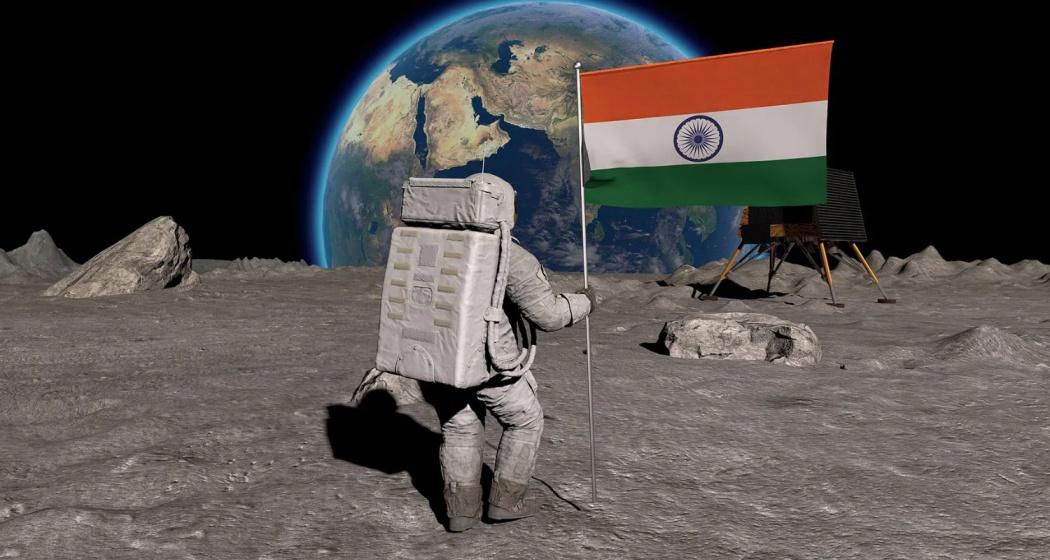
India plans to send astronauts to the Moon by 2040 and build a space station by the same year, former ISRO chief A S Kiran Kumar said on Wednesday, outlining the country’s long-term roadmap for space exploration.
Kumar, now chairman of the management council of the Physical Research Laboratory (PRL), made the remarks during the inauguration of the 5th Astronomical Society of India (ASI) Symposium. “Between now and 2040 there are a whole lot of missions which are going to go into space activities. So, 2040 is a plan where we want to land Indians on the Moon and bring them back safely. India is also working towards building a space station by 2040,” he said.
In the near term, India will pursue follow-on Chandrayaan missions, including collaboration with Japan on a lander and rover. Kumar said the focus will initially be on the Moon’s South Polar region, describing it as the beginning of a broader programme of lunar and deep-space exploration.
The former ISRO chief emphasised that India’s space programme has historically prioritised societal applications over military purposes, citing the pioneering vision of Dr Vikram Sarabhai. Sarabhai, he noted, developed India’s space technology soon after independence to improve broadcast communication and weather monitoring for citizens.
Also read: Shukla returns to Lucknow, aspires for moon mission by 2040
Kumar also highlighted opportunities for academic institutions, engineering colleges, and private companies to contribute to India’s space exploration goals.
The three-day ASI symposium brings together nearly 150 scientists, engineers, academicians, young researchers and industry participants, focusing on optics, instrumentation, astronomy, planetary and space science, atmospheric science, and emerging areas like quantum technologies.
Those present at the inaugural session included Prof Yashwant Gupta, Director of the National Centre for Radio Astrophysics; Prof Annapurni Subramaniam, Director of the Indian Institute of Astrophysics, Bengaluru; and Prof Anil Bhardwaj, Director of the Physical Research Laboratory.

 Follow us