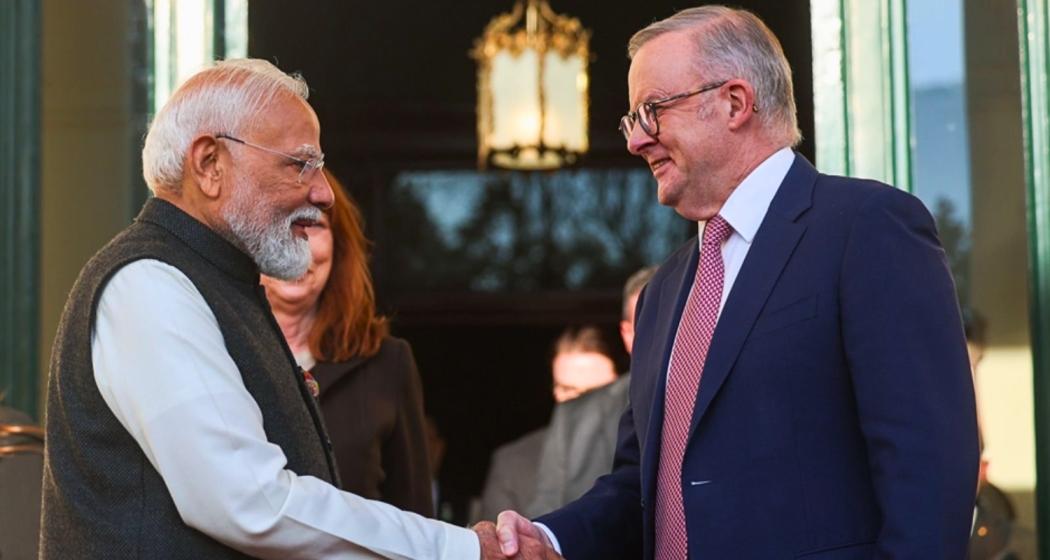
Prime Minister Narendra Modi concluded his two-day visit to Australia on Thursday with a sweeping expansion of bilateral ties, as India and Australia unveiled 18 major outcomes spanning defence, civil nuclear cooperation, maritime security, energy, critical minerals, education, technology and cultural heritage.
The centrepiece of the visit was the operationalisation of the India-Australia Civil Nuclear Agreement, paving the way for Australia to export uranium for India's civilian nuclear energy programme, an important step towards New Delhi's target of achieving 100 GW of nuclear power capacity by 2047.
Australian Prime Minister Anthony Albanese described India as one of Australia's closest strategic partners and said the agreement would help expand clean energy cooperation while opening new opportunities for Australia's resources sector.
"Australia and India are close partners and even closer friends," Albanese said after holding bilateral talks with Modi.
No details regarding the volume or timeline of uranium exports were announced.
Defence, maritime cooperation receive major boost
The two countries adopted a Joint Declaration on Defence and Security Cooperation, significantly upgrading collaboration in defence manufacturing, cyber security, interoperability, humanitarian assistance and disaster relief (HADR), intelligence sharing and counter-terrorism.
A Maritime Security Collaboration Roadmap was also unveiled to strengthen Indo-Pacific cooperation through enhanced information sharing, maritime domain awareness, operational coordination and search-and-rescue capabilities.
In another significant development, the Indian Coast Guard and Australia's Maritime Border Command signed an MoU to deepen cooperation in coastal surveillance and maritime law enforcement.
Australia also invited an Indian military instructor to join the Australian Defence College during 2028-29, further expanding defence engagement.
Also read: India-Australia sign arrangement for Civil Nuclear Agreement
Energy, technology and education partnerships expand
Beyond nuclear cooperation, both countries issued a Joint Statement on Energy Security, reaffirming collaboration in renewables, green hydrogen, critical minerals and resilient energy supply chains.
Australia and India also launched the Australia-India Partnership for Cyber, Critical Technologies and Supply Chains (PACTS) to enhance cooperation in cybersecurity, emerging technologies and supply chain resilience.
Education and skills development featured prominently in the outcomes.
Letters of approval were issued for Victoria University to establish a campus in Gurugram, while Flinders University will open its Indian campus in Bengaluru. The two countries also signed agreements on vocational education, mining technology, research collaboration and rooftop solar training that will train around 2,000 women and youth as solar technicians.
Australia's largest pension fund, AustralianSuper, also announced an additional investment of A$500 million in India's National Investment and Infrastructure Fund (NIIF).
Ancient Indian artefacts to return home
Australia announced the repatriation of three priceless Indian antiquities—a granite sculpture of Nandi, a bronze Trident with Goddess Bhadrakali, and a 12th-century basalt sculpture of the six-headed Skanda (Kartikeya)—strengthening cultural cooperation between the two countries.
In a reciprocal gesture, India agreed to return the ancestral remains of an Australian First Nations individual currently housed at Chennai's Government Museum.
Diaspora hailed as 'living bridge'
During his visit, Modi also met Australia's Governor-General Sam Mostyn, with both leaders reviewing progress in trade, education, technology, defence and people-to-people ties while reaffirming the growing Comprehensive Strategic Partnership.
Addressing nearly 30,000 members of the Indian diaspora in Melbourne, Modi described overseas Indians as the driving force behind bilateral ties.
Albanese called Modi a "living bridge" between the two nations, saying his leadership had reshaped Australia's engagement with India.
Calling India a reliable destination for global investment, Modi urged Australian businesses to invest in India's infrastructure, logistics and urban development sectors, saying the partnership offered "historic opportunities" for long-term growth as he concluded the Australia leg of his three-nation tour before departing for New Zealand.

 Follow us