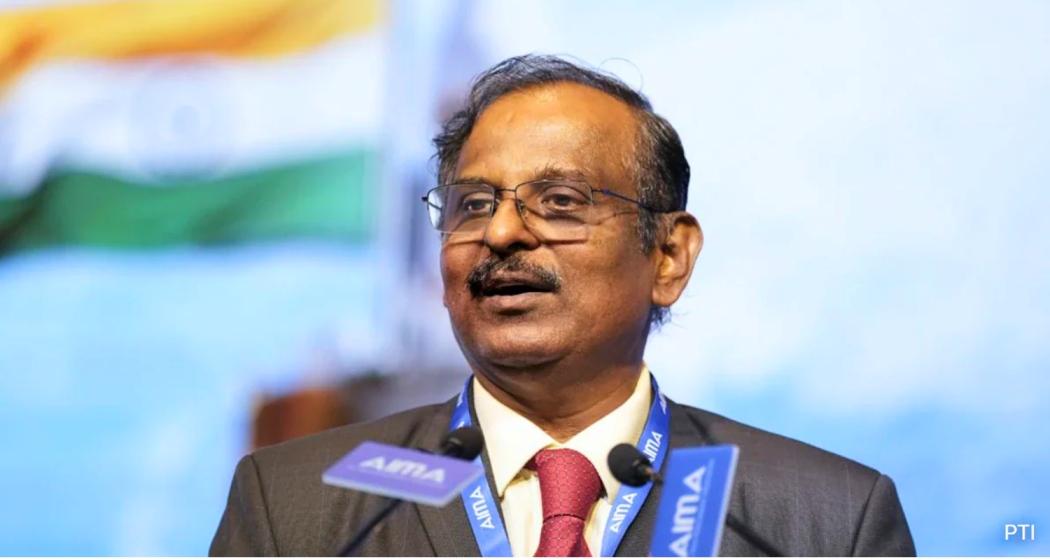
India has mastered the cryogenic engine technology that was once denied to it by foreign countries, Indian Space Research Organisation (ISRO) Chairman V Narayanan said on Saturday, as he outlined the country's ambitious plans for human spaceflight, lunar exploration and the establishment of an Indian space station.
Delivering the 17th Air Chief Marshal L M Katre Memorial Lecture at the HAL Management Academy in Bengaluru, Narayanan said India had transformed technology denial into technological self-reliance by developing three indigenous cryogenic propulsion systems.
"We have developed a cryogenic rocket engine, the technology which was denied to India," Narayanan said.
Recalling the country's early challenges, he added: "Today, I thank the countries that denied the technology. Today we have developed three cryogenic propulsion systems."
The ISRO chief said the agency's immediate priority was the first uncrewed Gaganyaan mission, scheduled for later this year, before proceeding with India's maiden crewed spaceflight.
"We are now working on the first uncrewed mission this year. Then once we review the result, we'll come back to the crewed mission," he said.
Narayanan also outlined India's long-term space roadmap, which includes establishing an Indian space station by 2035 and landing an Indian astronaut on the Moon by 2040 using an indigenous launch vehicle.
Also read: ISRO plans to launch G20 satellite by 2027
"By 2040 Indian will land on the Moon using an Indian launcher with our national flag," he said.
He said Chandrayaan-4 would become India's first lunar sample return mission, while Chandrayaan-5, a joint mission with Japan, would deploy a 350-kg rover capable of operating on the lunar surface for nearly 100 days, a significant improvement over Chandrayaan-3's 25-kg rover, which functioned for 14 days.
Highlighting India's achievements in space exploration, Narayanan said the country had progressed from launching a seven-kilogram sounding rocket in 1963 to conducting more than 105 launch vehicle missions and 135 satellite missions, besides launching 434 satellites for 34 countries.
He credited the Indian Air Force and Hindustan Aeronautics Limited (HAL) for their contributions to programmes such as Gaganyaan and the reusable launch vehicle, and said ISRO's satellites had performed flawlessly during Operation Sindoor.
Speaking to reporters later, Narayanan said ISRO had achieved a major milestone in developing its 200-tonne semi-cryogenic engine by reaching nearly 90 per cent of the required thrust level and was preparing for engine tests.
He added that launch schedules for upcoming satellite missions would be announced soon, while all major human-rating work for Gaganyaan had been completed and the programme had entered the flight validation phase.

 Follow us