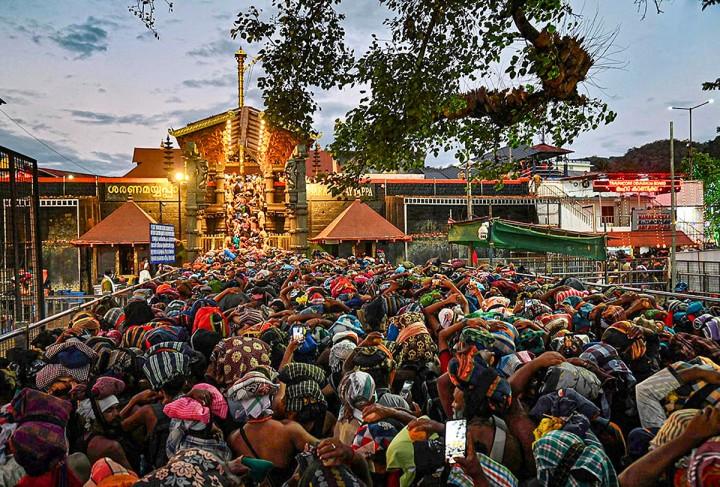
Contending that India is not patriarchal unlike what the West thinks, the Centre on Tuesday asserted Indian society not only treats women equally but places them on a higher pedestal. The argument was made by Solicitor General of India (SG) Tushar Mehta before the Supreme Court on Tuesday.
Mehta made the submission before a nine-judge Bench of the Supreme Court, which is examining several legal and Constitutional questions touching upon religious practices. The said ruling will also have a bearing on the question of whether women of menstruating ages should be permitted entry into Sabarimala, despite a customary bar on such entry.
Mehta questioned why those pushing for the entry of women to the Sabarimala temple cite 'patriarchy' in their arguments. Mehta contended that the notion was alien to a country like India. “India, my Lords, has always not only treated ladies equally, but they have always been treated at a higher pedestal. There are several judgments of the recent past where there is a concept of ‘patriarchal society’ or there is some 'gender stereotypes' etc. They were never there. In Indian society, we worship ladies. The President of India to the Prime Minister of India to the judges of the Supreme Court, we bow down before our ladies. So, let us not introduce those concepts of ‘patriarchy’ and ‘gender stereotypes'. There has never been (such notions in India),” he said.
Mehta also highlighted that earlier laws and judgments calling for non-discrimination when it comes to temple entry tackled caste-based discrimination and had nothing to do with gender.“In the past, we, unfortunately, were living in a society where, one particular part of Hindus was not permitted to be part of the broader Hindu denomination by denying them right to worship. This had nothing to do with gender. In the last decade or so, there is a jurisprudence which is developed, where every constitutional provision will have to be seen from the lens of gender … There is no discrimination. (Under) Article 14 (of Constitution)- all genders are equal. Article 15 - irrespective of sex, all fundamental rights are given. This (earlier laws against discrimination) was that era’s specific provision, that if it is a public temple or a public religious institution, it should be open for all. We must do away with untouchability or section within a section etc,” he said.
The President of India to the Prime Minister of India to the judges of the Supreme Court, we bow down before our ladies deities. So, let us not introduce those concepts of ‘patriarchy’ and ‘gender stereotypes'. He further took serious objection to an observation made in the Supreme Court's 2018 Sabarimala judgment, which equated the bar on women’s entry to the Sabarimala temple to a form of untouchability. “India is not that patriarchal or a gender-stereotyped society as the West understands. Sometimes, that is the problem,” he added.

 Follow us