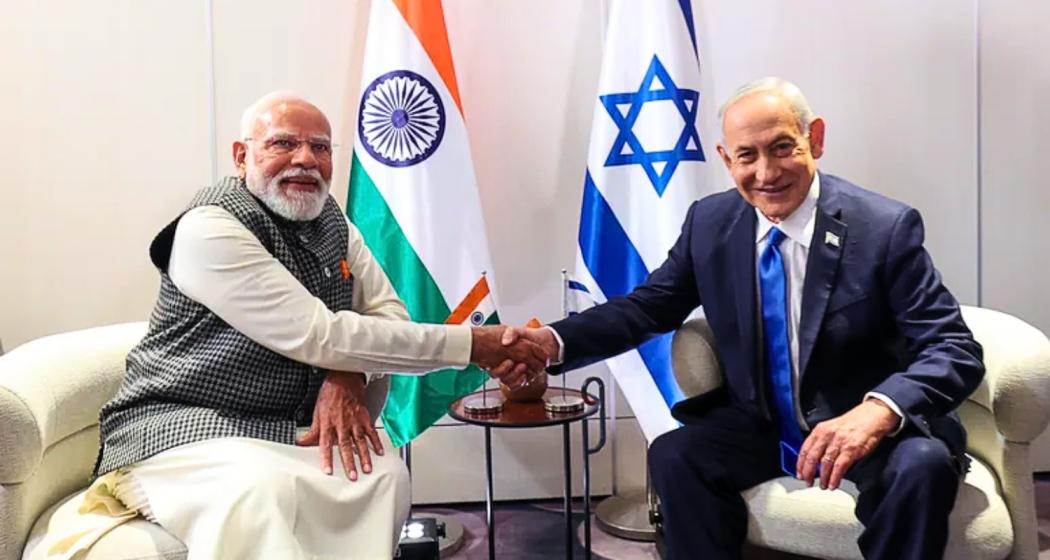
India and Israel on Friday elevated their “time-tested” ties to a Special Strategic Partnership, agreed to conclude a mutually beneficial free trade agreement at the earliest, and expanded cooperation across defence, technology and trade, as Prime Minister Narendra Modi backed the Gaza peace initiative.
After wide-ranging talks with Israeli Prime Minister Benjamin Netanyahu, Modi said the decision marked a “historic” step in bilateral relations founded on deep trust and shared democratic values. “Our relationship is founded on the strong bedrock of deep trust, shared democratic values, and human sensitivities. Our bond has stood the test of every trial of time,” Modi said. “Today, we have taken the historic decision to elevate our time-tested partnership to the status of a ‘Special Strategic Partnership’.”
The two leaders also agreed to expedite negotiations on a long-pending Free Trade Agreement, describing it as a mutually beneficial step that would significantly expand bilateral trade and investment. Both sides expressed confidence that the proposed pact would unlock new opportunities in goods, services, innovation and high-technology sectors, and provide fresh momentum to the rapidly growing economic partners. Modi strongly endorsed the Gaza Peace Initiative, asserting that conflict must not undermine humanity.
“India's stance is clear: humanity must never become a victim of conflict. A path to peace has been created through the Gaza Peace Plan. India has fully supported these efforts,” he said, adding that New Delhi would continue dialogue with all stakeholders in the region.
Both sides inked multiple agreements to expand cooperation in trade, agriculture, energy, cyberspace and digital payments. Modi announced an India-Israel partnership in critical and emerging technologies to boost collaboration in artificial intelligence, quantum technologies and critical minerals.
“I am pleased that an agreement has been reached for the use of UPI in Israel,” he said, describing it as a step towards deeper financial integration.
Defence cooperation figured prominently in the talks. The two countries agreed to further expand joint development and joint production of military hardware under technology transfer frameworks, reinforcing their already robust security partnership.
On terrorism, Modi underscored shared concerns. “India and Israel are completely clear that there is no place for terrorism in the world. In any form, in any expression, terrorism cannot be accepted,” he said. “We have stood shoulder-to-shoulder in opposing terrorism and its supporters, and we will continue to do so.”
The leaders also reviewed progress on the India–Middle East–Europe Economic Corridor (IMEC) and discussed cooperation under the I2U2 framework involving India, Israel, the UAE and the United States.
Modi, on a two-day visit, his second to Israel in nine years, described the partnership as future-oriented, anchored in innovation and strategic convergence, and aimed at contributing to peace and stability in the Middle East.
Also read: Netanyahu greets PM Modi in Indian attire
Key deals and agreements announced during Modi-Israel talks
-
Elevation of ties to a Special Strategic Partnership
-
Early conclusion of a Free Trade Agreement (FTA) for deeper economic integration
-
India–Israel critical and emerging technologies partnership
-
Defence cooperation expansion
-
UPI rollout in Israel to strengthen digital payments cooperation
-
Agreements in trade, agriculture and energy sectors
-
Cooperation in cyberspace and digital innovation
-
Progress review on India-Middle East-Europe Economic Corridor (IMEC)
-
Enhanced engagement under the I2U2 framework (India–Israel–UAE–US)
-
Continued joint commitment to counter-terrorism efforts

 Follow us