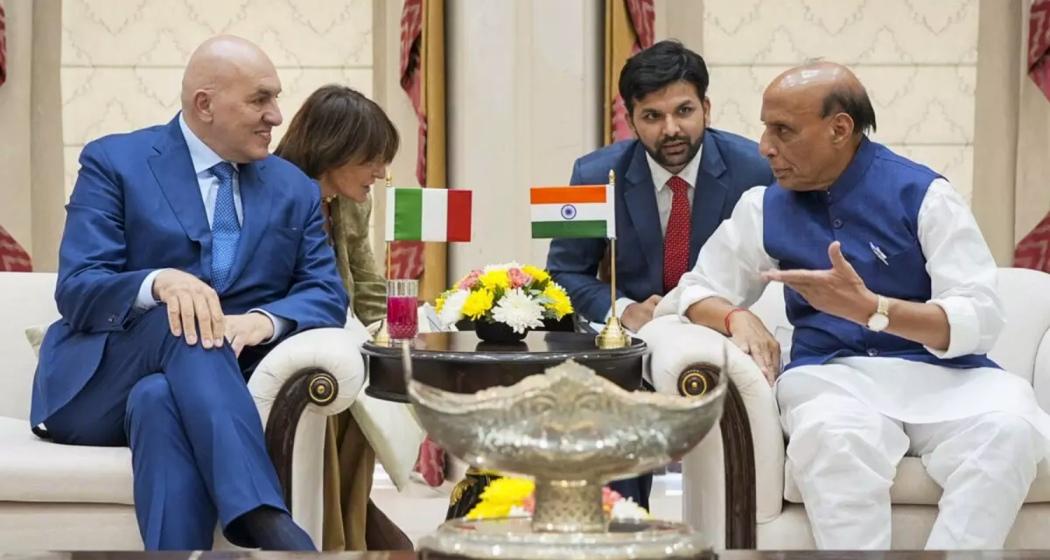
India and Italy on Thursday agreed to develop a defence industrial framework to enable co-production of military hardware, as the two countries moved to deepen strategic ties amid an evolving global security environment.
The decision was taken during talks between Defence Minister Rajnath Singh and his Italian counterpart Guido Crosetto in New Delhi, where both sides reviewed bilateral cooperation and regional developments, including the situation in West Asia.
Following the meeting, the two countries unveiled a Military Cooperation Plan (MCP) for 2026–27, outlining future engagements between their armed forces and areas of collaboration.
“We discussed a wide range of regional and global issues including the current situation in West Asia,” Singh said. “We also discussed the avenues to further develop mutually beneficial defence industrial cooperation under India's Atmanirbhar Bharat programme and Italy's defence cooperation initiative,” he added.
The defence ministry said the India–Italy strategic partnership rests on shared values of peace, stability, freedom and mutual respect, with both sides reaffirming their commitment to strengthening cooperation.
Also read: No double standards on combating terrorism: Rajnath at SCO Meet
It noted convergence between the two countries on key maritime issues, including information sharing through the Information Fusion Centre–Indian Ocean Region in Gurugram.
Earlier in the day, Crosetto laid a wreath at the National War Memorial and paid homage to personnel who died in service. He also inspected a tri-services Guard of Honour.
The talks come as India and Italy seek to expand collaboration in defence manufacturing, with a focus on co-production and co-development of platforms and equipment, alongside technology partnerships involving public and private stakeholders.
Both sides are also looking to enhance cooperation in the Indo-Pacific region, with an emphasis on improving interoperability between their armed forces.
Officials said the proposed framework is expected to strengthen industrial linkages and support domestic manufacturing goals, while opening avenues for joint ventures in defence production.
The engagement reflects a broader push by both countries to align their defence strategies and respond to emerging security challenges through closer cooperation.

 Follow us