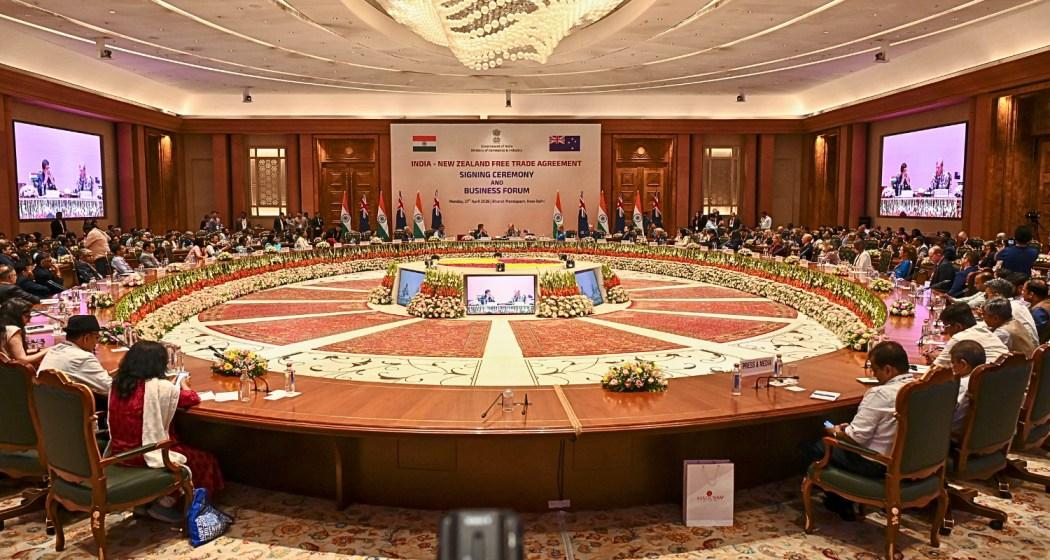
India and New Zealand on Monday signed a comprehensive free trade agreement (FTA) aimed at boosting bilateral trade, investment flows and economic cooperation across key sectors.
The agreement was inked by Commerce and Industry Minister Piyush Goyal and visiting New Zealand Trade and Investment Minister Todd McClay, marking a significant step in strengthening economic ties between the two countries.
Under the pact, India will gain duty-free access for 100 per cent of its exports to New Zealand, covering all tariff lines. The move is expected to enhance the competitiveness of Indian goods, particularly in labour-intensive sectors such as textiles, apparel, leather, footwear, gems and jewellery, engineering goods and processed foods, thereby providing a boost to MSMEs and employment.
Prior to the agreement, New Zealand imposed peak tariffs of up to 10 per cent on several Indian exports, including ceramics, carpets, automobiles and auto components. With the elimination of duties, Indian products are expected to enjoy a level playing field in the New Zealand market, on par with other trading partners.
India has also secured duty-free access to key inputs required for its manufacturing sector. These include wooden logs, coking coal, and metal scrap, which are expected to reduce production costs and improve the global competitiveness of domestic industries.
Also read: 'Proposed FTA with New Zealand boon for Agra leather exporters'
On its part, India has agreed to tariff liberalisation on 70.03 per cent of tariff lines, covering about 95 per cent of bilateral trade value. However, it has retained 29.97 per cent of tariff lines in the exclusion category to protect sensitive domestic sectors.
These exclusions include dairy products such as milk, cream, cheese and yoghurt; certain agricultural items like onions, chana, peas, corn and almonds; sugar; as well as selected industrial goods including copper and aluminium products. Sensitive categories such as arms and ammunition and certain oils have also been kept out of the agreement.
India will provide immediate duty elimination on around 30 per cent of tariff lines for New Zealand exports, including wood, wool, sheep meat and raw hides. Another 35.60 per cent of tariff lines will see phased tariff reductions over periods of 3, 5, 7 and 10 years, covering products such as petroleum oils, vegetable oils, machinery and other industrial goods.
New Zealand exports set to benefit from tariff reductions include wine, pharmaceutical products, polymers, and iron and steel goods. A small portion, about 0.06 per cent, will be governed by tariff rate quotas, including items such as Manuka honey, apples and kiwi fruit.
The agreement also includes a commitment to facilitate investments worth USD 20 billion into India, alongside a rebalancing clause to address any shortfall in investment delivery.
Bilateral trade in goods and services between India and New Zealand stood at USD 2.4 billion in 2024, with the new pact expected to significantly expand economic engagement in the coming years.
Key points of the pact:
- 100% duty-free access for Indian exports to New Zealand
- Boost expected for MSMEs, jobs, and labour-intensive sectors
- Earlier tariffs up to 10% on key Indian exports removed
- India to get duty-free import of key raw materials (coal, wood, metals)
- India to liberalise tariffs on ~70% of tariff lines (95% trade value)
- ~30% tariff lines fully protected (sensitive sectors like dairy, agriculture)
- Some NZ goods get immediate duty cuts (wood, wool, sheep meat)
- Others to see phased tariff cuts over 3–10 years
- NZ exports like wine, pharma, steel to benefit
- Limited quota-based access for items like Manuka honey, apples, kiwi
- $20 billion investment commitment included
- Rebalancing clause added to ensure investment delivery
- Current bilateral trade: $2.4 billion (2024)

 Follow us