India is projected to remain a Hindu-majority country for the next several decades, even as its Muslim population is expected to grow significantly by 2070, according to a study by the Pew Research Centre. The projection places India as the country with the world’s second-largest Muslim population after Pakistan by that year.
The study also forecasts that Muslims could become the world’s largest religious group by 2035, overtaking Christians. Its assessment of India points to a gradual change in the country’s religious composition, driven mainly by differences in age profiles and fertility rates.
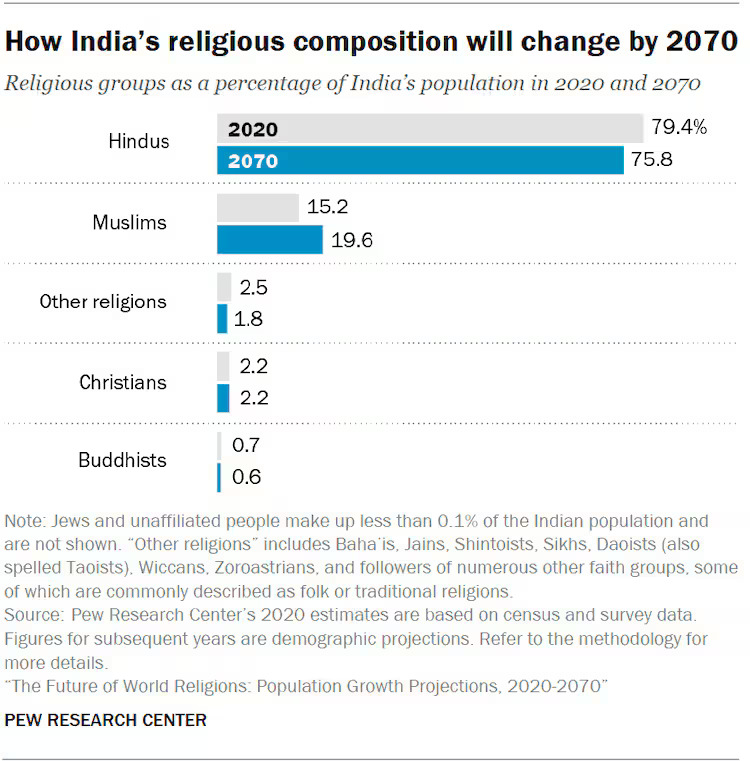
Hindus are projected to account for 76% of India’s population in 2070, compared with 79% in 2020. Over the same period, the Muslim share is expected to increase from 15% to 20%. The study examined demographic trends among seven religious groups across 201 countries, which together represented 99.98% of the global population.
Hindu population to rise in absolute numbers
India’s Hindu population is estimated to increase from 1.11 billion (111 crore) in 2020 to 1.29 billion (129 crore) by 2070, an increase of around 176 million (17.6 crore). Despite this growth in absolute terms, Hindus are expected to make up a slightly smaller proportion of the country’s overall population.
A study by the Economic Advisory Council to the Prime Minister, released two years ago, had also pointed to a decline in the share of Hindus in India. It found that the Hindu share fell by 7.8% between 1950 and 2015, while the combined share of minorities, including Muslims, Christians, Buddhists and Sikhs, increased.
Age and fertility differences behind projected shift
The Pew study identifies the younger age profile and higher fertility rate of Indian Muslims as key factors behind the projected change. In 2020, the median age of Indian Muslims was 24, compared with 29 among Hindus.
Fertility among Hindu women has also declined substantially. The average number of children per Hindu woman is estimated to have fallen to 1.9 from 3.3 three decades ago. Between 2025 and 2030, Muslim women in India are projected to have an average of 2.3 children, compared with 1.8 among Hindu women.
Even with these changes, Hindus are expected to remain India’s largest religious community and account for more than three-fourths of the population in 2070.
India had an estimated 1.11 billion Hindus in 2020, representing 94.5% of the global Hindu population. Their number is projected to reach 1.29 billion by 2070, although India’s share of the world’s Hindu population may decline slightly to 93.6%.
Worldwide, the Hindu population is expected to increase by 199 million during the same period. However, its share of the global population is projected to dip marginally from 15% in 2020 to 14% in 2070.
Pakistan and US also expected to see Hindu population growth
Outside India, Pakistan and the United States are projected to record growth in their Hindu populations. Pakistan’s Hindu population could nearly double from 5 million to 10.3 million, with natural population increase—births exceeding deaths—identified as the likely driver.
The United States is projected to have the world’s fifth-largest Hindu population by 2070, reaching 7.4 million. Immigration is identified as the main contributor to that increase.
India’s Muslim population may reach 334 million
India’s Muslim population is projected to rise from 213 million (21.3 crore) in 2020 to 334 million (33.4 crore) by 2070. This would move India from third to second place among countries with the largest Muslim populations. India could account for 9.2% of the global Muslim population by then.
In 2020, Indonesia had the world’s largest Muslim population, followed by Pakistan and India. By 2070, Pakistan is projected to overtake Indonesia with 461 million Muslims. Nigeria is expected to rank third, followed by India.
The study’s projections link the increase in India’s Muslim population to the community’s younger age structure and higher fertility rate. Hindu fertility is already below replacement level, while Muslim fertility is expected to remain above that level for another two decades.
Replacement-level fertility refers to the rate at which births are sufficient to maintain a stable population from one generation to the next.
Projections depend on demographic trends continuing
The projections use 2020 as the baseline and are based on factors including fertility, mortality and migration. However, the study’s picture of the religious composition in 2070 would hold only if the demographic patterns observed in 2020 continue over the next five decades.
Changes in economic conditions, healthcare, migration, conflicts, government policies and social behaviour could all influence future population growth and alter the projected religious distribution.

 Follow us