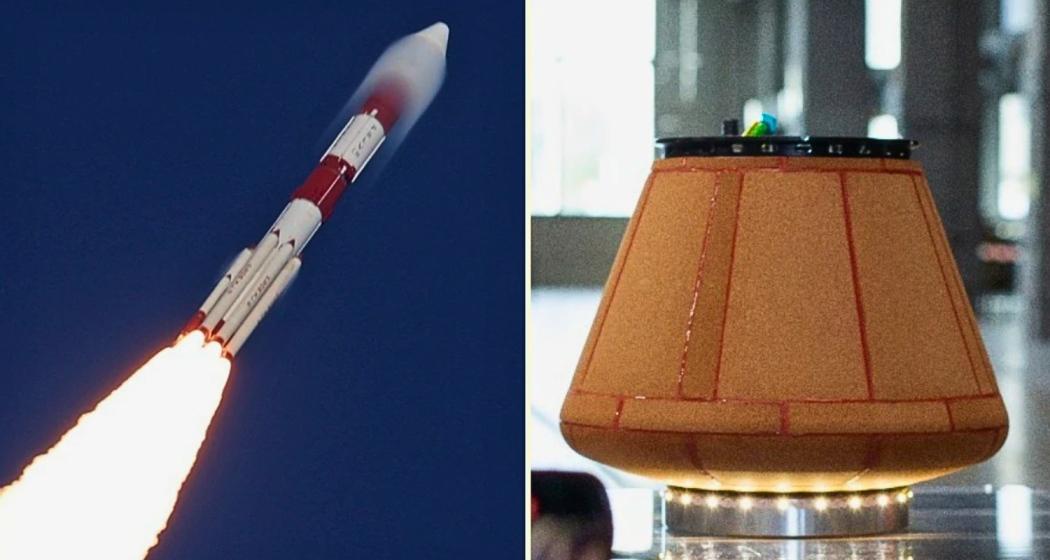
The Kestrel Initial Technology Demonstrator (KID) capsule, developed by Spanish start-up Orbital Paradigm, reportedly survived the failed PSLV-C62 mission and transmitted data after separating from the rocket, the company claimed on its official X account on January 13.
The 25-kg capsule was one of 16 payloads onboard the PSLV-C62/EOS-N1 mission launched on January 12. The mission, intended to place 15 satellites into a Sun Synchronous Orbit at 512 km, failed when the rocket deviated from its flight path due to disturbances in the third stage, according to ISRO Chairman V Narayanan. The KID capsule, scheduled as the final payload to separate at 504 km, was intended to re-enter the atmosphere along with the fourth stage (PS4) and make a splashdown in the South Pacific Ocean.
“Our KID capsule, against all odds, separated from PSLV-C62, switched on and transmitted data,” Orbital Paradigm said. While all other satellites onboard were lost, KID survived, demonstrating its re-entry capabilities. The start-up added that it is reconstructing the capsule’s trajectory to analyse its performance.
Also read: ISRO's PSLV-C62 mission fails
The PSLV-C62 mission, dubbed EOS-N1, was part of ISRO’s ongoing effort to provide reliable satellite deployment for Earth observation, scientific research, and commercial purposes. The mission’s failure has underscored the technical challenges involved in multi-payload launches, particularly when precise stage separations and orbital insertions are critical.
Orbital Paradigm, which focuses on reusable space logistics and re-entry technologies, described the KID capsule as a step towards efficient and frequent space cargo return. Its survival offers valuable insights for the development of resilient payload systems capable of surviving atmospheric re-entry and transmitting data even when primary missions fail.
Experts note that while PSLV has a strong track record of over 50 successful missions, occasional anomalies, such as third-stage disturbances, can jeopardise payloads. The KID capsule’s successful data transmission may provide crucial information for both ISRO and international collaborators developing reusable or returnable payloads.

 Follow us