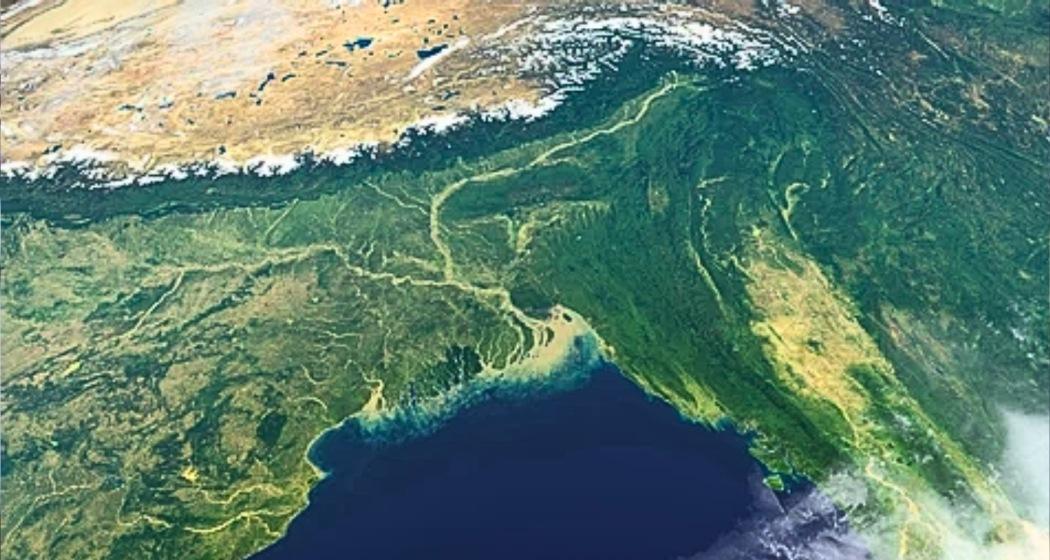
The world’s largest river deltas, including the Ganga-Brahmaputra, are subsiding faster than global sea levels are rising, sharply increasing flood risks and endangering the lives and livelihoods of around 236 million people, a new study has found.
The research, published in the journal Nature, shows that land subsidence now exceeds climate-driven sea-level rise in many densely populated deltas, creating a “double burden” that accelerates relative sea-level rise beyond global averages.
Using satellite data collected between 2014 and 2023, researchers analysed surface elevation changes across 40 major river deltas spanning five continents. The assessment revealed that some portion of nearly every delta studied is sinking faster than the sea is rising.
The Ganga-Brahmaputra in India, along with the Mekong in Vietnam, the Nile in Africa, the Chao Phraya in Thailand and the Mississippi in the United States, are among the most affected systems, with nearly 90 per cent of their areas experiencing subsidence.
“Our analysis shows that current average subsidence rates exceed geocentric SLR in 18 of the 40 deltas, including the Nile, Mekong, Red River, Ganges-Brahmaputra, Brahmani, Mahanadi, Chao Phraya, Ciliwung, Brantas and Yellow River deltas, affecting approximately 236 million people — a population about 50 per cent larger than those residing in deltas in which the current rates of geocentric SLR outpace the subsidence rates (156.9 million),” the authors wrote.
Also read: Ganga erosion ravages Malda, Murshidabad; villages on the brink
The study was conducted by an international team that included researchers from Virginia Polytechnic Institute and State University in the United States. It represents the first high-resolution, delta-wide assessment of elevation loss across such a large number of river deltas globally.
Co-author Manoochehr Shirzaei, associate professor of geophysics and remote sensing at the Virginia Polytechnic Institute and State University, said, “Our results show that subsidence isn't a distant future problem, it is happening now, at scales that exceed climate-driven sea-level rise in many deltas.”
The researchers identified groundwater extraction as the strongest overall driver of delta subsidence, though the dominant causes vary by region. Reduced river sediment supply and rapid urban expansion were also flagged as major contributors.
“When groundwater is over-pumped or sediments fail to reach the coast, the land surface drops. These processes are directly linked to human decisions, which means the solutions also lie within our control,” said Susanna Werth, assistant professor of hydrology and remote sensing.
While global sea-level rise is driven by large-scale climate processes and progresses relatively uniformly, subsidence occurs at local and regional levels, shaped by human activity and geological conditions, the study noted.
The findings underscore the urgent need for region-specific mitigation strategies to slow land subsidence in delta regions already vulnerable to climate change and extreme flooding.

 Follow us