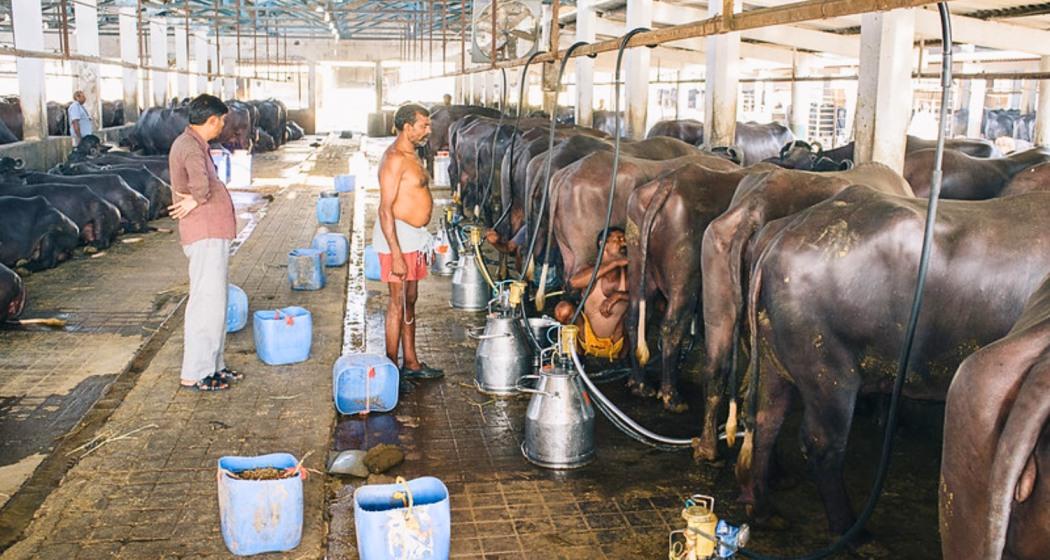
India’s milk production has risen nearly 70 per cent over the past 11 years to reach 248 million tonnes in 2024-25, with the Centre aiming to make the country's cattle free from foot-and-mouth disease (FMD) within the next three years, the government informed the Rajya Sabha on Wednesday.
Replying to supplementary questions during Question Hour, Union Minister Rajiv Ranjan Singh said India continues to be the world’s largest milk producer, with output increasing sharply from 146.3 million tonnes in 2014-15.
He said productivity has also improved significantly, rising from 1,648 kg per animal annually to 2,251 kg over the same period.
“We are not able to export despite being the largest milk producer. The main reason is FMD,” the minister said, noting that developed countries require certification declaring India free from the disease before allowing dairy imports.
Singh informed the House that outbreaks of FMD and brucellosis have declined substantially in recent years due to sustained vaccination efforts. The number of FMD outbreaks has reduced to 40 in 2025 from 132 in 2019, while brucellosis cases have fallen from 22 to six during the same period.
Also read: HP signs three MoUs with NDDB to boost dairy sector
The Centre is bearing the entire cost of vaccination under its disease control programmes, he said, adding that the government is working towards securing certification from the World Organisation for Animal Health to enable exports.
In a written reply, the minister said 132.49 crore animals, including 130.30 crore cattle and buffaloes and 2.19 crore sheep and goats, have been vaccinated against FMD so far. In addition, 3.17 crore bovine female calves aged between four and eight months have been vaccinated against brucellosis under the National Animal Disease Control Programme.
The Department of Animal Husbandry and Dairying has streamlined mass vaccination drives under the Livestock Health and Disease Control Programme, with FMD vaccination carried out bi-annually.
The government has also developed a digital database, Bharat Pashudhan, assigning a unique 12-digit tag ID to livestock for identification and traceability. So far, 36.81 crore animals have been registered on the portal.
The measures, the minister said, are aimed at strengthening disease control, improving productivity, and enhancing India’s prospects in the global dairy trade.

 Follow us