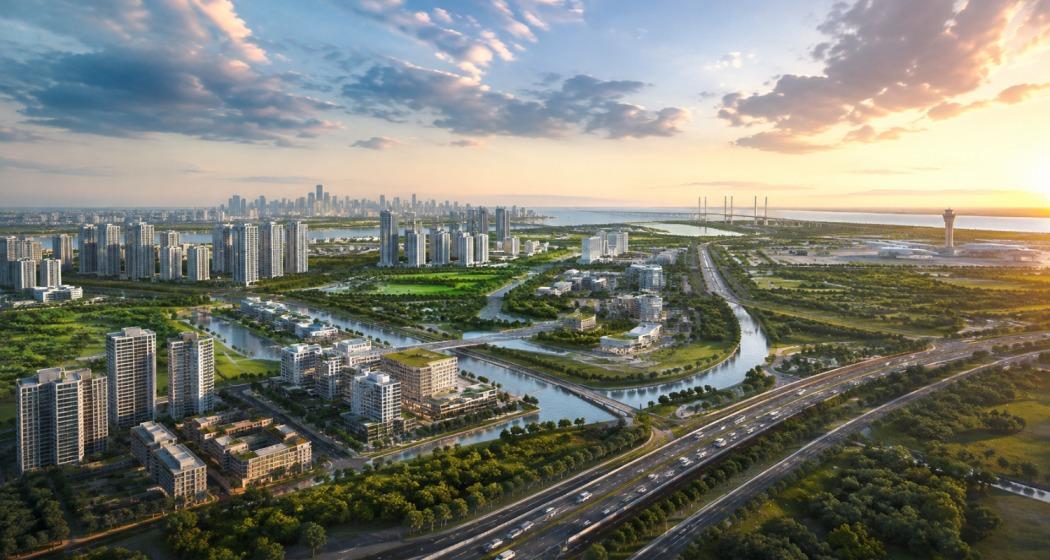
Mumbai is set to look beyond its traditional boundaries as Maharashtra plans a new urban centre across the Raigad district, aimed at easing pressure on the existing Mumbai Metropolitan Region (MMR) and creating a new hub for housing, jobs and infrastructure.
Known as Mumbai 3.0, the Karnala-Sai-Chirner (KSC) New Town will cover 124 villages across Uran, Panvel and Pen talukas. Spread over 323.44 sq km, the proposed development is being planned as a new economic and residential centre rather than simply another housing suburb.
The Mumbai Metropolitan Region Development Authority (MMRDA) has been appointed as the New Town Development Authority for the project.
A new urban centre beyond Navi Mumbai
The project is being planned against the backdrop of Mumbai's limited land availability, high property prices and growing pressure on housing and infrastructure. Navi Mumbai had emerged as a major planned extension of Mumbai, but increasing demand has also put pressure on land there.
The KSC New Town is envisioned as an integrated urban centre with commercial districts, technology hubs, logistics facilities, data centres, healthcare and education institutions, along with residential areas.
Around 104 sq km is expected to accommodate townships and industrial corridors, while other parts of the planned area will retain green zones, forests and rural settlements.
The broader aim is to create employment and housing closer to each other, reducing the need for long daily commutes and allowing the new development to grow as a self-contained urban ecosystem.
Also read: Siwan SP shifted over use of AK-47 at student protest
Atal Setu, airport to drive connectivity
Connectivity is expected to be one of the biggest advantages of Mumbai 3.0. The Atal Bihari Vajpayee Sewri-Nhava Sheva Atal Setu has significantly improved connectivity between Mumbai and the Navi Mumbai-Raigad region.
The proposed city will also benefit from the Navi Mumbai International Airport, the Panvel-Karjat railway corridor, the proposed Virar-Alibaug multimodal corridor and the Mumbai-Pune Expressway.
The planned economic ecosystem is expected to include IT and IT-enabled services, financial services, global capability centres, data centres, healthcare, education and logistics.
The MMRDA has also secured a proposed $12-billion investment commitment from Brookfield covering sectors including real estate, transit-oriented development, logistics parks, data centres and global capability centres.
The state-backed infrastructure push is already taking shape. For 2026-27, the MMRDA has earmarked Rs 4,000 crore for the Karnala-Sai-Chirner New Town as part of its infrastructure-focused budget.
Land acquisition is another key component of the project. The MMRDA has offered landowners in the 124 villages different compensation options, including monetary compensation, development rights and land pooling.
The large-scale development is also expected to open up new residential and commercial markets in the wider MMR. The combination of major transport links, the international airport and planned industrial and commercial zones could create demand for housing, offices, retail and allied services.
At the same time, officials and industry stakeholders have stressed that the project's success will depend on coordinated development of transport, social infrastructure, green spaces and mixed-use neighbourhoods.
The project is unlikely to transform the region overnight. Planning and land-related processes are underway, with the first phase expected to take shape towards the end of this decade. The larger urban ecosystem, however, is expected to take considerably longer to develop.

 Follow us