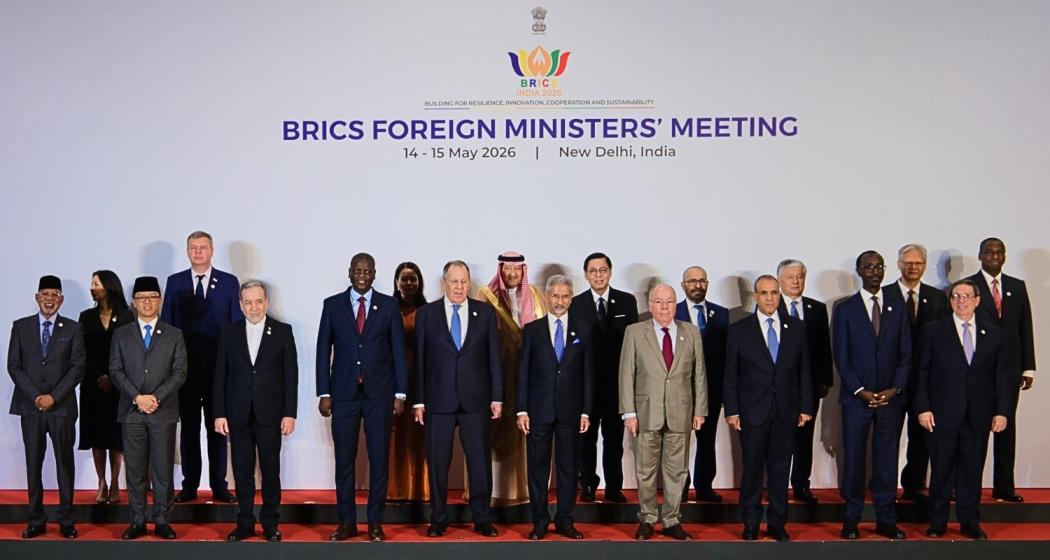
Deep divisions within the expanded BRICS bloc came to the fore on Friday after a two-day meeting of foreign ministers in New Delhi ended without a joint statement, with disagreements over the ongoing Iran war preventing consensus among member nations.
Instead of a customary joint communique, India, which hosted the meeting as BRICS chair for 2026, issued a chair’s statement acknowledging “differing views” among member states regarding the conflict in West Asia and the Gulf region.
The diplomatic deadlock highlighted growing tensions within the expanded grouping, which now includes Brazil, Russia, India, China, South Africa, Egypt, Ethiopia, Indonesia, Iran and the United Arab Emirates.
Iran had pushed the bloc to condemn what it described as the US-Israeli war against Tehran and accused the UAE — also a BRICS member — of involvement in military operations against it. Tehran has launched repeated missile and drone strikes targeting the UAE since the conflict erupted on February 28.
Iran-UAE tensions dominate talks
Without directly naming the UAE, Iranian Foreign Minister Abbas Araqchi suggested that one BRICS member had blocked portions of the proposed joint statement.
“We only hit American military bases and installations unfortunately located on their soil,” Araqchi said, while expressing hope that differences could be resolved before the BRICS leaders’ summit later this year.
Also read: India can play 'greater role' in for peace in West Asia: Araghchi
The UAE did not immediately respond publicly to Iran’s remarks. However, diplomats said the sharp exchange between Tehran and Abu Dhabi signalled the challenge of maintaining unity within an increasingly diverse BRICS grouping.
China’s Foreign Minister Wang Yi did not attend the meeting, adding to the subdued diplomatic atmosphere.
Middle East conflict raises concerns for India
The escalating conflict in West Asia has also emerged as a growing concern for India, one of the world’s largest energy importers.
As the world’s third-largest importer and consumer of crude oil, India has been severely affected by Iran’s effective blockade of the Strait of Hormuz, a critical maritime route through which nearly a fifth of global oil and liquefied natural gas supplies pass during normal times.
Iranian attacks linked to the conflict have reportedly led to the deaths of at least three Indian personnel in the waterway, while an India-flagged ship was sunk earlier this week as Araqchi travelled to New Delhi for the BRICS meeting.
During a brief visit to the UAE on Friday, Prime Minister Narendra Modi strongly condemned the attacks on the Gulf nation.
“The way the UAE was targeted is unacceptable in any form,” Modi said. “In these difficult circumstances, the restraint and courage you demonstrated are highly commendable.”
India’s chair statement called for dialogue, diplomacy and respect for sovereignty and international law, while also stressing the importance of ensuring secure maritime trade routes amid fears of prolonged disruption in global energy supplies.

 Follow us