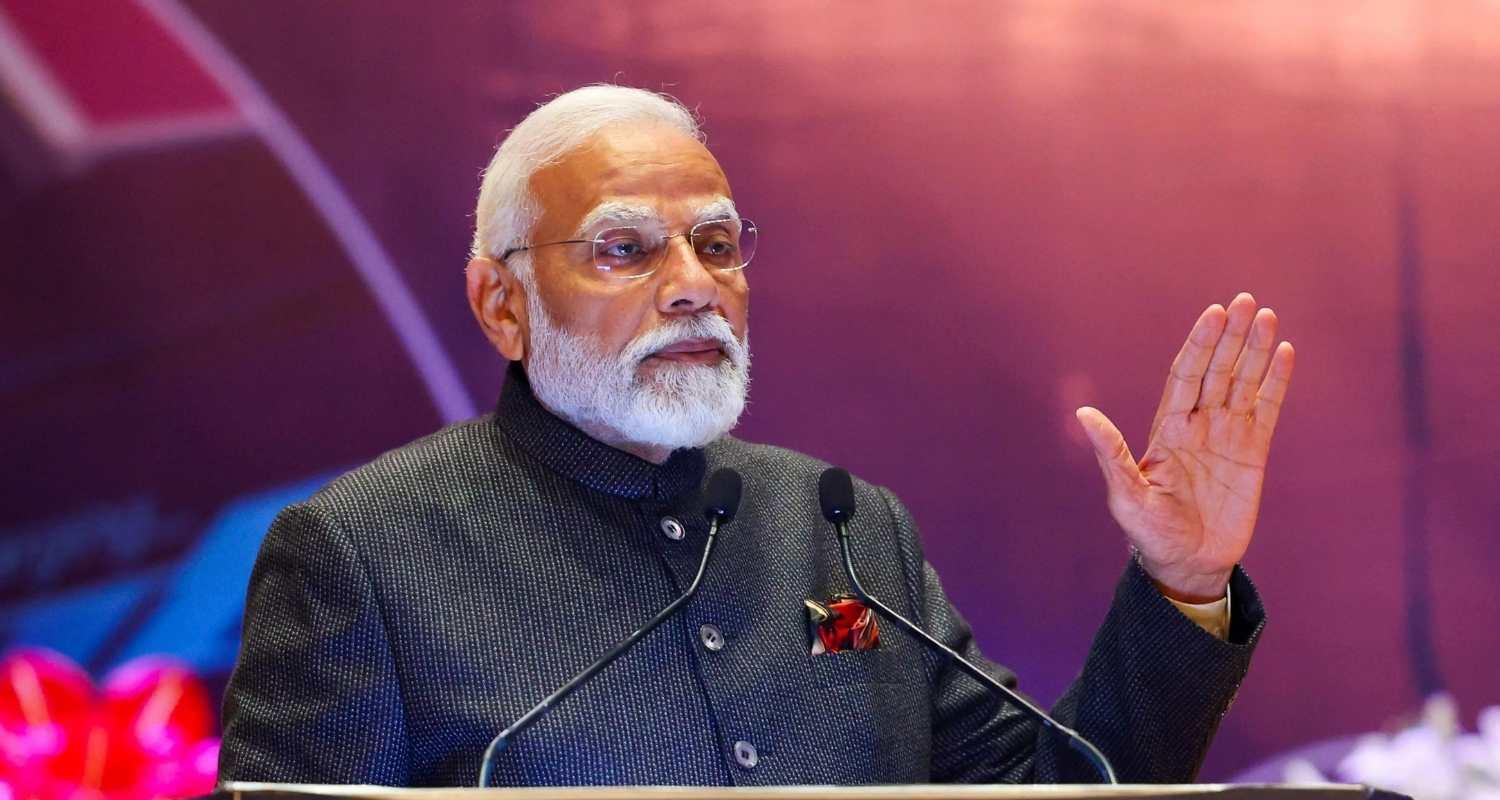
Prime Minister Narendra Modi will inaugurate the special discussion on the “150 years of Vande Mataram” in the Lok Sabha on Monday, with Defence Minister Rajnath Singh expected to wind up the 10-hour debate that is likely to witness intense political sparring and sharp exchanges.
The principal opposition Congress has prepared a strong lineup of speakers, anticipating pointed attacks from the treasury benches on India’s first Prime Minister Jawaharlal Nehru and his role in the truncated adoption of Vande Mataram as the national song.
From the Congress side, Deputy Leader in the Lok Sabha Gaurav Gogoi is expected to open the debate, to be followed by Priyanka Gandhi Vadra, Deepender Singh Hooda, Bimol Akoijam, Praniti Shinde, Prashant Padole, Chamala Reddy, and Jyotsna Mahant.
Ahead of the discussion, senior government sources said on Sunday that several important and hitherto lesser-known aspects of Vande Mataram will come to light during Monday’s proceedings. “PM Modi will speak on the subject and many hitherto unknown facts will stand out for everyone to see,” the sources added.
While marking the 150th anniversary of Vande Mataram on November 7 this year, Prime Minister Modi had directly questioned the Congress establishment under Nehru for dropping significant stanzas of the song.
“The spirit of Vande Mataram illuminated the nation during the freedom struggle. But in 1937, significant verses of Vande Mataram—its very soul—were removed. The song was fragmented. This division sowed the seeds of the country’s Partition. Today’s generation must understand this history because the same divisive mindset continues to pose a challenge to the nation even today,” Modi had stated.
The Prime Minister was referring to the Congress Working Committee resolution of October 29, 1937, which, under Nehru’s presidency of the Congress, adopted only the first two stanzas of Vande Mataram and excluded the subsequent stanzas that contained references to Goddess Durga.
The Congress has rejected these charges, insisting that Nehru merely followed the advice of Rabindranath Tagore on the matter.
Detailed historical accounts are available in historian Sabyasachi Bhattacharya’s book “Vande Mataram: The Biography of a Song”, which records that Netaji Subhas Chandra Bose was keen that the Congress adopt Vande Mataram in full. The book describes how Bose pressed both Mahatma Gandhi and Nehru on the issue.
“Nehru had, meanwhile, decided to consult Tagore. Nehru had only recently read ‘Anandmath’. Only six days before the CWC meeting, Nehru wrote about the poem,” Bhattacharya notes.
The book quotes Nehru: “I have managed to get an English translation of ‘Anandmath’ and I am reading it to get the background of the song. It does seem that this background is likely to irritate Muslims.” It further records Nehru’s admission: “I do not understand it without the help of a dictionary.”
Bhattacharya’s work also reproduces Tagore’s considered response to Nehru’s queries:“To me the spirit of tenderness and devotion expressed in its first portion, the emphasis it gave to the beautiful and beneficent aspects of our motherland made a special appeal, so much so that I found no difficulty in dissociating it from the rest of the poem and from those portions of the book of which it is a part, with all the sentiments of which, brought up as I was in the monotheistic ideals of my father, I could have no sympathy.”
Consequently, on October 29, 1937, the CWC adopted only the first two stanzas, and on January 24, 1950, these two stanzas were officially recognised as India’s national song alongside Jana Gana Mana, the national anthem.
Also Read: Yogi mandates Vande Mataram in UP schools, colleges
On the eve of the Lok Sabha debate, the BJP made it clear that Nehru’s role will come under scrutiny.
BJP national spokesperson and MP Sambit Patra said on Sunday: “Three points are noteworthy about Nehru from Bhattacharya’s book: First, he read the English version of ‘Anandmath’ six days before the CWC meeting, even though it was translated into Indian languages at the time. If someone needs a dictionary to understand Vande Mataram, then he is not a legacy maker. Most importantly, Nehru said that Vande Mataram is going to irritate the Muslims. This was Nehru’s false sense of secularism. Tomorrow, when there will be a discussion in Parliament on Vande Mataram, I feel that the legacy of Nehru will again be a subject of debate, discussion and might be exposed.”
Vande Mataram was composed by Bankim Chandra Chatterjee on November 7, 1875. It was first published the same day in the literary journal Bangadarshan. Bankim Chandra later included the hymn in his seminal novel Anandamath, published in 1882. Rabindranath Tagore set the song to music, and it became an integral part of India’s national consciousness.
Also Read: Lok Sabha to hold special discussion on 150 yrs of Vande Mataram

 Follow us