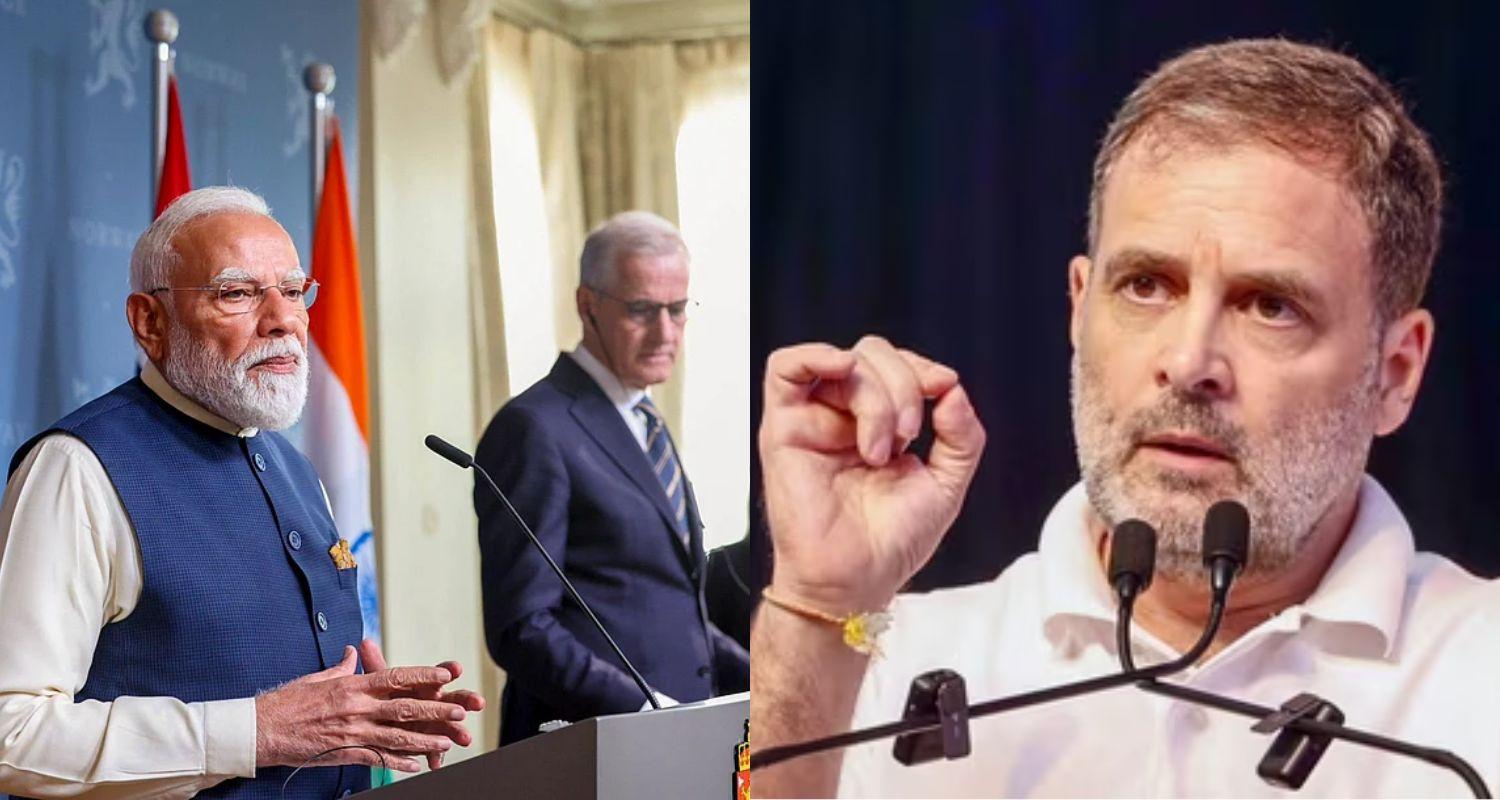
On a day reserved for diplomacy and carefully choreographed optics, it was a single unanswered question that reverberated far beyond Oslo. As Prime Minister Narendra Modi concluded his engagements at the India–Nordic Summit, a Norwegian journalist’s voice cut through the formalities— direct, unscripted, and ultimately ignored. What followed was not just a moment of awkward silence, but the spark for a political storm back home.
The incident, captured on camera, showed Modi walking away as journalist Helle Lyng attempted to ask why he avoids taking questions from what she described as “the freest press in the world.” The exchange — or rather, the lack of one — quickly crossed borders, finding a second life on social media timelines in India, where it was instantly reframed, dissected, and politicised. Rahul Gandhi was among the first to seize upon the footage, sharing the clip with a pointed critique that blurred the line between a routine political attack and a broader public concern.
“When there is nothing to hide, there is nothing to fear,” Gandhi wrote, questioning not just the Prime Minister’s immediate reaction, but the image it projected on the global stage. His sharper remark — asking what it signifies when “the world sees a compromised PM panic and run from a few questions” — echoed across the domestic political discourse, transforming a fleeting interaction into a larger debate about accountability and perception.
Yet beneath the political theatre lies a deeper, more structural tension—one that has quietly defined the relationship between the current Indian establishment and the media over the years. For many political observers, the Oslo episode was less an anomaly and more a continuation of a familiar pattern characterised by tightly managed public appearances, strictly rationed unscripted interactions, and an increasing distance between power and probing questions. In that sense, the journalist’s voice in Oslo did not just pose a query; it exposed a long-standing communication gap.
Back in India, the reactions unfolded along predictable partisan lines. Opposition leaders framed the moment as emblematic of a leadership uncomfortable with rigorous scrutiny, whilst government supporters countered that the format of the event — a joint press statement rather than an open press conference — did not mandate an interactive Q&A session. Between these competing narratives, the core issue seemed less about official protocol and more about political perception: how a leader is perceived when directly confronted, and what silence communicates in a hyper-connected world that is always watching.
Meanwhile, for the journalist at the centre of the row, the motive was perhaps far simpler. In a country like Norway, which consistently ranks at the top of global press freedom indices, questioning authority is not an act of defiance— it is routine professional duty. However, in that brief intersection between two vastly different media cultures, the ordinary became extraordinary.
In reality, the importance of the Oslo process lies not in its explicit articulation but in what was not said. The silence surrounding the question was quickly filled by a flurry of political activity, with allegations and counter-allegations flying around. The irony is that sometimes the most effective political narratives may emerge out of silences rather than from explicit declarations.
Also read: India slams ‘ignorant NGO’ reports on rights, press freedom

 Follow us