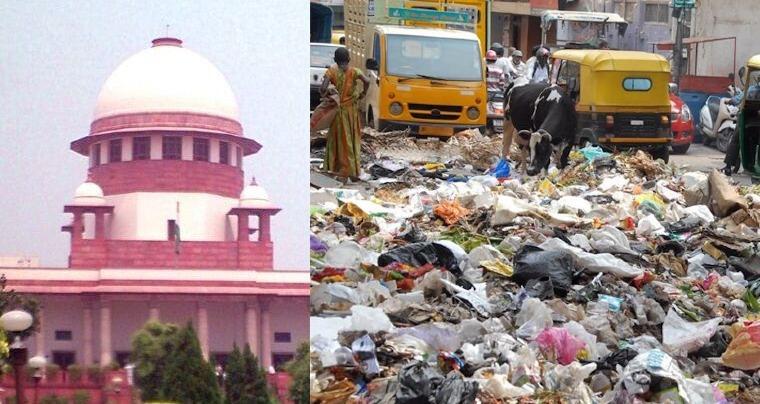
The Supreme Court has issued nationwide directions to ensure strict implementation of the Solid Waste Management (SWM) Rules, 2026, which are scheduled to come into effect on April 1 .
In an order passed on February 19, a Bench of Justice Pankaj Mithal and Justice SVN Bhatti flagged serious gaps in implementation of the Rules, noting that compliance with waste management norms has remained uneven across the country.
“Compliance of MSW/SWM Rules meant to govern waste management remains uneven across India. While mandated at source, the segregation at source into wet, dry and hazardous streams is still not fully realised in many urban and rural areas. Massive dumpsites in metropolitan areas remain active, though bio-remediation efforts, as informed, have been initiated under the latest mandates,” the Court observed.Hence, it issued detailed directions to ensure proper compliance of the Rules.
Key directions include, four-stream segregation of wet, dry, sanitary and special care waste and building infrastructure for the same, empowering local bodies for implementing the SWM Rules, Citizen participation, Oversight by District Collectors and Fines and criminal prosecution of officials for non-compliance.
The Bench was hearing two appeals arising from separate orders of the National Green Tribunal (NGT) concerning environmental compliance by the Bhopal Municipal Corporation under the SWM Rules, 2016.“To ensure realisation of the objects of the SWM Rules, 2026, we consider it appropriate to issue directions which are applicable not only to the Bhopal Municipal Corporation but also to the entire country,” the Court said.
The Court underscored that the right to a clean and healthy environment forms an inseparable part of the right to life under Article 21 of the Constitution.It thus directed Chief Justices of High Courts and chairpersons of Tribunals to ensure compliance with the new regime by courts and tribunals within their jurisdictions.
Referring to the Central Pollution Control Board (CPCB)'s annual report for 2021–2022, the Bench noted that approximately 170,000 tonnes per day of municipal solid waste is generated in the country. Of this, around 156,000 tonnes is collected, 91,000 tonnes treated and 41,000 tonnes landfilled.
The Bench expressed concern that the ground reality does not match the claims made by local bodies.While collection efficiency may have improved in cities such as Bhopal and Indore, waste processing continues to remain a major bottleneck.“The waste that is unprocessed often ends up in unscientific landfills or legacy dumpsites. The uncollected and unaccounted solid waste generated in the local bodies is a perennial challenge in the country,” the Court remarked.
To address these concerns, the top court laid down the detailed compliance framework ahead of the SWM Rules, 2026 coming into force.Authorities have been asked to file a joint sworn affidavit by March 25 confirming that essential digital and physical infrastructure is in place. This includes registration of local bodies on the Central Pollution Control Board’s centralised portal, operationalisation of Material Recovery Facilities, procurement of four-stream compartmentalised vehicles and the establishment of an escrow account for environmental compensation.
The Ministry has also been asked to circulate the order to Chief Secretaries of all States and Union Territories and operationalise a multi-level governance structure at the State, District and Gram Panchayat levels.“It is now or never. Expecting high results without fundamental spadework of source segregation and infrastructure would be unreasonable. Every stakeholder is duty-bound to ensure the realisation of a waste-free India,” the Court warned.The matter is now listed for further hearing on March 25, 2026.

 Follow us