Scientists confirm first-ever visual proof of black hole pair
Astronomers have captured the first-ever image of two supermassive black holes orbiting each other within quasar OJ287, a discovery that confirms a century-old cosmic prediction.
News Arena Network - New Delhi - UPDATED: October 11, 2025, 02:28 PM - 2 min read
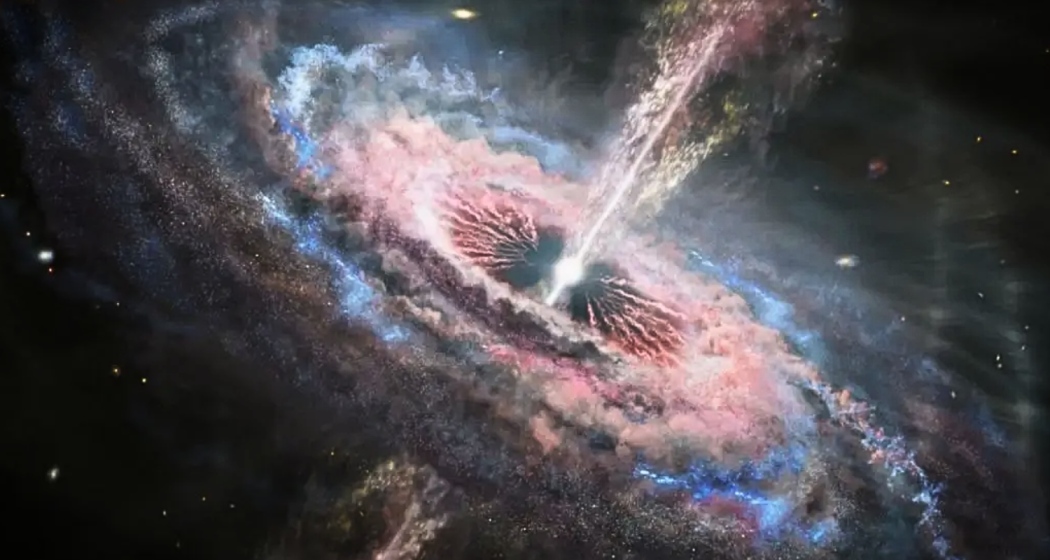
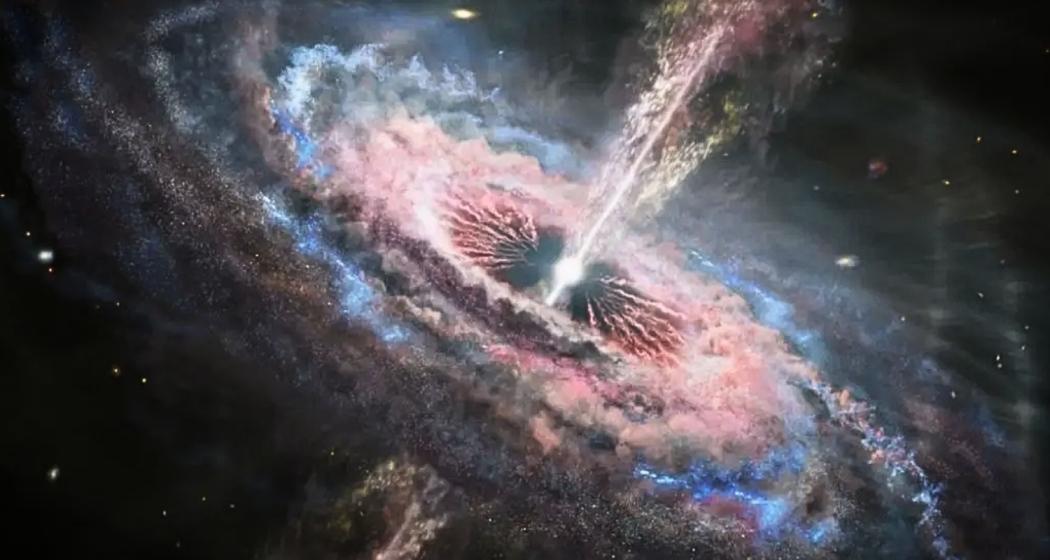
Astronomers have captured the first-ever image of two supermassive black holes orbiting each other within quasar OJ287, revealing a rare cosmic dance nearly five billion light-years away. (Representative image)
Astronomers have unveiled a breathtaking image of two colossal black holes locked in a slow, swirling orbit within the luminous quasar OJ287, a discovery that confirms a prediction that has puzzled scientists for generations. The image marks the first direct visual proof of a binary black hole system, offering an extraordinary glimpse into one of the universe’s most powerful and mysterious phenomena.
Captured through an exceptional feat of radio imaging, the black holes were observed around five billion light-years away in the constellation Cancer. The result, described by scientists as a milestone in modern astrophysics, validates theoretical models that had long suggested the existence of a dual black hole at OJ287’s blazing core.
The discovery, published on October 9 in The Astrophysical Journal, is the culmination of years of international collaboration. The research team included Mauri Valtonen from the University of Turku, Finland; Alok C Gupta and Shubham Kishore from the Aryabhatta Research Institute of Observational Sciences (ARIES), Nainital; and A Gopakumar from the Tata Institute of Fundamental Research (TIFR), Mumbai.
The achievement was made possible by an unprecedented combination of ground-based radio telescopes and the Russian RadioAstron (Spektr-R) satellite, whose orbit stretched halfway to the Moon. This configuration provided an image nearly 100,000 times sharper than typical optical photographs. When astronomers compared the captured image with decades of theoretical predictions, the match was precise, the twin black holes appeared exactly where scientists had anticipated.
Quasars, such as OJ287, are intensely luminous regions surrounding supermassive black holes. They shine as infalling gas and dust spiral inward, releasing immense amounts of energy. OJ287, among the brightest quasars in the known universe, can even be detected through amateur telescopes.
“Quasar OJ287 is so bright that it can be detected even by amateur astronomers with private telescopes,” said study lead author Mauri Valtonen in a statement released by the University of Turku.
Valtonen added that the discovery confirmed astronomers’ long-standing suspicions about the quasar’s dual nature. “The black holes themselves are perfectly black, but they can be detected by these particle jets or by the glowing gas surrounding the hole,” he said.
Astronomers have been observing OJ287 for well over a century. The earliest photographic records of the region date back to the late 19th century, but the real intrigue began in 1982 when Finnish astronomer Aimo Sillanpaa noticed that the quasar’s brightness fluctuated in a recurring 12-year cycle. That rhythmic variation hinted at a second black hole orbiting the primary one, a celestial companion whose gravitational pull disturbed the surrounding material and altered the light emissions.
Part of the first image showing two black holes orbiting each other within quasar OJ287, captured by astronomers. (PC: University of Turku)
Since then, researchers around the world have monitored OJ287’s flickering behaviour, waiting for direct evidence of the two black holes’ existence. The new radio image has finally settled that question.
The data not only confirm the binary system but also reveal fascinating details within it. Astronomers observed a twisted jet of material emerging from the smaller black hole, shaped like the spray from a spinning garden hose. This spiral pattern, they explained, is caused by the smaller black hole’s rapid orbit around its massive partner.
The findings carry profound implications for understanding galactic evolution. Most large galaxies, including the Milky Way, are believed to harbour supermassive black holes at their centres. Binary black hole systems such as OJ287 offer a rare opportunity to study how these giants interact, merge, and influence the galaxies around them.
“This discovery marks a turning point in understanding how galaxies evolve and how supermassive black holes interact,” the researchers noted.
By confirming a theory that has endured since the early days of astrophysics, the image of OJ287’s twin black holes has not only provided visual proof of a cosmic prediction but also illuminated one of the most extraordinary dances ever witnessed in the depths of space.

 Follow us