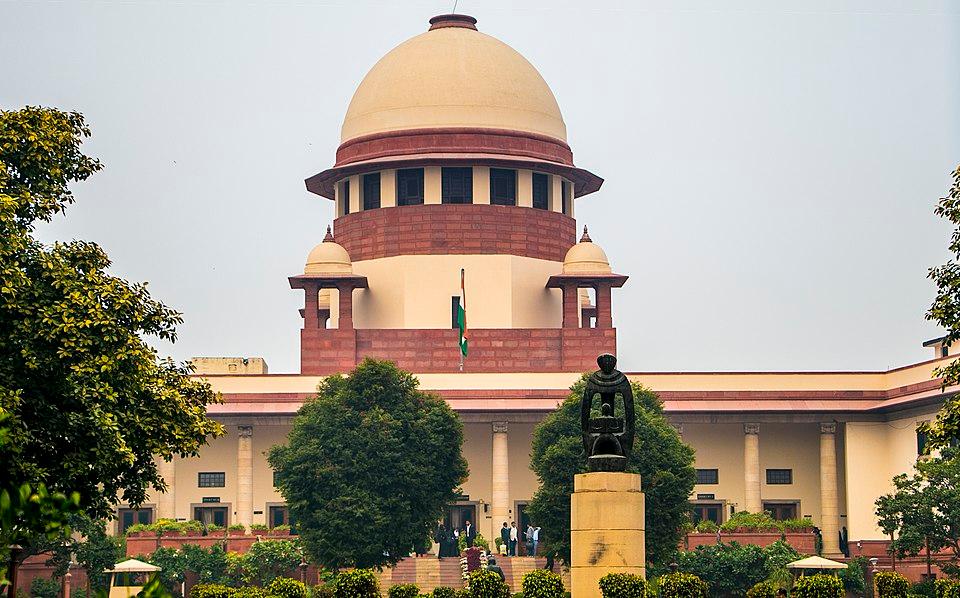
The Supreme Court on Wednesday saw a brief, but fiery exchange between lawyers in the case filed by the Enforcement Directorate (ED) against the State of West Bengal alleging obstruction to the agency's raids on the premises of political consultancy firm I-PAC.
While senior advocate Sidharth Luthra, appearing for the State of West Bengal, said the ED was being weaponised, Additional Solicitor General SV Raju, representing the ED, alleged that the agency was being terrorised. "They will have to justify how an agency can be weaponised like this," Luthra said. "No, agency is not weaponised. The agency has been terrorised," ASG Raju said.
Solicitor General Tushar Mehta, appearing for the Central government, said the case involves an important principle regarding Article 32 of the Constitution. He was referring to the State's claim that the ED's petition, which has been filed under Article 32, is not maintainable.
The State has opposed the maintainability of the plea on the ground that Article 32 is a remedy available to citizens against the government's actions and the same cannot be invoked by a government agency like the ED. "I will also address on great constitutional principle. (Kapil) Sibal, Dr Singhvi tried to persuade Your Lordships on Article 32," SG Mehta said.
Senior advocate Abhishek Manu Singhvi, appearing for the State, interjected. "Let him not say that. Your lordships recorded my submissions in the order saying maintainability will be fully open. His instructing counsel should have told him that," Singhvi said.
Senior advocate Menaka Guruswamy said the claim by the ED is that its fundamental rights have been violated. Luthra and she also opposed issuance of notice on a fresh petition filed by one Satish Kumar Agarwal. "A very questionable character who has come," Luthra said. "His PIL has been disallowed multiple times," Guruswamy too weighed in.
A Bench of Justices Prashant Kumar Mishra and KV Viswanathan eventually adjourned the matter for further consideration on March 18. West Bengal Chief Minister Mamata Banerjee had entered the I-PAC office and the residence of its co-founder on January 8 while the ED was conducting searches in connection with a money laundering probe.
Banerjee is alleged to have removed several documents and electronic devices from the premises. She claimed that the material contained information pertaining to her political party. According to reports, I-PAC has been associated with the Trinamool Congress since the 2019 Lok Sabha elections.The ED has maintained that the searches were part of its investigation into a 2020 money laundering case registered against businessman Anup Majee, who is accused of involvement in coal smuggling.
According to the ED, a coal smuggling syndicate led by Majee used to steal and illegally excavate coal from ECL leasehold areas of West Bengal and then sell it at various factories/plants in West Bengal. ED has alleged that a large part of this coal was sold to Shakambhari Group of companies. The ED initially moved the Calcutta High Court against Banerjee, but the High Court could not hear the matter due to unruly commotion inside the courtroom.
The agency then approached the Supreme Court under Article 32 accusing Banerjee and State officials of interfering with its investigation and search operations. According to the petition, the intervention resulted in the removal of crucial physical and electronic material connected to the investigation and prevented officers from carrying out their duties in accordance with the law.
It urged the Court to order a Central Bureau of Investigation (CBI) probe into the incident.

 Follow us