The shirtless protest staged by Indian Youth Congress (IYC) workers during the India AI Impact Summit at Bharat Mandapam was allegedly inspired by Nepal’s Gen Z movement, Delhi Police told Patiala House Court on Friday. Officials described it as part of a “larger conspiracy” requiring custodial interrogation.
Seeking custody, the police argued that the accused needed to be confronted with one another and with digital evidence. “This is a larger conspiracy that has taken inspiration from the Gen Z protests in Nepal. The accused need to be confronted with each other as well as with digital evidence. This is a very important investigation,” the prosecution submitted.
The protest, held in the presence of international technology leaders including Sam Altman and Sundar Pichai, involved activists displaying slogans such as “PM is compromised”, “India-US Trade Deal”, and “Epstein Files”. Police reported that three officers sustained injuries while managing the demonstration and detained four participants for allegedly disrupting the event.
Patiala House Court sends four to police custody
The Patiala House Court on Saturday rejected the bail pleas of the four detained IYC members, remanding them to five days in police custody. Those arrested were identified as Krishna Hari and Kundan Yadav (Bihar), Ajay Kumar (Uttar Pradesh), and Narasimha Yadav (Telangana).
Authorities emphasised that custodial questioning was necessary as the accused belonged to different states, and mobile phones and other digital evidence required thorough examination. The defence contended that the protest was peaceful and non-violent, with no assault on public servants, asserting that it fell within constitutional rights.
Also read: 'PM compromised'; US trade deal has become an 'ordeal', says Cong
Nationwide political fallout
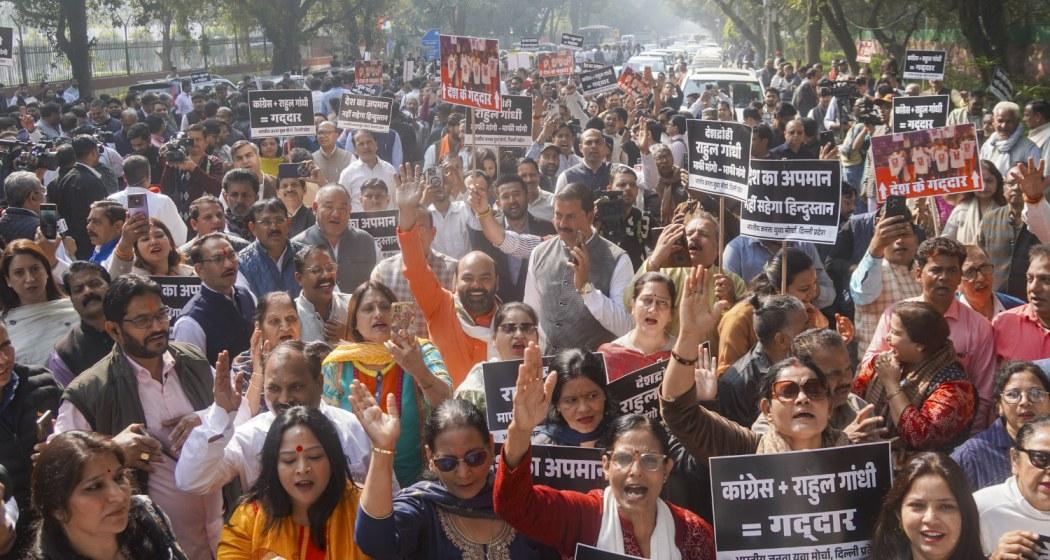
The demonstration triggered a nationwide political confrontation. The Bharatiya Janata Yuva Morcha (BJYM) staged counter-protests across several cities on February 21, denouncing the act as “anti-national” and damaging to India’s global image during a high-profile summit. Demonstrations were reported in Delhi near Akbar Road, Mumbai airport, Jaipur, Jammu, Bhopal, Surat, Guwahati, Mysuru, Panchkula, Hubballi, Vijayawada, Ongole, Tirupati, and Indore. Actions ranged from black flags and placards to effigy burnings, with stone-pelting reported in some areas.
Congress leaders, while defending the protest as legitimate democratic dissent, largely countered through statements and media engagement rather than nationwide street protests. Senior leaders including Pawan Khera and IYC president Uday Bhanu Chib emphasised that peaceful protest is a constitutional right and highlighted issues such as unemployment, trade deals, and “cracks in government policies.” In several hotspots, Congress workers engaged in minor verbal or physical confrontations with BJP cadres, but largely relied on rhetoric and online campaigns to push back.
The episode has intensified the BJP-Congress rivalry, framing a domestic political confrontation against the backdrop of a global technology summit, and has sparked debates over protest, public order, and youth political activism.

 Follow us