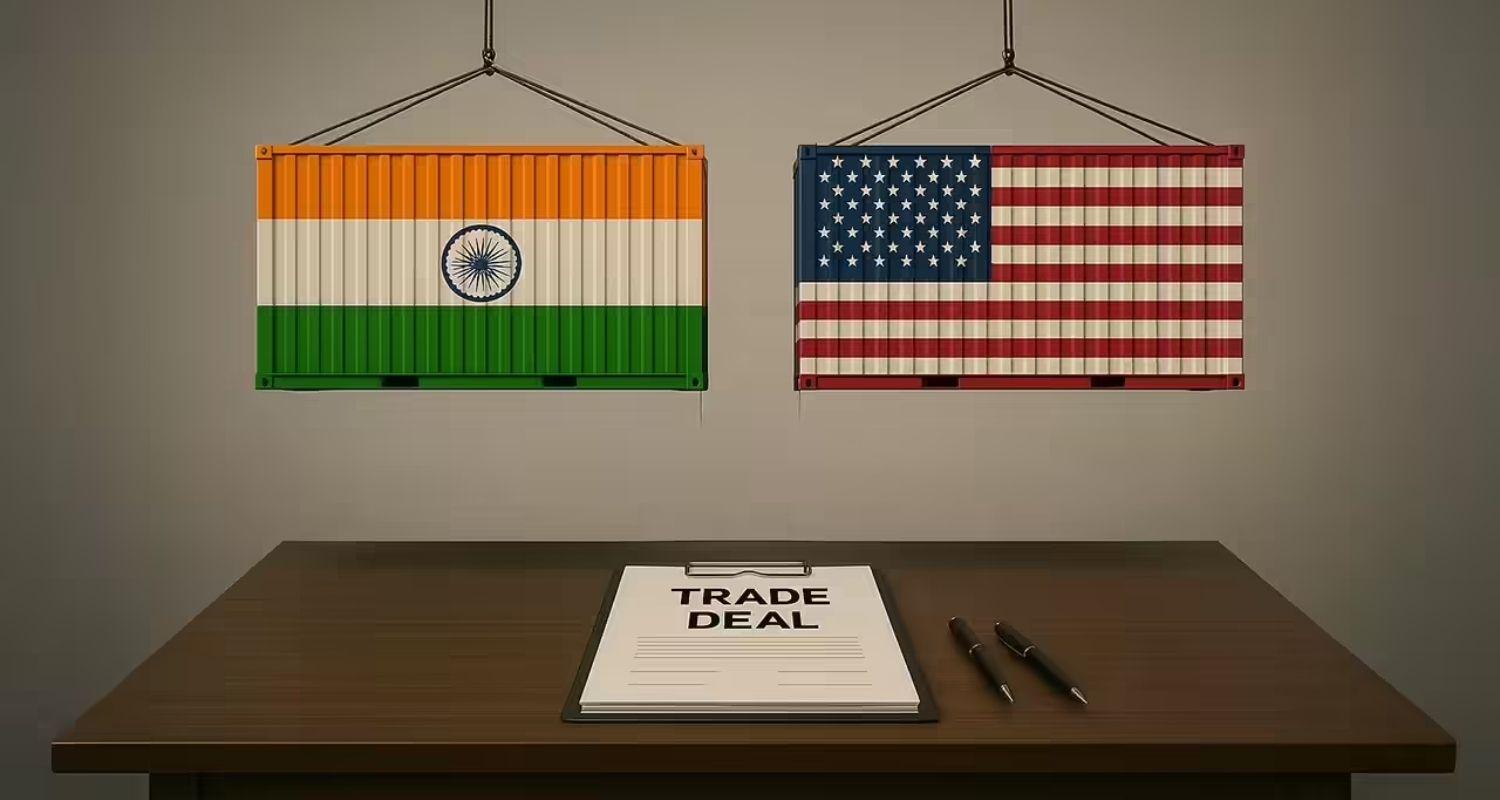
Chief negotiators from India and the United States on Tuesday began a three-day round of discussions in the national capital aimed at finalising the detailed framework of the proposed interim trade agreement, an official said. The broad contours of the pact had been agreed upon earlier in February.
The US delegation is being led by chief negotiator Brendan Lynch, while India’s side is headed by Darpan Jain, Additional Secretary in the Department of Commerce. The talks are being held at Vanijya Bhavan, the headquarters of the Ministry of Commerce and Industry. The ongoing discussions are focused on concluding the finer details of the interim arrangement while also advancing negotiations toward a comprehensive bilateral trade agreement (BTA), officials said.
On February 7, both countries issued a joint statement outlining the framework for the first phase of the BTA, which also serves as the basis for the interim trade deal. Under the earlier understanding, the United States had agreed to reduce tariffs on Indian goods to 18 per cent from 50 per cent. It had also withdrawn an additional 25 per cent tariff imposed on Indian exports linked to purchases of Russian oil and was expected to further reduce the remaining 25 per cent duty to 18 per cent as part of the proposed arrangement.
However, on February 20, the US Supreme Court ruled against President Donald Trump’s broad reciprocal tariff measures, which had been imposed under the 1977 International Emergency Economic Powers Act (IEEPA). Following this development, the US administration announced a temporary 10 per cent tariff regime applicable to all countries for 150 days beginning February 24.
In light of these policy changes, both sides had already held discussions in Washington in April, when an Indian delegation led by Jain visited the United States between April 20 and 23, 2026. Tuesday’s meeting marks a continuation of those negotiations, with the US delegation now in New Delhi for further engagement.
Officials indicated that given the shifting tariff environment in the United States, both sides may need to reassess certain aspects of the earlier framework to reflect current trade conditions.
Also read: India rejects third party role to resolve boundary row with Nepal
Under the proposed arrangement, India had offered to significantly reduce or eliminate tariffs on a wide range of US industrial products as well as several agricultural and food items. These include dried distillers’ grains (DDGs), red sorghum used for animal feed, tree nuts, fresh and processed fruits, soybean oil, wine and spirits, among others.
India has also indicated plans to expand its import commitments from the United States, including purchases worth USD 500 billion over the next five years across energy products, aircraft and aircraft components, precious metals, technology goods, and coking coal.
At the time the framework was agreed, India was considered to have a relative tariff advantage over competing exporting nations such as Sri Lanka, Pakistan and Bangladesh. However, with the United States now applying a uniform 10 per cent tariff across trading partners, the negotiating context has changed, prompting calls for recalibration of the agreement.
Sources indicated that India is seeking to ensure it retains a competitive advantage over peer economies in any finalised tariff structure. At the same time, with the US Supreme Court striking down certain tariff actions, the American administration may explore alternative mechanisms, including Section 301 investigations, to impose trade measures.
In March, the US Trade Representative (USTR) initiated two separate Section 301 probes targeting multiple countries, including India, focusing on issues such as excess industrial capacity and alleged failures to eliminate forced labour in global supply chains.
The United States remained India’s second-largest trading partner in 2025–26. India’s exports to the US rose marginally by 0.92 per cent to USD 87.3 billion in the last fiscal year, while imports from the US increased by 15.95 per cent to USD 52.9 billion. As a result, India’s trade surplus with the US narrowed to USD 34.4 billion from USD 40.89 billion in the previous year.

 Follow us