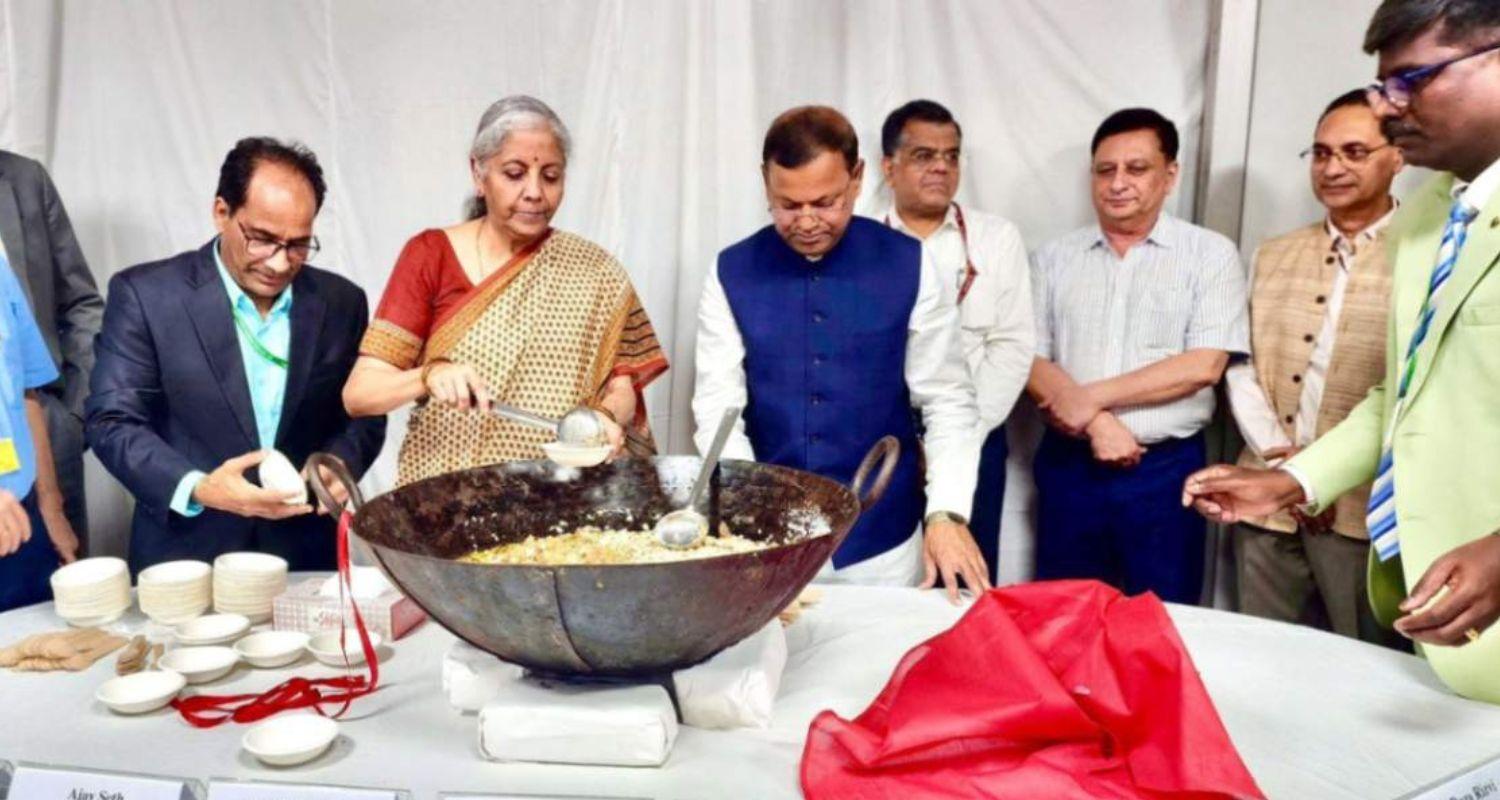
Finance Minister Nirmala Sitharaman on Tuesday participated in a traditional ‘halwa’ ceremony, marking the final stage for preparation of Union Budget 2024-25 to be unveiled on July 23 in Lok Sabha.
The ceremony is a ritual in which traditional dessert ‘halwa’ is prepared and served to officials and staff members of the finance ministry who are involved in the preparation of the budget.
It is organised in the basement of North Block, which houses the ministry in the national capital and is attended by the finance minister and other high-ranking officials.
“The final stage of the Budget preparation process for Union Budget 2024-25 commenced with the customary Halwa ceremony in the presence of Union Minister for Finance and Corporate Affairs Smt. @nsitharaman, in New Delhi, today,” the finance ministry said in a post on X.
As part of the ceremony, the finance minister also took a round of the Budget Press and reviewed the preparations besides extending her best wishes to the officials concerned.
Like the previous three full Union Budgets and one Interim, the full Union Budget 2024-25 will also be delivered in paperless form.
All the Union Budget documents, including the Annual Financial Statement (commonly known as Budget), Demand for Grants (DG), Finance Bill etc. as prescribed by the Constitution, will be available on the “Union Budget Mobile App” for hassle-free access to Budget.
Besides Sitharaman, Minister of State for Finance Pankaj Chaudhary and other senior officials, including Finance Secretary T V Somanathan, Economic Affairs Secretary Ajay Seth, and Financial Services Secretary Vivek Joshi were present at the ceremony.
Halwa ceremony: It is a kind of a ‘send-off’ for finance ministry officials and staff involved in the preparation of the Union government’s annual financial statement. They enter what is called a ‘lock-in’ period, during which they stay in the basement of North Block, cut off from the world outside with a view to maintaining the secrecy around the final budget document.
Tradition: While the Narendra Modi government has done away with several traditional aspects of the Budget since coming to power in 2014, such as merging the Rail Budget with the main Budget, bringing forward the date of presentation to February 1 instead of the last date of that month, and moving to a digital format— the ‘halwa’ ceremony as a tradition has survived.

 Follow us