
Trending:
UP Polls 2027: Asaduddin Owaisi-Azad Alliance Prepares for Lucknow Rally
Asaduddin Owaisi and Chandrashekhar Azad step up their UP 2027 election campaign with a Saharanpur visit ahead of the November 26 Lucknow rally. Follow us
News Arena Network - New Delhi - UPDATED: November 21, 2026, 05:17 PM - 2 min read
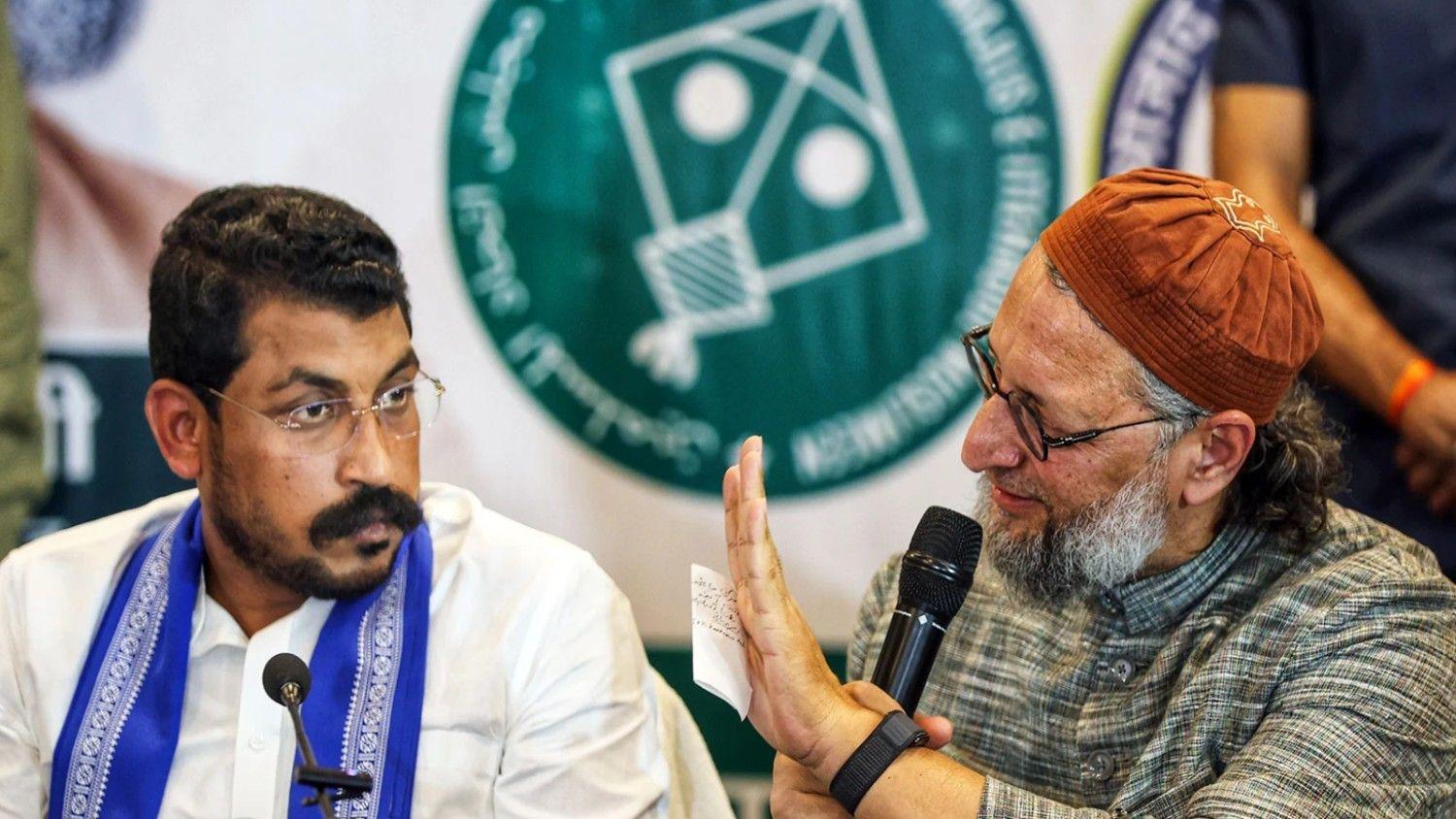
Asaduddin Owaisi and Chandrashekhar Azad during a political interaction as their alliance steps up its campaign ahead of the 2027 Uttar Pradesh Assembly elections.
The political partnership between AIMIM chief Asaduddin Owaisi and Azad Samaj Party-Kanshiram president Chandrashekhar Azad is moving towards a grassroots campaign in Uttar Pradesh, with Owaisi scheduled to visit Saharanpur ahead of the 2027 Assembly elections.
During the visit, Owaisi is expected to meet Azad at his residence in Chhutmalpur for political discussions over lunch. He is also scheduled to interact with the district administration on a mosque-related issue and visit a madrasa. Azad Samaj Party leaders and supporters are expected to welcome him in Chhutmalpur.
The engagement comes days after the formal launch of the Samajik Parivartan Morcha and is intended to showcase the alliance’s growing presence in western Uttar Pradesh. Saharanpur holds political significance because of its sizeable Dalit and Muslim populations and its historical connection with the Bahujan movement.
Alliance sets out wider political challenge
The Saharanpur programme follows the alliance’s first major public mobilisation in Meerut on November 14. Speaking at Nauchandi Grounds, Owaisi said the Morcha’s immediate goal was to prevent the BJP from returning to power in Uttar Pradesh in 2027. He also spoke of taking on the BJP nationally in the 2029 Lok Sabha elections.
Owaisi appealed to voters to support candidates backed by the new alliance and invited the Samajwadi Party and Congress to join its platform. He criticised established opposition parties over their claims of representing Muslims and other marginalised communities, while also raising unemployment, inflation, farmers’ concerns and constitutional rights.
The alliance’s political message extends beyond a direct contest with the BJP. Owaisi and Azad are also seeking to challenge the established opposition’s claim over social groups that have traditionally influenced electoral outcomes in Uttar Pradesh.
The Samajik Parivartan Morcha was announced in Lucknow on November 12 by Owaisi and Azad. The two parties have said they will contest all 403 Assembly constituencies together, with Azad projected as the alliance’s chief ministerial face. They have also kept the platform open to other parties willing to join the partnership.
Azad’s projection central to alliance strategy
Projecting Azad as the chief ministerial candidate places a prominent Dalit leader at the centre of an alliance with a major Muslim political figure. This allows the Morcha to present itself as a platform focused on social justice, political representation and leadership from marginalised communities.
For Owaisi, the partnership offers a route to expand the All India Majlis-e-Ittehadul Muslimeen’s presence in Uttar Pradesh, where it has not yet become a major electoral force. Azad, meanwhile, gets an opportunity to extend his influence beyond existing strongholds and position himself as a statewide leader with ambitions of becoming chief minister.
The alliance’s key electoral challenge will be converting its proposed Dalit-Muslim combination into a functioning vote coalition. Both communities have substantial demographic importance in Uttar Pradesh, but voting patterns vary across regions and are shaped by local social and political factors. Demographic strength by itself may not ensure electoral consolidation.
Potential impact on SP and BSP
The new formation could put pressure on the Samajwadi Party’s PDA strategy, through which Akhilesh Yadav has sought to bring backward classes, Dalits and minorities under one political umbrella. The Owaisi-Azad partnership is offering an alternative centred on independent representation and leadership emerging from marginalised communities.
This may create competition between the two formations for sections of the same electorate. A major question for the 2027 election will be whether the Morcha attracts voters who have traditionally supported the Samajwadi Party or contributes to a division of opposition votes.
The alliance could also affect the political space associated with the Bahujan Samaj Party. Mayawati’s legacy remains linked to the consolidation of Dalit voters and the broader Bahujan movement. Azad’s expanding ambitions and his references to Kanshi Ram’s legacy may intensify the contest for this space, although the extent of any shift in the BSP’s traditional support base is not yet clear.
The BJP will be monitoring these changing opposition equations. A consolidated Dalit-Muslim vote could influence results in several constituencies, while a separate contest by the Morcha, Samajwadi Party and Congress could fragment opposition votes and benefit the BJP.
November 26 rally to test alliance strength
The next major public test for the partnership is scheduled for November 26, when the alliance plans to hold a large gathering in Lucknow on Constitution Day. The event is expected to give Owaisi and Azad an opportunity to display their combined strength and outline a common programme for Uttar Pradesh.
The date also carries political significance because the Samajwadi Party is scheduled to unveil its election manifesto on the same day. The two events will place competing opposition formations in focus as they seek to establish their positions on social justice, constitutional values, political representation and the future direction of the state.
The Lucknow gathering may also shed light on seat-sharing between AIMIM and the Azad Samaj Party-Kanshiram. Discussions are underway, with constituency-level factors and local social equations expected to shape the allocation of seats. The possibility of more political organisations joining the Morcha is another issue likely to draw attention.
Organisational expansion remains a challenge
Beyond seat calculations, the alliance will need a credible programme covering unemployment, education, farmers’ distress, inflation, reservation and constitutional safeguards. Its handling of these issues will help determine whether it develops into a wider political movement or remains primarily an electoral arrangement between two leaders.
Building an organisation capable of contesting all 403 seats will be equally demanding. The Morcha will require networks across districts, constituencies and polling booths, along with credible candidates, coordination between its constituent parties and a campaign structure strong enough to compete with established political organisations.
Azad will have to demonstrate that his leadership can attract support across Uttar Pradesh, while Owaisi will need to show that AIMIM can contribute to a broader coalition and convert its existing support into victories beyond its current areas of influence.
The Saharanpur visit, the Meerut mobilisation and the planned Lucknow rally mark successive stages in the alliance’s early political journey—from announcement and public outreach to the creation of an electoral organisation. Whether the partnership can change Uttar Pradesh’s established political calculations remains uncertain.
The alliance has generated political attention, but its larger task is to turn its emphasis on social representation into a credible programme of governance and electoral strength. The Saharanpur engagement is an early step in that process, while the November 26 rally will provide a clearer indication of the partnership’s progress since its formation.
