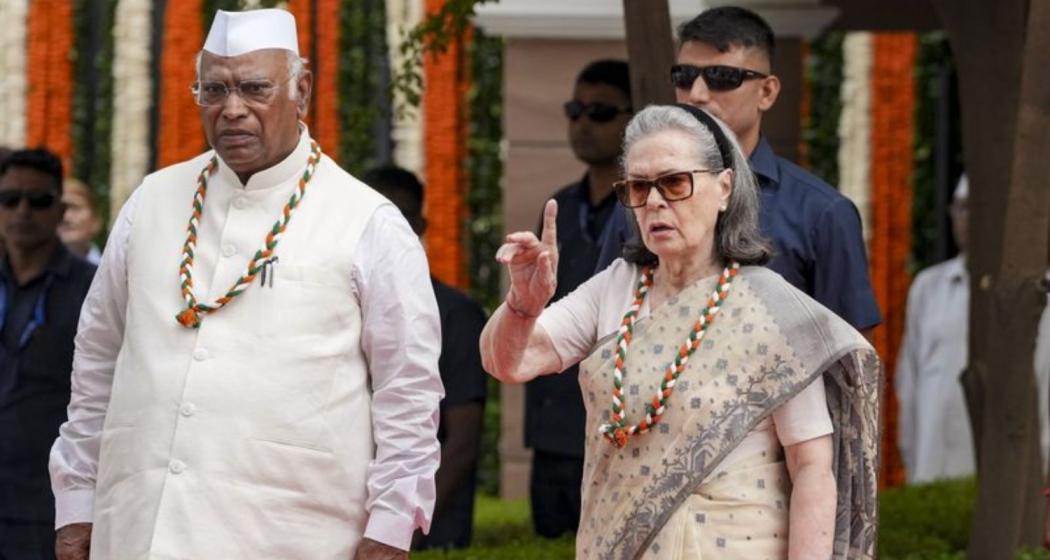
The Congress Working Committee’s decision to sing only the first two stanzas of Vande Mataram at party programmes has revived a longstanding debate over the National Song and the reasons behind its selective public rendition.
The Congress has cited a 1937 CWC resolution, arguing that leaders of the freedom movement, including Mahatma Gandhi and Rabindranath Tagore, had supported limiting public renditions to the first two stanzas.
What is the history of Vande Mataram?
Vande Mataram, meaning “Mother, I bow to thee”, was composed by Bankim Chandra Chattopadhyay in Sanskritised Bengali in 1875. It was later included in his novel Anandamath, which was set against the backdrop of the late-18th-century Sanyasi Rebellion in Bengal.
The song became a powerful rallying cry during the Swadeshi movement against the 1905 partition of Bengal and was subsequently closely associated with India’s freedom struggle.
However, some Muslim leaders objected to parts of the composition, particularly its religious imagery and references to the motherland as a goddess.
Why were only two stanzas chosen?
The issue came to a head in 1937, when Congress leaders discussed concerns over the song’s use at national gatherings.
Jawaharlal Nehru wrote to Subhas Chandra Bose in October that year, noting that the Anandamath context could cause concern among Muslims. Nehru and Bose sought Rabindranath Tagore’s opinion on the matter.
Tagore distinguished between the first two stanzas and the rest of the poem. He felt the complete composition, when read in the context of Anandamath, could hurt Muslim sentiments, but said the first two stanzas had acquired an independent significance and contained nothing offensive to any community.
The CWC subsequently resolved in October 1937 that only the first two stanzas should be sung at national gatherings. The resolution said there was nothing in those stanzas to which anyone could take exception.
Gandhi also defended the song’s historic role while opposing its imposition. He said that he would not risk a quarrel over its rendition at a mixed gathering and that the singing should be dropped if even the Congress-approved version caused objection.
Also read: Delhi HC asks Centre to consider curbs on children’s social media
What do the remaining stanzas say?
The first two stanzas celebrate the beauty and abundance of the motherland, describing its waters, greenery and fertile fields.
The later stanzas take a more religious and militant turn. The third describes millions of arms ready to wield swords in defence of the motherland. The fourth refers to the motherland’s image being present in temples and shrines.
The fifth stanza explicitly compares the motherland with Hindu goddesses Durga, Lakshmi and Saraswati. It is this imagery that has been a particular source of objection among Muslim scholars, who argue that treating the nation as a goddess conflicts with Islam’s prohibition on worshipping anyone other than Allah.
Historian Tanika Sarkar has argued that the latter sections of the poem, in the context of Anandamath, present a call to war in which Muslims are portrayed as the adversary.
How did it become the National Song?
On January 24, 1950, Constituent Assembly president Rajendra Prasad said Vande Mataram, which had played a historic role in the freedom struggle, would be honoured equally with Jana Gana Mana. The version traditionally accorded the status of the National Song consists of the first two stanzas.
The controversy resurfaced during Parliament’s discussions on the song’s 150th anniversary in December 2025, when Prime Minister Narendra Modi criticised Nehru over the decision to limit its rendition.
Congress leader Priyanka Gandhi defended the 1937 decision, pointing to Nehru’s criticism of communal politics in the same correspondence.
The latest CWC decision has once again brought the historical, religious and political debate over Vande Mataram into focus.

 Follow us