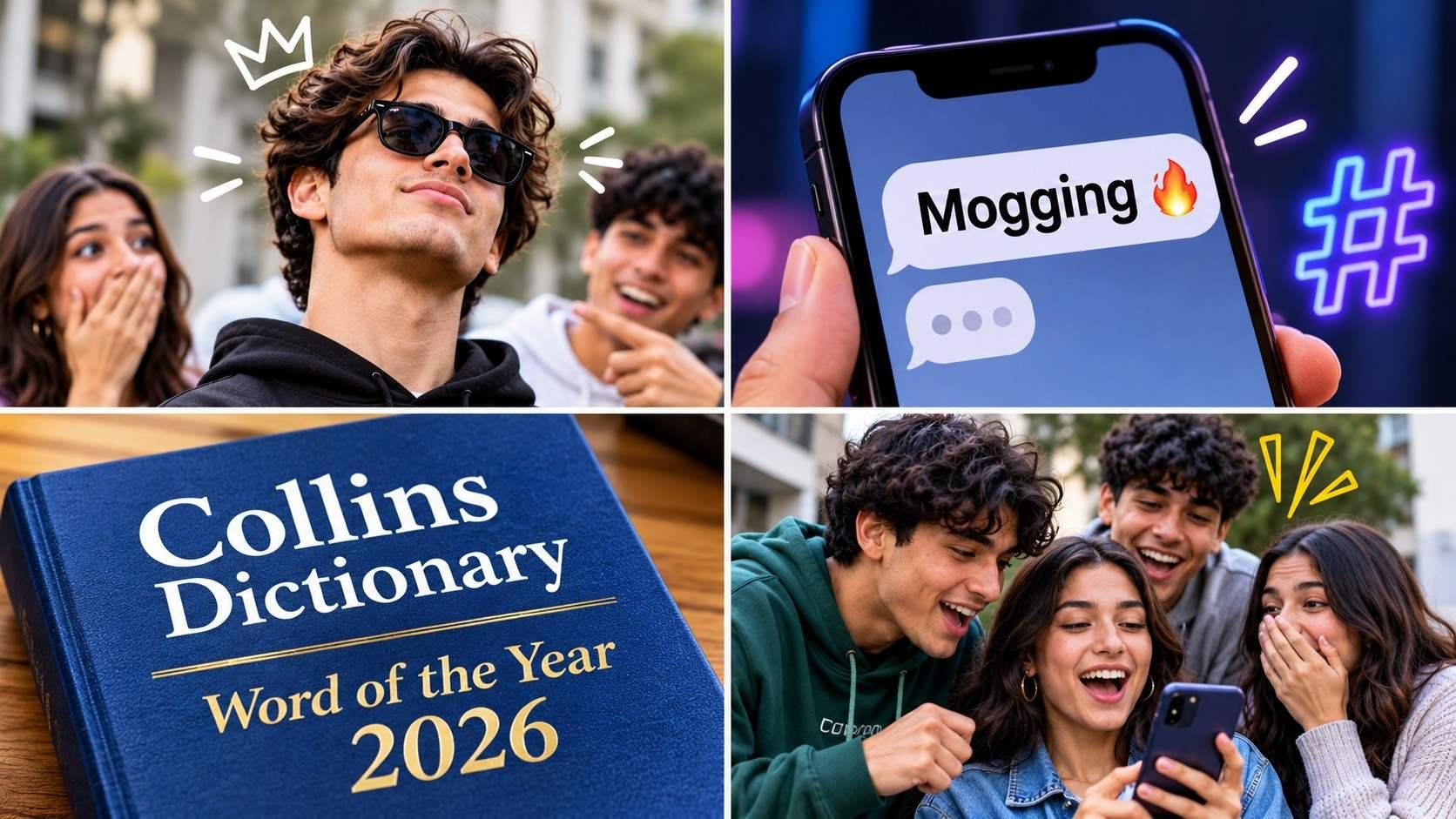
Collins English Dictionary has selected “mogging” as its Word of the Year for 2026, placing the internet slang term ahead of shortlisted entries including “firewave” and “ghost job”.
The dictionary defines “mogging” as outperforming or outshining another person or thing, often in a way that makes the comparison appear unfavourable for the other side. The term can relate to appearance, confidence, social standing or almost any other quality.
Collins said use of the word has increased by 210% this year as it spread widely across social media. It is now commonly used in a humorous or ironic sense. A new video game, for example, may be said to “mog” an older favourite, while a friend’s homemade bread could “mog” someone else’s effort.
Origins of ‘mogging’
The expression is believed to have developed from AMOG, an abbreviation for “alpha male of the group”. Collins traces its early use to around 2016, when it appeared as a noun in bodybuilding circles to describe the most physically dominant man in a gym.
It later became a verb and gained circulation through online manosphere and incel communities, which are often linked to misogynistic views. Gen Z and Gen Alpha have since adopted the word in a more light-hearted manner.
Alex Beecroft, managing director of Collins, said younger users had transformed the expression into humorous slang, “making the language their own and ‘mogging’ the rest of us!”
Other words on the 2026 shortlist
“Carspreading”, modelled on “manspreading”, describes vehicle manufacturers producing larger and heavier cars with each successive model. Collins noted that SUVs accounted for well over half of new car sales in 2025.
“Manchesterism” refers to the political philosophy associated with Andy Burnham. It centres on giving greater powers to regions while combining economic growth with social progress. The term dates back to the 19th century, when it had a different meaning. Burnham revived it in a newspaper article in January, and by July he had replaced Keir Starmer as Prime Minister.
“Firewave”, coined by researchers at Imperial College London in 2025, refers to several wildfires occurring within a short period after extended hot and dry conditions. The same heat-related theme placed “hydration break” on the list, referring to short water breaks for players that featured in every match at the 2026 World Cup.
“Ghost job” describes a vacancy advertised by an employer that has no genuine intention of hiring. Collins referred to a UK study which found that approximately one-third of advertised roles were ghost jobs.
“Friendslop” began as a disparaging term for inexpensive independent video games made to be played with friends, although gamers later adopted the word themselves. “Fricy” combines fruity and spicy to describe food with both qualities.
Another shortlisted term, “bixie”, refers to a hairstyle positioned between a bob and a pixie cut. The style was worn this year by Zendaya, Jessie Buckley and Helen Mirren.
The most serious term on the list is “P(doom)”, which denotes the estimated probability that artificial intelligence could cause the collapse of human civilisation. It began as an inside joke among AI specialists before entering wider discussions, including informal conversations at dinner parties.
Collins said the shortlisted words share a common theme: in 2026, almost everything appears to be outdoing something else.
Last year, the dictionary selected “vibe coding” as its Word of the Year. The term refers to creating software with artificial intelligence by describing the desired result instead of writing the code manually.
 Follow us