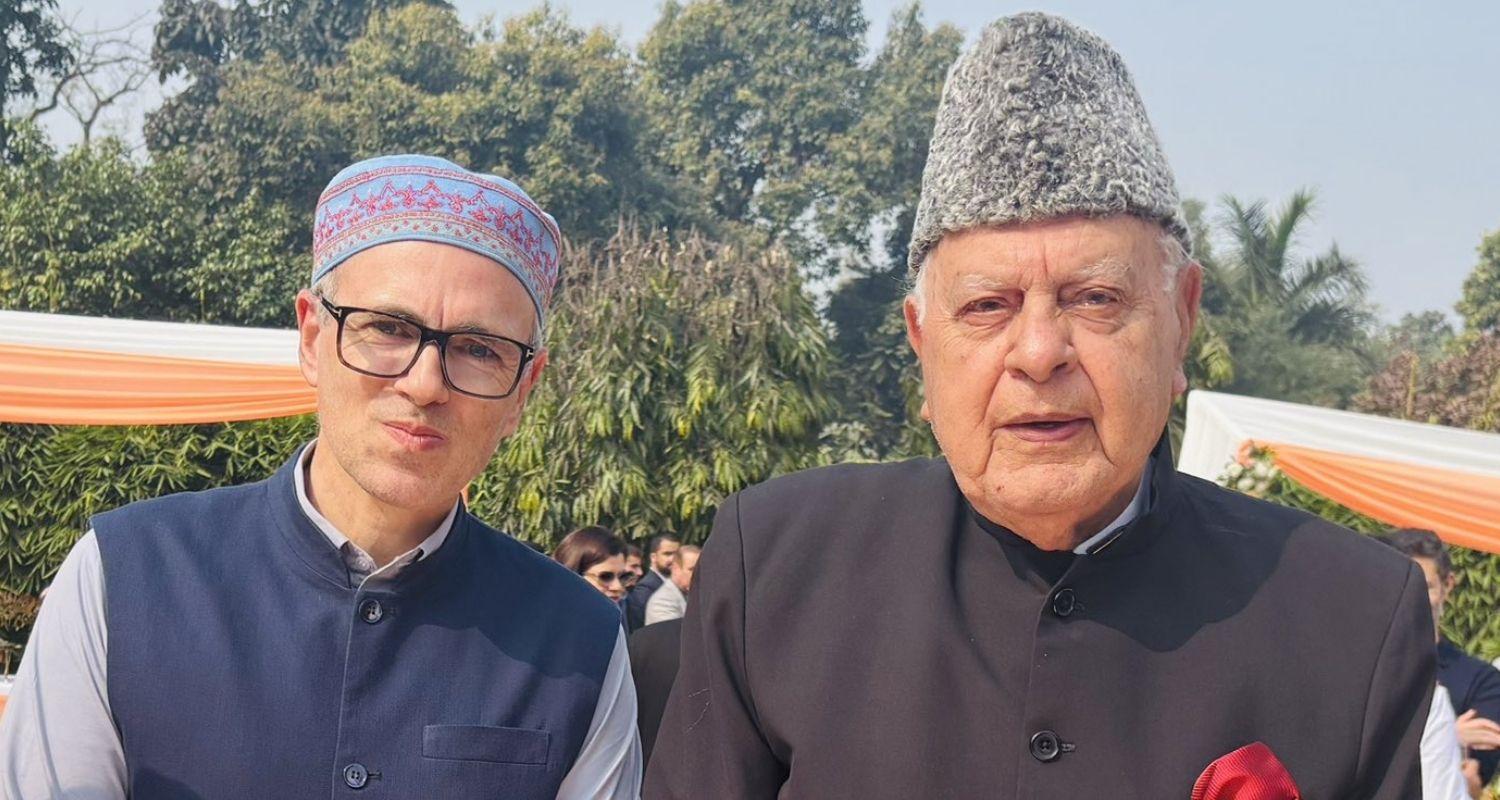
Jammu and Kashmir National Conference president and former chief minister Dr Farooq Abdullah escaped an attack on his life on Wednesday evening when an assailant fired at him from a very close range. It was an alert personal security officer who deflected the assailant’s hand and the shot missed Farooq. It was a providential escape for the former chief minister. Farooq is father of current JK Chief Minister Omar Abdullah.
Later during questioning, the assailant, identified as Kamal Singh Jamwal, claimed that he had wanted to “kill” Farooq for the last 20 years. When he was presented before the media, he expressed no remorse or regret over what he did. He was said to be in an inebriated condition when he tried to kill Farooq.
Farooq belongs to one of the oldest “political families” in the country. It was his father Sheikh Mohammad Abdullah, a towering personality of Kashmir also known as Sher-i-Kashmir (Lion of Kashmir) who founded the Jammu and Kashmir National Conference. In fact, he had originally founded the Jammu and Kashmir Muslim Conference to fight against the Dogra rule. He later changed the sectarian sounding name to the more secular sounding Jammu and Kashmir ‘National’ Conference, instead of the ‘Muslim’ Conference, as he wanted to broaden its base.
Sheikh had an immense contribution in Muslim-dominated Kashmir being part of a secular India instead of a theocratic Pakistan. He was a close associate of Pandit Jawaharlal Nehru and the two families enjoyed a close bond. After Jammu and Kashmir acceded to India, Sheikh became the ‘Prime Minister’ (that time Chief Minister of Jammu and Kashmir was designated as the Prime Minister under the special provision of Article 370 of the Indian Constitution). Later, Sheikh and Nehru fell apart as he (the Sheikh) reportedly started nourishing the ambitions of making Jammu and Kashmir an independent state with the support of Western powers. Nehru removed Sheikh from prime ministership and jailed him.
Sheikh then started the separatist Plebiscite Front seeking the right of self-determination for the people of Jammu and Kashmir. In the meanwhile, Nehru passed away and the mantle eventually passed on to his daughter Indira Gandhi, as Lal Bahadur Shastri died a premature death.
After India divided Pakistan into two parts and created Bangladesh, Sheikh realised the futility of his demand for a plebiscite. He reconciled with Gandhi and signed the famous Indira-Sheikh Accord of 1975 and became the Chief Minister. He occupied the position till his death in 1982. Till the time he was alive, he ensured that no separatist or secessionist forces raised their head in Kashmir. He was so popular that about a million people attended his funeral.
The mantle of leadership was passed on to his son Farooq Abdullah. Farooq could not handle it well. Within five years of Sheikh’s death, radicals, secessionists and separatists became a force to reckon with. Farooq tried to resist it, but the situation had gone out of control. This was probably because a new generation of Kashmiris had emerged, which started finding faults with Sheikh’s decision of opting for India against Pakistan.
Also read: Farooq Abdullah escapes assassination attempt at wedding
Farooq has always been unfailingly and undisputedly a true patriot. When Pakistan started sponsoring terrorism in Kashmir in late 1980s, he was the chief minister. He was the first Indian leader who suggested that India should bomb the terrorist training camps in Pakistan-Occupied Kashmir (PoK), way back in 1988. It took the country about three decades to carry out what are now known as “surgical strikes” to smash and destroy the terrorist training camps in Pakistan and Pakistan-Occupied Kashmir.
Farooq has never compromised on patriotism. That is why he has always remained at highest risk from terrorists and anti-national forces. Not only was he a staunch votary of striking terror camps in PoK, he always called for “zero tolerance” and no compromise with terrorists.
When then union home minister Mufti Mohammad Sayeed’s daughter Rubiya Sayeed was kidnapped from Srinagar in December 1989 and the terrorists demanded release of five of their dreaded colleagues in exchange, Farooq tried to hold down his foot against the “surrender”. He argued then that the terrorists will not dare to harm Rubiya as they will not risk losing public support and sympathy.
Besides, he had also warned that once the Government of India decides to release the terrorists in exchange, there will be no end to it. He proved prophetic. After the government of India, headed by VP Singh, decided to release the terrorists, they became emboldened. Farooq resigned as the chief minister within a month after the appointment of Jagmohan as Governor in January 1990.
Farooq again strongly resisted the attempts to release five more dreaded terrorists in exchange for the release of Indian Airlines Flight 814, which had been hijacked while on its way from Kathmandu to Delhi.
But the Government of India at that time headed by Prime Minister Atal Bihari Vajpayee succumbed to the pressure as the terrorists had taken the flight to Kandahar, then ruled by the Taliban, and were threatening to kill all passengers. They had already killed one.
Farooq once aligned with the BJP and his National Conference was part of the National Democratic Alliance headed by Vajpayee. His son, Omar Abdullah, current Chief Minister of Jammu and Kashmir, at that time was also a junior minister in the Vajpayee government.
When one of the National Conference MPs, Saifudin Soz, voted against the Vajpayee government in defiance of the party whip, which led to the fall of the government, he was expelled from the party. Soz later joined the Congress.
With such patriotic and nationalist credentials, it is understandable that Farooq and his family will always be the target of the anti-national forces. But someone like Kamal Singh targeting him and claiming that he wanted to kill him for the last 20 years, is surprising. So far, it has emerged that Kamal Singh acted on his own. What grudge he was nourishing against Farooq is not known so far.

 Follow us