
Trending:
All is not well in Himachal Pradesh
Perhaps, for the first time, the state is witnessing such a severe financial crunch that salaries of officers and employees have been deferred, development works have slowed down, political bitterness is at its peak, and the administration is under constant scrutiny for contradictions in governance. Follow us
News Arena Network - Shimla - UPDATED: April 12, 2026, 07:34 PM - 2 min read
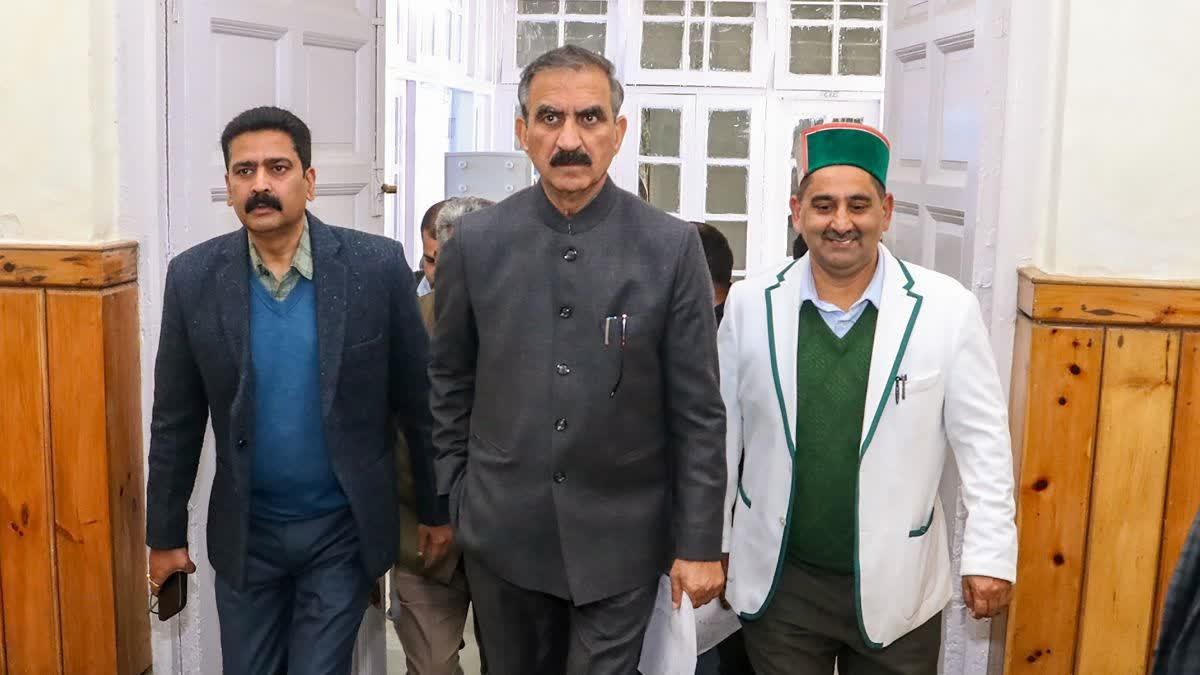
Chief Minister of Himachal Pradesh Sukhvinder Singh Sukhu (C).
All is not well in the hill state of Himachal Pradesh, which is currently passing through a difficult phase financially, politically and administratively. Perhaps, for the first time, the state is witnessing such a severe financial crunch that salaries of officers and employees have been deferred, development works have slowed down, political bitterness is at its peak, and the administration is under constant scrutiny for contradictions in governance.
The budget for the financial year 2026–27 had to be reduced by over Rs 4,000 crore compared to the previous fiscal, with the government citing the withdrawal of the Revenue Deficit Grant by the 16th Finance Commission as the primary reason. The state’s debt has crossed Rs 1.10 lakh crore. The government finds itself in a tight spot, struggling to meet public expectations, especially after making significant promises during the 2022 Assembly elections—ranging from employment generation to providing Rs 1,500 per month to women.
At the same time, political bitterness has reached unprecedented levels, both within the ruling Indian National Congress, and between the Congress and the Bharatiya Janata Party. The top bureaucracy, often perceived as being driven by self-interest, appears to have failed the system that the Congress government had promised to reform under its ‘Vyavastha Parivartan’ initiative, with little visible positive impact so far.
Also read: BJP failed to protect state interests: CM Sukhu
Chief Minister Sukhvinder Singh Sukhu, who assumed office in December 2022, has faced a series of unprecedented challenges—political, natural, and administrative. From internal rebellion within the Congress that led to cross-voting in the Rajya Sabha elections and the subsequent disqualification of six MLAs under the anti-defection law in 2024, to devastating natural calamities in 2023 and 2025, and now a deepening financial crisis, his tenure has been marked by continuous turbulence.
However, a mismatch in priorities has further complicated the situation. Many government decisions—whether related to administration, employees, or broader policy matters—are frequently challenged in courts, with the government often facing setbacks. Despite the financial strain, the administration has appointed more than 70 deputy and additional advocate generals and is spending crores on high-profile legal battles in the Supreme Court, including those aimed at protecting the positions of Chief Parliamentary Secretaries.
That said, certain welfare initiatives have been appreciated, particularly those targeting marginalised groups such as orphaned children, single women, and low-paid government workers. However, the government faces mounting criticism for failing to improve ground-level systems, especially in key sectors like healthcare and education. While the Chief Minister has spoken of introducing advanced services such as robotic surgery, the lack of basic infrastructure and adequate staffing in health institutions remains a serious concern.
The opposition BJP has made this a central issue, alleging that welfare schemes like Himcare—introduced by the previous government and benefiting around 11 lakh people—are being undermined on the pretext of irregularities.
Leader of Opposition Jai Ram Thakur accused the government of creating unnecessary controversies and implementing decisions without assessing their impact. He cited the example of the increase in entry tax at state borders, which faced strong opposition from Punjab and had to be rolled back. He also alleged that the government is attempting to delay panchayat elections and even approached the Supreme Court in this regard, suggesting a lack of political confidence.
Government employees and pensioners—numbering over four lakh—remain largely silent, but there is significant underlying discontent due to unpaid arrears. Category A and B employees have been further affected by the deferment of 3 per cent of their salaries for six months, while senior bureaucrats have faced deferments of up to 20–30 per cent. This unprecedented move has added to public concern, especially as the government continues to spend on political appointments, perks, and luxury vehicles for ministers.
The decision to withdraw cabinet rank for advisors and chairpersons, along with salary deferments for elected representatives—including 50 per cent for the Chief Minister, 30 per cent for ministers, and 20 per cent for MLAs—has failed to convince the public, as these positions continue to enjoy substantial allowances and benefits beyond salaries.
Job-seekers have also raised concerns over contradictions in governance. While the government recently announced that no retired officials would be re-employed, instances of reappointments on the same day have drawn criticism and raised questions about policy consistency and administrative clarity.
Further controversy has arisen over the ‘trainee officers’ recruitment policy, which seeks to limit benefits associated with contractual employment, even retrospectively. This move has faced backlash and is currently under legal challenge.
Tensions within the bureaucracy have also come into the spotlight. Acting Chief Secretary Sanjay Gupta, reportedly under scrutiny for a land deal in Solan, publicly accused two former Chief Secretaries—now holding key post-retirement positions—of irregularities and conspiracy against him. The situation became more complex when the government later directed that the disputed land be vested with the state due to violations of Section 118 of the Himachal Pradesh Tenancy and Land Reforms Act, contradicting earlier positions.
Responding to criticism, Chief Minister Sukhu has attributed the current situation to alleged mis-governance by the previous BJP government. He pointed out that the earlier administration received over Rs 40,000 crore as Revenue Deficit Grant, which is no longer available. He also claimed that the Centre has not extended adequate support, particularly in the aftermath of recent natural disasters.
Despite the challenges, Sukhu has maintained that the government is committed to supporting marginalised sections and improving governance. He expressed confidence that the ‘Vyavastha Parivartan’ strategy will yield results, stating that Himachal Pradesh will become self-reliant by 2027 and the richest state in the country by 2032—a claim that many, including members within his own party, view with skepticism given the current circumstances.
Meanwhile, the increasingly personalised political clashes between the Congress and the BJP, amplified by social media, have injected a level of bitterness into Himachal’s political environment that was previously uncommon in the state.
