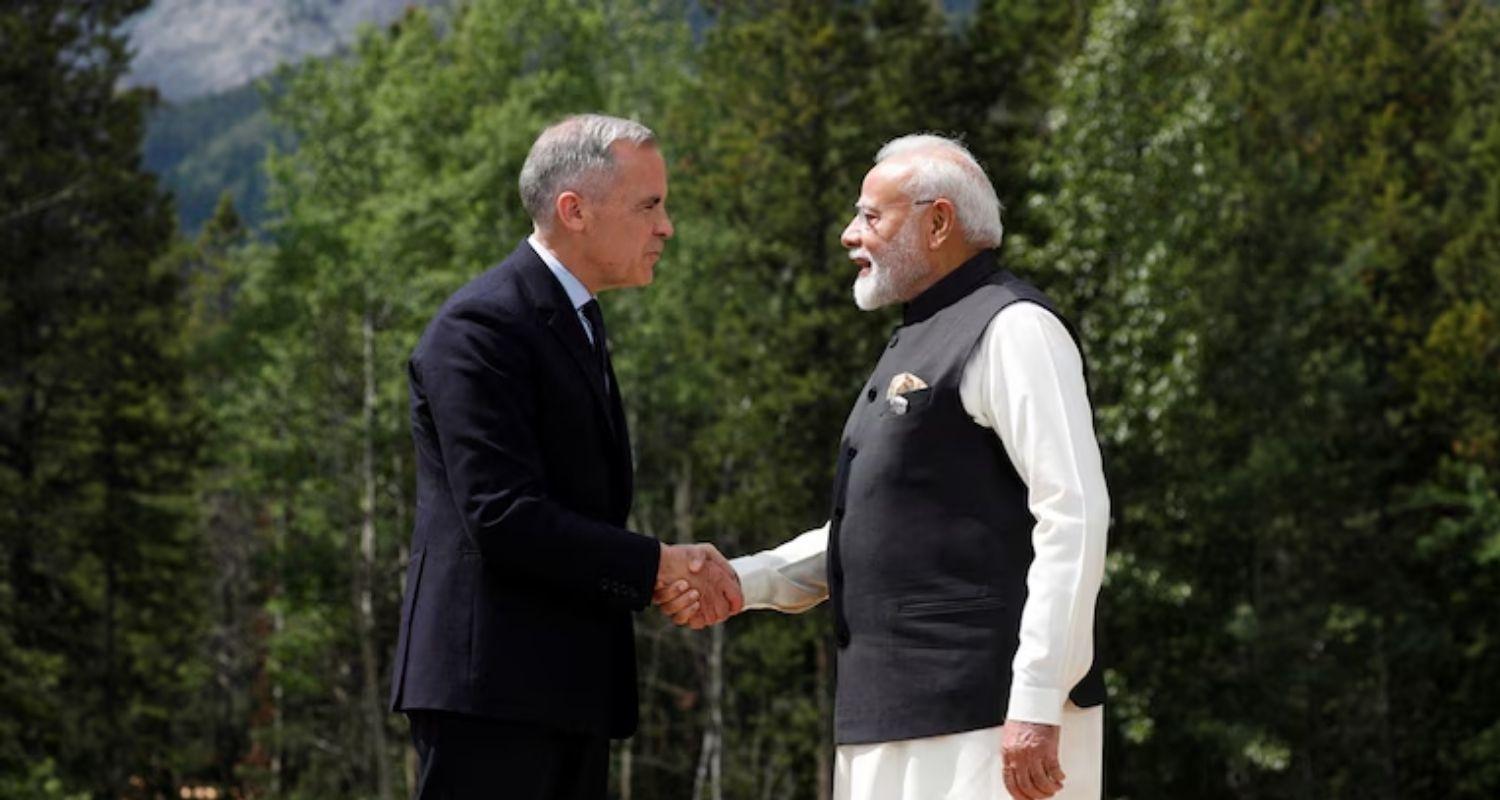
As Canadian Prime Minister Mark Carney lands on Indian soil, it puts behind the ugly and acrimonious chapter that was scripted by his predecessor Justin Trudeau. Carney is scripting a new chapter in Indo-Canadian relationship, based on mutual trust, respect and of course trade as well.
The Government of India was looking forward with great anticipation to regime change in Canada hoping that the Conservative Party will replace the Liberal Party. The Liberal Party under the leadership of Justin Trudeau was too influenced by the radical and pro-Khalistan elements. So much so, the longstanding Indo-Canadian relationship touched its nadir under Trudeau, as he bowed too much to appease such elements in antagonising India.
It started with Trudeau, because of obvious influence of the extremists and an intention to appease a section of the Punjabi diaspora, accusing the Indian government of being involved in the killing of pro-Khalistan activist Hardeep Singh Nijjar. Till now the Canadian government has not provided any proof or evidence about India’s involvement in Nijjar’s killings. But it spoiled the relationship between two long-time democratic allies.
While one section of the diaspora and his supporters are blaming the Indian government for Nijjar’s killing, a separate opinion suggests that he was killed as a result of local political rivalry. His arch-rival in local Gurdwara politics Ripudamman Singh Malik had been killed a year ago under almost similar circumstances. The needle of suspicion at that time was pointed towards Nijjar. Malik was among the masterminds of Air India bombing but was never convicted.
On the diplomatic as well as domestic front Trudeau proved to be too immature and incompetent to lead the party and the government. He was deservingly removed just ahead of the general elections in that country and replaced by much sober and mature Mark Carney, who holds the unique distinction of having headed both the Bank of England and Bank of Canada as their Governor in separate terms.
Trudeau’s mishandling of the situation eventually led to complete breakup in the diplomatic relations between the two countries. Both the countries expelled most of their diplomats, including the high commissioners from their respective diplomatic missions. Things deteriorated so rapidly that everyone was left clueless. Trudeau, it seemed, was going out of way to appease the radical and pro-Khalistan elements living in Canada. In fact, he seemed to be doing their bidding. It looked like it was not him as the head of the Canadian government, but certain leaders in his party who were dictating the foreign policy about India.
Once Trudeau was replaced by Carney, there was balance and stability in governance both on the domestic as well as the diplomatic front. As Canada was hosting the G-7 summit in June 2025, Indian Prime Minister Narendra Modi was not expected to attend for the obvious freeze in the diplomatic relations between the two countries. Carney went out of way to call Modi personally just about a week before the summit and invited him to attend the summit, which Modi did.
Thus began the revival of the relationship between the two countries, which are diplomatically at the pre-2023 stage now. Both the countries have restored most of their diplomatic channels in their respective missions and appointed the staff also. There is no hostility shown anywhere in any circles. While there are still some remnant hawkish elements from Trudeau’s time trying to sabotage the thaw, their voices are gradually falling silent as there are no more listeners of their anti-India rants.
Also read: Canada PM lands in Mumbai, begins four-day India visit
India has genuine concerns over the rabidly hostile anti-India propaganda being carried out on Canadian soil that challenges India’s sovereignty. So far no Canadian government has appreciated Indian concerns. Trudeau went to the extent of supporting these elements in the name of the Canadian Charter of Rights and Freedoms, which, among other freedoms and rights, guarantees the Right to Freedom of Expression. It took a lot of time for the Canadian establishment to realise and understand that while the pro-Khalistan elements remain peaceful on the Canadian soil, they openly preach violence in and against India.
Even when there was an open and shut case in the Air India Bombing that killed 329, most of them Canadian citizens of Indian descent, the Canadian government did not show any seriousness in punishing the guilty. At best the Canadian government has been indifferent and at worst encouraging towards the pro-Khalistani elements.
Ultimately, the Canadian government has realised that it will have to draw a line between the freedom of expression and propagation of hate by different groups. In September last, the Liberal government moved a legislation ‘Bill C 9’ that proposes to combat hate crimes and propagation of hate by different groups. Although the bill is still in the initial stages of legislation, some civil rights groups in the country are opposing it on the pretext that it may curtail the liberties and freedom of people.
The bill has apparently been prompted because of the misuse of the country’s freedom law on Canadian soil. The pro-Khalistan parades in different cities of Canada openly propagate and glorify hate and violence against the Government of India and the Hindu community. There have also been anti-Semitic protests in Canada targeting the Jewish community.
In the Indian context, a senior Canadian government official was recently quoted by newspapers saying there was no longer any involvement of the Government of India in the “transnational repression” on Canadian soil. This was not to the liking of some leaders within the ruling Liberal Party like the Surrey MP Sukh Dhaliwal, himself of Indian descent.
Carney, being himself an economist of international repute, realises the importance of relationship with a large democratic country like India. Besides, the mercurial and hostile attitude of US President Donald Trump towards Canada has prompted him to look for other options and alternatives and build up trade partnerships. India offers the best opportunity.
The current visit of the Prime Minister Carney is expected to formalise a trade deal that will see the two countries expanding the mutual trade to $70 billion in next few years.

 Follow us