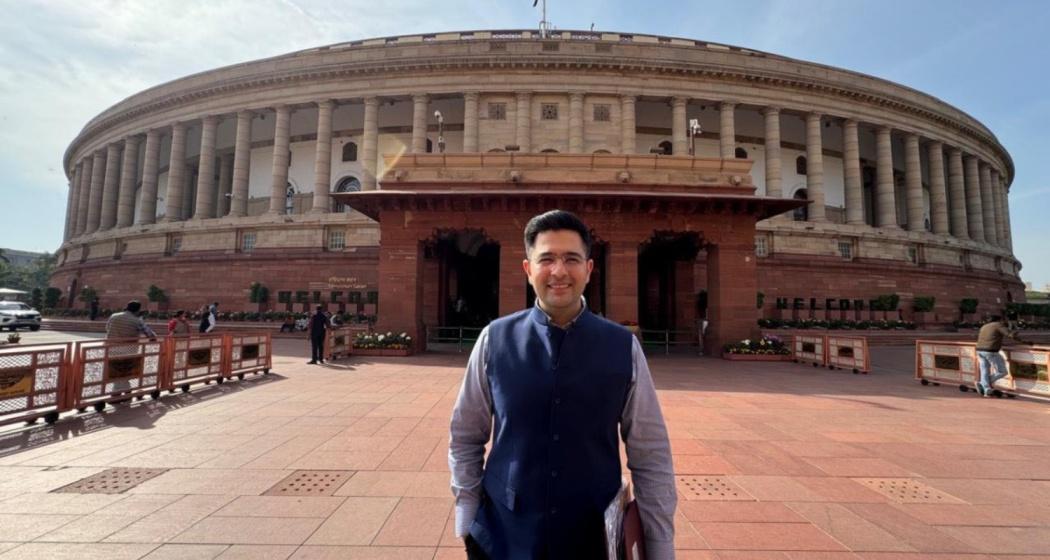
Martin Luther King Jr once famously said, “In the end, we will remember not the words of our enemies, but the silence of our friends”, thus highlighting how betrayal through inaction by friends hurts more than open hostility. This perhaps best explains why the Aam Aadmi Party removed its high-profile Rajya Sabha MP Raghav Chadha as the Deputy Leader of the party in the House. Chadha chose not to speak when it mattered most. The party obviously did not expect him to speak only about “cheap samosas” and mobile recharges while overlooking major pressing issues that the AAP has espoused for a long time.
Chadha hit back defiantly, saying, “silenced, but not defeated”.
Whether one agrees with the AAP, its policies, or its leadership, the fact remains that what Chadha is today is because of the party and its leader Arvind Kejriwal. Kejriwal may have faults, everyone in his position does, but for Chadha, he has been a proverbial godfather. From being picked up as a volunteer during the India Against Corruption movement, to being fielded as a candidate from Rajinder Nagar, then appointed Vice Chairman of the Delhi Jal Board, nominated to the nine-member apex political affairs committee, and eventually elevated to the Rajya Sabha—his rise has been extraordinary. It reflected the trust his leader had in him. Above all, he was nominated to the Rajya Sabha at the age of 33, making him one of the youngest members of the Upper House.
In Punjab, Chadha proved to be the proverbial right person at the right time in the run-up to the 2022 Assembly elections. He was appointed co-in-charge of AAP for Punjab in December 2020 along with Jarnail Singh. Suave and media-savvy, with a gift of the gab, he soon grabbed the limelight. As events turned in AAP’s favour for multiple reasons and the party eventually won 92 of the 117 Assembly segments, Chadha stole the show and much of the credit as a successful strategist and organiser. He used his characteristic PR skills to the hilt, gaining disproportionate credit for the victory along with the rewards.
He continued to wield considerable power after the AAP formed the government and Bhagwant Mann took over as Chief Minister. So much so that he began using a specially customised bulletproof Land Cruiser, otherwise meant exclusively for the Chief Minister. While he eventually had to give it up, the impression had already been made in the corridors that mattered.
With the perception that Chadha was the “main man from Delhi”, he ruled the roost for quite some time. His imprint was visible in key postings in the police and bureaucracy. He was also designated Chairman of an advisory panel to the Chief Minister. Files reportedly began to be routed through him, and he even conducted meetings of senior officials in the Chief Minister’s absence.
At times, this made the newly appointed Chief Minister uncomfortable, though Mann handled the situation tactfully while asserting his authority when needed. Mann’s apparent relief over Chadha’s virtual ouster was visible during a press conference when he agreed with a reporter suggesting that Chadha had been compromised. It was not just what he said, but the visible enthusiasm with which he said it, as if he had long wanted to express it.
Chadha, meanwhile, appeared to chart an independent course, one that did not contradict the party line but did not fully align with it either. His refusal to sign the petition to impeach the Chief Election Commissioner and his absence from opposition walkouts created the impression that he was attempting to build a “different” and “non-confrontational” image.
In modern politics, however, such ambiguity often leads to the perception that one is not aligned with the party one represents. It becomes a question of “with us or against us”, and Chadha was eventually seen as “not with” the AAP, effectively meaning “against” it, despite his denials.
Chadha seemed to position himself alongside “independently thinking MPs” like Manish Tewari and Shashi Tharoor of the Congress. But he is neither Tewari nor Tharoor. Both have spent more time in politics than Chadha’s age and have been directly elected to the Lok Sabha in tough contests. Chadha, in contrast, rose through the ranks via nominations and appointments. Moreover, the AAP is not the Congress, which often allows greater internal dissent.
When the party decided to clip his wings by removing him as Deputy Leader, Chadha responded with defiance, seemingly ignoring that his rise was enabled by the very party he was now confronting. At his position, he needed not only to be “in the party” but also “with it”, which did not appear to be the case.
The AAP perhaps did not anticipate such defiance. After all, it had not taken strict action, merely reshuffled his role. In hindsight, however, the leadership may feel vindicated and relieved to have acted in time.
The current optics are not favourable for the AAP, particularly in Punjab, where Chadha had become a prominent face. Had this occurred closer to elections, the damage could have been greater. With polls still nine months away, the party has time to absorb the shock.
For Chadha, options appear limited. In his defiance, he may eventually realise that he attempted more than he could manage.

 Follow us