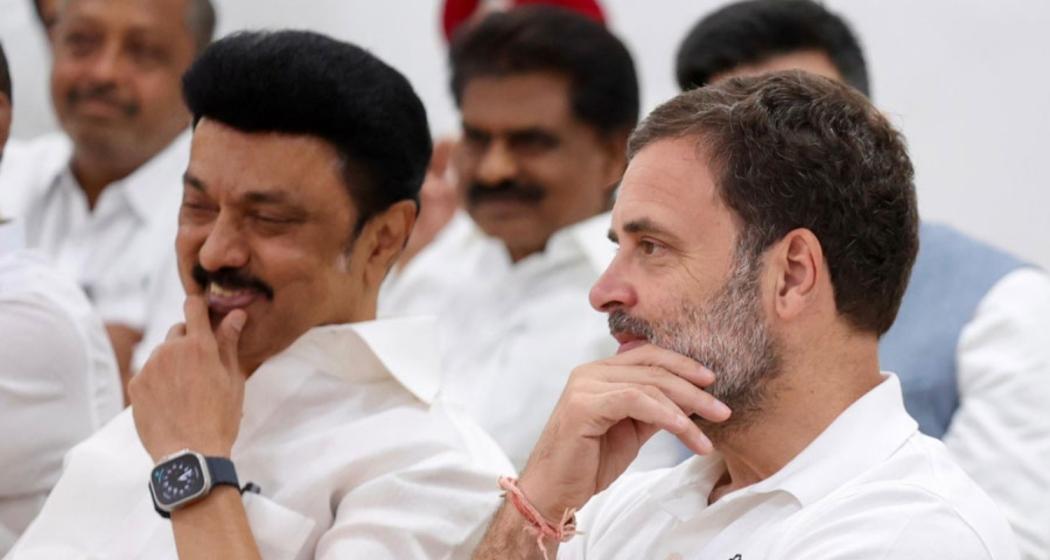
The Congress-DMK alliance was not only opportunistic but also unnatural. The Congress allied with the DMK in 2004. Just six years prior to that, the Congress had caused the IK Gujral government at the Centre to fall after he (Gujral) refused to drop DMK ministers from his government and dismiss the Karunanidhi government in Tamil Nadu following the revelations in the Jain Commission Report, which was released in 1996.
The Jain Commission was probing the assassination of Rajiv Gandhi by the LTTE. It was revealed during the investigation that the DMK had close links with the LTTE. The Congress, then headed by Sitaram Kesri, was supporting the minority government of Gujral, in which the DMK was a constituent party. The Congress wanted the DMK to be removed from the central government and also demanded that the DMK government in Tamil Nadu be dismissed. Gujral refused and resigned, leading to the fall of the government.
In a complete turnaround in 2004, the Congress, in a bid to form a government at the Centre, aligned with the same DMK, whose links had been suspected with the LTTE. Since then, the two parties remained close allies. While many constituent groups in the INDIA bloc were reluctant to accept the leadership of Rahul Gandhi, DMK leader and outgoing Tamil Nadu Chief Minister M.K. Stalin remained a staunch supporter. In fact, he even suggested Gandhi as the prime ministerial candidate.
Then the 2026 assembly elections happened. The DMK lost. The TVK emerged as the single largest party in the assembly with 108 seats. The TVK had reportedly offered to align with the Congress before the assembly elections. At that time, the Congress did not want to ditch its long-time ally, the DMK, probably because it was believed the latter would return to power.
But once the DMK lost, the Congress took no time to switch over to the TVK. The Congress support actually does not count as it has only five members in the assembly. The TVK needs 118 members for a simple majority. Even with Congress support, it still remains five short of a simple majority. TVK leader Vijay is still struggling to cobble together a simple majority.
What did the Congress gain? It lost a trusted ally, which is genuinely feeling betrayed. The DMK has already written to the Lok Sabha Speaker urging that DMK members be made to sit separately from Congress members. This is a strong snub to the Congress. The DMK has 22 members in the Lok Sabha and 8 members in the Rajya Sabha. Not only has the Congress antagonised the DMK, it has left it open to exercise its options. The DMK in the future may not be averse to some understanding with the ruling NDA. As of now, it is likely to remain neutral, thereby giving an advantage to the ruling alliance.
It is difficult to make out who in the Congress took such a hasty and hurried decision to announce support for the TVK even when the party did not have adequate numbers. Agreed that the Congress did not want the TVK to go along with the AIADMK, which it alleges is a “BJP proxy”, it could still have waited and taken the DMK into confidence. The DMK may not have objected, as it would also not have liked the TVK going along with the AIADMK.
But once the Congress rushed through its support, the equations changed fast. The AIADMK and the DMK buried their hatchet and started exploring the possibility of coming together. Although that would be against the mandate of the people of Tamil Nadu, who have rejected both traditional Dravidian parties, given the “realpolitik” being practised in modern times, which is devoid of moral principles, anything could be possible. The two parties have only 106 seats between them, 12 short of a simple majority.
It is quite likely that had the TVK not taken the support of the Congress, the Governor would have called it to form the government. Given his lack of experience, Vijay fell into the Congress trap. Had he remained neutral and maintained “safe distance” from everyone, he may already have taken the oath by now. By aligning with the Congress even before forming the government, Vijay created political enemies for no reason. The Congress should also have been more discreet in extending its support to Vijay. In the process, it lost an ally and gained nothing.
It is not only about the DMK; the Congress stance on the Trinamool Congress is also strange and surprising. All through the campaign, Congress leaders from Mallikarjun Kharge and Rahul Gandhi criticised Mamata Banerjee’s government, accusing it of corruption, lawlessness and polarisation. Gandhi went to the extent of saying that the BJP was making inroads in Bengal because of Mamata’s failures. Once the results were out, the Congress again took a complete U-turn, claiming that elections in Bengal were “stolen” by the BJP.
Interestingly, even the Bengal Congress does not subscribe to Gandhi’s views, and leaders like Adhir Ranjan Chowdhury are actually celebrating Mamata’s defeat. Gandhi criticised such leaders for “gloating over TMC’s defeat”. Interestingly, Mamata has never stood by the Congress or Rahul Gandhi as M.K. Stalin has. Still, Gandhi showed tremendous soft corner and support for Mamata while ditching Stalin. Nobody is able to fathom the reasons for this strange positioning, other than to dispute and question the BJP’s victory.
The way the Congress handled the outcome of the assembly elections has further added to doubts about the party’s ability to provide effective leadership as a principal opposition force. Nobody is sure who takes decisions in the Congress. Whoever is taking the decisions is not doing the party any good.
When Rahul asserted that only the Congress, and no other party, can defeat the BJP, he apparently wanted to send a message to estranged partners like the DMK. Given the state of affairs of the Congress, not many people are convinced by Rahul’s assertion.
Also read: DMK seeks split from Congress in LS seating

 Follow us