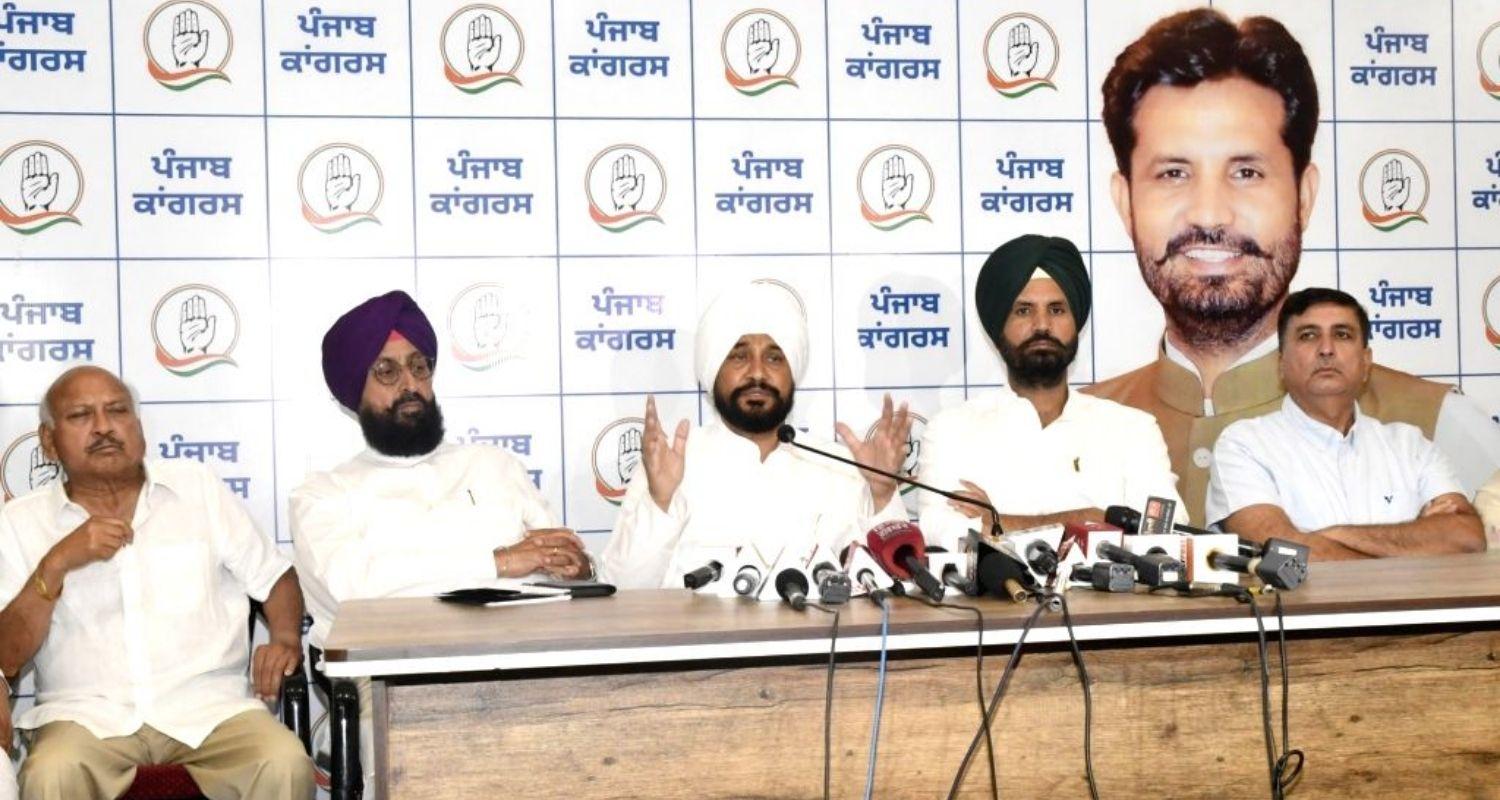
With around eight months left for the crucial Assembly elections in Punjab, the Congress — the principal opposition party and one of the frontrunners — continues to be plagued by indecisiveness. The party risks losing ground in a state where it has a realistic chance of staging a comeback if it does not put its house in order soon. It appears to be replaying the mistakes of 2021, creating uncertainty and acting too late.
Recently, the party high command carried out a three-day marathon exercise, meeting party leaders from the state and seeking their views on the leadership, whether it should continue with the existing arrangement or a change was needed.
Since little remains confidential in the Congress, details of what transpired in the meetings between the three-member team of observers and state leaders were reported almost verbatim. This removed any doubt that the party’s state leadership remains busy with factional infighting.
The party also lost a crucial opportunity to corner the government and capitalise on the confrontation between the ruling Aam Aadmi Party and the Akal Takht Jathedar, after Chief Minister Bhagwant Mann rejected the Jathedar’s “findings” regarding an old video allegedly showing him disrespecting a picture of the Sikh Gurus. Mann and the AAP have repeatedly asserted that the person seen in the purported video is not him (the Chief Minister).
The Congress remains the principal opposition party in Punjab. Going by the results of the 2024 General Elections, the party is ahead of its rivals, including the ruling AAP. The Congress has an opportunity to further consolidate its position, given the anti-incumbency against the government and the ongoing controversy, which has undoubtedly come as a setback for the AAP.
The only assertive voice against the AAP appears to be that of Sukhpal Singh Khaira, a long-time critic of the ruling party and the Chief Minister.
Punjab Congress chief Amarinder Singh Raja Warring did criticise the Chief Minister over the confrontation with the Akal Takht Jathedar, but the rest of the leadership has mostly maintained silence or limited itself to token statements.
The Shiromani Akali Dal, which has remained on the margins so far, has been trying to capitalise on the issue, fully aware of its sensitivity and appeal among the people. The party has already announced to launch a mass agitation against the government and termed it as “dharam yudh”.
The Congress, being a secular party, obviously has its limitations, but it can still corner the government through protests. It cannot afford to leave the opposition space at such a crucial time. But with confusion over leadership that has been further deepened by the recent three-day exercise by the high command, there is practically no visible activity on the ground.
The Congress’s problem is, in a sense, a problem of plenty. While there is indeed a strong demand for a leadership change, it appears to be driven more by the personal ambitions of competing chief ministerial aspirants than by concern for the party’s prospects. Given that the Congress is not a person-driven party, it should not matter greatly who is at the helm — unless it is someone charismatic like former Chief Minister Capt Amarinder Singh.
The performance of the incumbent PCC president, Amarinder Singh Raja Warring, has not been bad either. Under his leadership, the party won seven of Punjab’s 13 parliamentary seats and led in 38 Assembly segments. He himself won a cliffhanger in Ludhiana against three-time MP and friend-turned-rival Ravneet Singh Bittu. While Bittu had been an MP from Ludhiana since 2014, Warring contested from the seat for the first time as an outsider. He belongs to Gidderbaha, which falls in the Faridkot parliamentary constituency.
For Congress leaders pushing for a leadership change, the real issue is not the party’s prospects of victory, but the question of who gets to be Chief Minister if the party returns to power. Since the PCC president is often seen as a potential chief ministerial candidate, all those aspiring to be the chief minister want Warring replaced. Their concern is that if he remains PCC chief and the party wins the election — which it has strong chances — it may become difficult to ignore his claim to the top post.
There are at least three other serious contenders for the coveted position: Charanjit Singh Channi, who served as Chief Minister for about six months from September 2021 to March 2022; Partap Singh Bajwa, the current Leader of Opposition; and Sukhjinder Singh Randhawa, a former Deputy Chief Minister. But no one can say with certainty who the eventual choice might be. Given the element of surprise both the BJP as well as the Congress have sprung in the past, there may be other options too if the party wins.
The Congress high command, at the moment, appears to be caught in a piquant situation. Making a leadership change at this stage, when the elections are round the corner, may create ripples, if not any turmoil.
The best course for the party may be to bring all probable chief ministerial contenders to the table and make it clear that the choice could be any one of them, without signalling a preference for anyone in particular.
Whatever decision the party has to take, it must do so quickly, lest it start losing ground to other opposition parties such as the Shiromani Akali Dal and the Bharatiya Janata Party. The sooner it decides, the better it will be for the Congress.
Also read: Will Mann’s defiance push Punjab into ‘church-state’ conflict?

 Follow us