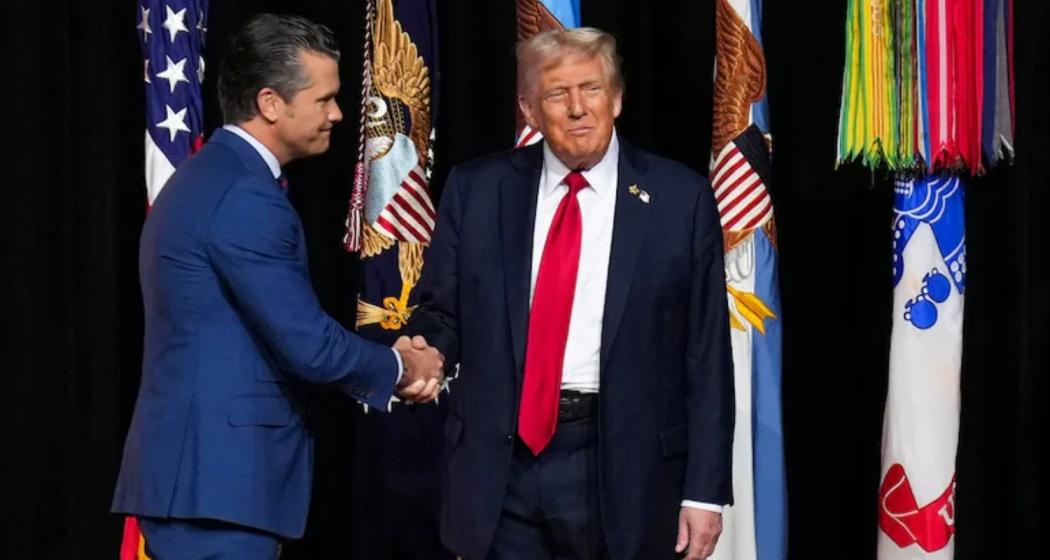
The sudden sacking of US Army Chief of Staff General Randy George by Defence Secretary Pete Hegseth has triggered fresh debate in political and defence circles, with many analysts seeing it as a sign of misalignment between the US Army and the Trump administration over the war in Iran.
Political motivations behind the purge
The primary reason behind General George’s removal appears to be a systematic purge by the administration to install military leaders who fully align with President Trump and his Defence Secretary. Any form of rebellion or hesitation will not be tolerated, nor will Trump and his Iran war hawk, Pete Hegseth, allow such generals to continue in senior positions.
Friction over Iran strategy
Trump wants more aggressive military leadership against Iran, which, according to US analysts, is not on the same page, largely due to the high risks involved in sending ground troops into the country. The main friction point between Hegseth and George was the chief of staff’s resistance to Trump’s call for an extremely aggressive military campaign aimed at sending Iran “back to the Stone Age”. General George reportedly favoured a more measured and traditional tactical approach involving reservists rather than large-scale ground deployment.
Hegseth’s controversial agenda
Hegseth, a figure mired in controversies himself, has recently intensified Iran war rhetoric by calling for a “holy war” against the country. He has been a central figure in recent information-leaking scandals, the ordering of a double-tap strike on a school in Minab, Iran, and calls for the elimination of survivors in a Venezuelan boat incident. His aggressive posturing in the media has made him the centre of controversy within the Trump government.
Since assuming office, the man in charge of the world’s most powerful military has, on multiple occasions, called for war and the annihilation of Iran without fully understanding the real consequences of a conflict that has now entered its second month.
Analyst reactions and long-term implications
One of the controversies linked to the alleged sacking of General George stems from his close ties to the previous US administration. According to analysts, Hegseth reportedly “lost trust and confidence” in George due to his deep connections with the previous administration, specifically his past role as a senior military assistant to former Defence Secretary Lloyd Austin.
Hegseth, a staunch opponent of George, has undermined the military chief’s power and authority on multiple occasions. In one incident, an American Apache helicopter was publicly seen flying over a celebrity’s house in violation of army rules, which should have required disciplinary action against the pilots. Hegseth overrode the chain of command, blocked any investigation, and prevented punishment of the accused pilots, triggering further friction between the Pentagon and senior military leadership.
Additionally, there are unconfirmed reports that General George was sacked due to his alleged opposition to Hegseth’s plan to deploy US forces on the ground in Iran. While Hegseth has been an open advocate of invasion, Trump has been more reserved, fearing massive casualties and a war that could last for decades and draw in more US resources and personnel.
Trump backtracking from his promises
Trump, who became president on a “no more wars on foreign soil” platform, has already toppled the Venezuelan government, imposed restrictions on Cuba, shown a lacklustre approach to Israel’s actions against Palestinians, and become the first US president to start a direct war against Iran. His legacy, like that of several predecessors, risks being remembered as one of broken promises, global economic uncertainty, and a return to the pattern of US presidential invasions seen since the 1950s, beginning with Vietnam.
General George has now been replaced by General Christopher LaNeve, a former personal military aide to Hegseth and former commander of the 82nd Airborne Division, which is already deployed to the region. This rare wartime removal of a service chief is widely interpreted by analysts as a calculated move to ensure the military command presents no obstacles to the administration’s intensified assault on Iran.
With this development, the war in Iran is expected to escalate and stretch far longer than many observers initially believed. The Trump administration’s intensified purges of military leadership resisting wartime deployment to Iran suggest the conflict could drag on for years.
However, plans to send troops on the ground have been termed “tactical suicide” by several international and Indian defence analysts, including Pravin Sawhney, retired generals, and former army veterans, due to the high risk of prolonged conflict and massive casualties.
By Waseem Ahmad Ganie

 Follow us