
Trending:
Expectations galore from the Union Budget
As the Union Budget approaches, India faces the challenge of sustaining high growth while navigating currency pressures, unemployment, and global uncertainty. Expectations are high that the 2026-27 Budget will balance fiscal discipline with reforms to drive investment, manufacturing, and inclusive growth. Follow us
News Arena Network - New Delhi - UPDATED: January 23, 2026, 04:19 PM - 2 min read
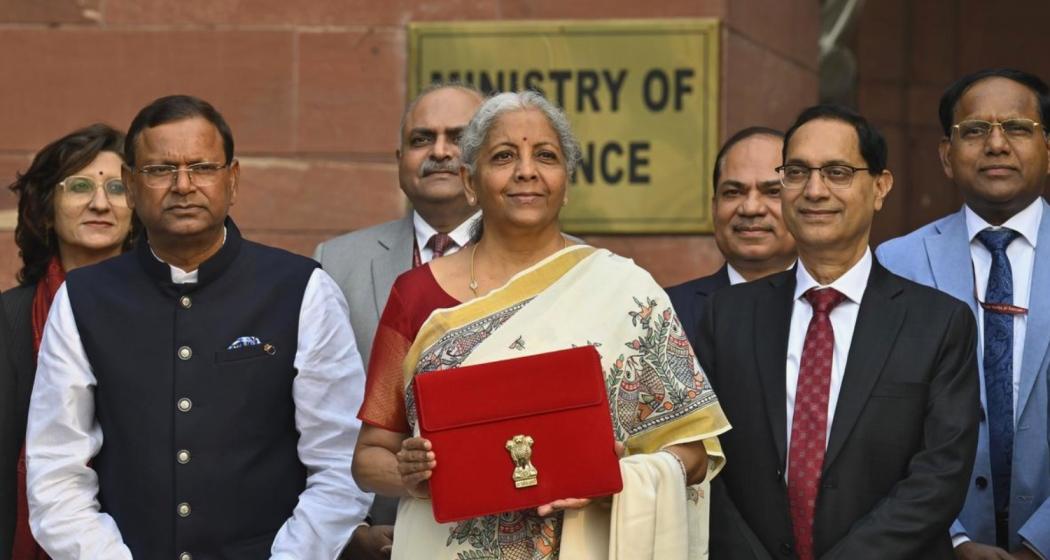
Union Minister for Finance and Corporate Affairs Nirmala Sitharaman along with the Ministers of State for Finance Pankaj Chaudhary and team members of Finance, outside the her office at North Block in New Delhi.
As the Union Budget Day draws closer, a set of paradoxes stares at the country’s economy. While India has been the fastest-growing major economy for several years now, it remains stuck in a middle-income trap and needs a major policy push to become a developed nation by 2047.
On one hand, India’s real GDP growth is projected at around 7% to 7.5%, in contrast to a slowing global economy. On the other, the eroding value of the Indian rupee, predicted to touch the 100 mark against the US dollar in the months ahead, poses a complex policy trade-off.
Micro, Small and Medium Enterprises (MSMEs) account for a large share of employment and exports, yet they remain vulnerable to credit constraints and volatility. While the country is endowed with a large pool of young talent, the unemployment rate, particularly in urban areas, is on the rise, touching 6.7% in December 2025, according to data released by the Ministry of Statistics and Programme Implementation (MoSPI).
For Finance Minister Nirmala Sitharaman, preparing to present the Union Budget for a record ninth consecutive time, this is a defining fiscal moment amid external headwinds and internal tests. The key challenge is to balance growth with fiscal discipline and provide momentum for fiscal, labour and tax reforms.
Long wish list
Every section of society looks forward to the 2026–27 Budget with hope and expectation. The wish list is long and comprehensive.
It is hoped that the Budget will outline priorities aimed at sustaining economic momentum, addressing sector-specific concerns, and aligning public spending with long-term growth objectives. It is particularly important for India to remain resilient amid a volatile global economy.
Simplification of personal and corporate tax structures, an increase in exemption thresholds, relief measures aimed at stimulating demand, sustained public investment, particularly in the infrastructure sector, and focused reforms across key sectors are among the principal expectations of industry bodies and the public alike.
As the NDA government charts an ambitious path towards its ‘Viksit Bharat 2047’ vision, the forthcoming Budget is seen as a potential catalyst for self-reliance and growth across key sectors. There are expectations that the Budget will present a roadmap for strengthening competitiveness, boosting investment confidence, and unlocking the next phase of domestic demand and manufacturing-led expansion.
Domestically, leaders across industries are seeking GST rationalisation and policy support, while working professionals will have their ears peeled for any tax relief.
As far as the market is concerned, investment firms and asset managers have sought tax relief on long-term capital gains and have urged the government to avoid transaction tax hikes.
Manufacturing, the key barometer
Manufacturing remains central to India’s economic ambitions. However, the sector continues to grapple with challenges such as high interest rates, volatile raw material prices, rising machinery import costs, and intense global competition. As India seeks to strengthen its ‘Make in India’ credentials, the upcoming Budget is expected to focus on unlocking private capital expenditure and deepening domestic value chains.
Industry bodies such as the Confederation of Indian Industry (CII) have called for measures to reduce the cost of doing business, from rationalising customs duties to reining in logistics costs and bureaucratic hurdles. A coherent package could catalyse manufacturing competitiveness, encourage capital deepening, and improve export performance, vital in a world where tariff regimes and geopolitical tensions complicate trade patterns.
One of the key expectations from manufacturers is the reintroduction or expansion of accelerated depreciation benefits to reduce the upfront tax burden on capital investments.
Also read: Educationists urge FM to focus on infrastructure
Backbone of the economy
MSMEs continue to be the backbone of India’s economy, contributing significantly to employment, exports, and regional development. While recent policy measures have expanded credit guarantee coverage and introduced targeted lending instruments, access to timely and affordable finance remains a challenge.
Ahead of the Budget, the MSME sector is seeking simplified collateral-free lending, faster loan approvals, and more equitable access to capital. High borrowing costs and compliance-related delays continue to strain working capital, particularly for growing enterprises and exporters.
The banking sector, captive to credit cycles and asset quality concerns, has been among the loudest voices calling for structural reform.
As global rates remain elevated and currency volatility persists, banks face dual pressures on margins and non-performing assets. Budgetary support through tax incentives for long-term financing, recapitalisation measures for public sector banks, and regulatory clarity for digital finance could collectively strengthen financial intermediation and credit flow.
India’s public health spending remains below 2% of GDP, short of the 2.5% target set under the National Health Policy. Additional budgetary support and prioritisation of Made-in-India medical devices would reduce out-of-pocket costs, drive innovation, and strengthen India’s MedTech competitiveness.
There is also an urgent need to address the concerns of senior citizens. Their primary demands include tax relief on pensions, reconsideration of taxation on withdrawals from pension schemes such as the National Pension System (NPS), and greater social security support. India’s burgeoning elderly population demands a nuanced approach, combining targeted fiscal support, better healthcare provisioning, and incentives for private retirement savings.
With an ageing population and prolonged inflationary pressures, particularly on essentials such as groceries, fuel, and healthcare, there is both social and economic rationale for senior-friendly fiscal measures.
The agriculture sector, India’s largest employer, is seeking a technology boost from the government. Industry experts believe greater investment in digital infrastructure, climate-resilient farming practices, and technology adoption can unlock significant growth.
AI and education
The next wave of reform must encompass AI-enabled learning outcomes, faculty upskilling, and curriculum modernisation. Strategic budgetary support is required to integrate AI across disciplines, not merely as a technical subject, but as a managerial, ethical, and decision-making tool that future leaders must master.
More significantly, investments in AI-driven research, simulation-based learning, and industry-academia collaboration could substantially improve employability and innovation capacity.
A forward-looking Budget that embeds AI into the education ecosystem will be critical to building globally competitive institutions and future-ready talent for India’s knowledge economy.
The Union Budget 2026-27 provides an opportunity to enhance ease of doing business. Reforms, particularly in eliminating regulatory excesses, must be undertaken far more swiftly than past efforts such as GST restructuring and labour code implementation. Only then will it be possible to push growth to the levels required for India to become a developed economy.
A stronger dollar, coupled with tariff-induced capital flows, would raise import bills, exert upward pressure on inflation, and complicate fiscal planning.
The government will have to factor exchange-rate realities into its budget forecasts, potentially conservatively estimating both revenues and subsidy costs. Whether Sitharaman opts for a contingency buffer to manage currency volatility or relies on structural measures to stimulate exports will be closely watched by markets and policymakers alike.
Trade remains a major issue on the horizon in a world of rapidly shifting alignments driven by US President Donald Trump’s maverick economic policies. Given the delay in finalising a trade pact with the United States, the Budget will need to support export-led industries that could face challenging times ahead.
The manufacturing sector has yet to expand sufficiently to absorb the skilled and unskilled workforce available. Lessons can be drawn from other Asian economies that have successfully expanded MSMEs to generate labour-intensive employment. As India aspires to become a global supply-chain hub and an alternative to China, it must reduce the cost of doing business, from rationalising customs duties to curbing logistics costs.
