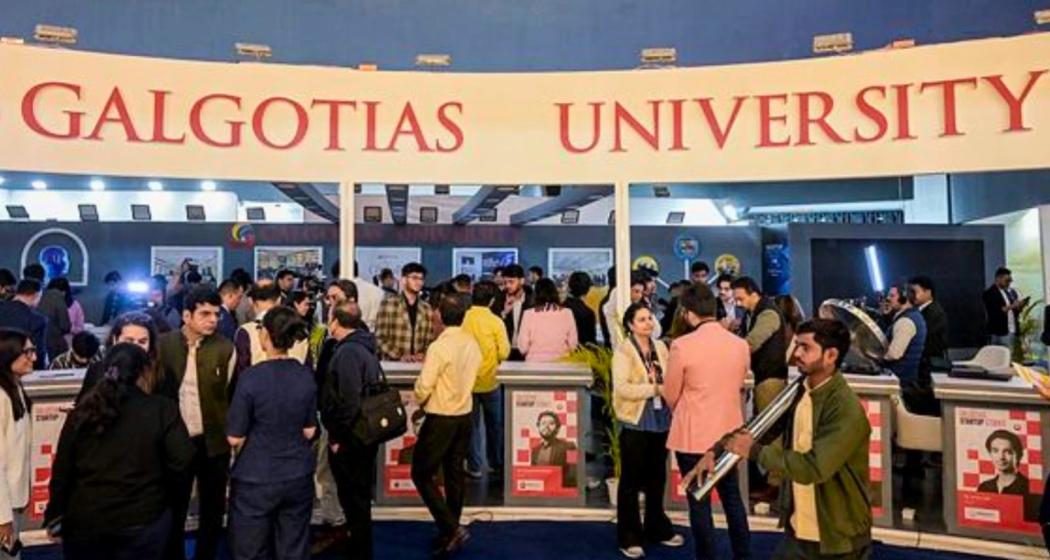
Galgotias University had its ample share of the stage lights at the AI Impact Summit, sparked satirical terms, triggered a meme fest, went viral on social media, and gained fame that will last far longer than the proverbial fifteen minutes. But the embarrassment and loud jeers are not where the sad part lies. As the debate, and the disrepute, over the university’s forged claims about the robotic dog refuse to leave the public memory, academicians see a silver lining in the mortifying episode. The fact that it has brought to the fore a deep-rooted problem long flagged by those concerned — the state of academic research in the nation.
The increasing pressure to publish and declining research integrity have contributed to ever-increasing retractions. A study published in PLOS Biology addresses the issue by quantifying the number of retractions. “The number of retracted papers per year is increasing, with more than 10,000 papers retracted in 2023.” It further flags how the problem is not centred on India but is a global issue within the research ecosystem. “The countries with the highest retraction rates (per 10,000 papers) are Saudi Arabia (30.6), Pakistan (28.1), Russia (24.9), China (23.5), Egypt (18.8), Malaysia (17.2), Iran (16.7), and India (15.2).”
Anna University set a record for the highest number of research paper retractions last year. As many as 161 research articles and works published by engineering colleges affiliated with the university were retracted by research journals in 2025. Almost half of the published works, pertaining to the period 2019 to 2024, were from the domains of computer science and information technology.
Medicine and the dangers of sham research
Bogus research in the field of medicine has far bigger repercussions for public health. When medical research is compromised, it directly hinders drug development, a fact learnt the hard way during the Covid-19 pandemic. Courtesy of the sham science sweeping laboratories and clinical trials, Ivermectin was peddled as a “miracle drug” for Covid treatment. After the hype, health authorities in the US, UK and EU found insufficient evidence supporting the drug against the disease. Several independent researchers concluded that the drug did not stand up to evidential scrutiny, eventually leading to it being removed from treatment advisories in several nations, including Peru and India, which stopped recommending Ivermectin in their treatment guidelines.
Paper mills, the underbelly of academic publishing
How did we get here? A network and ecosystem of enabling organisations known as research paper mills are said to be exponentially driving the scam of forged studies and stolen data. Simply put, research paper mills write the thesis, dissertation or research study, invent or forge the data, extrapolate the findings, and sell it to anyone ready to pay.
But why would researchers use paper mills? The reasons vary widely, but pressure to publish, academic expectations, and the “publish or perish” culture are among the factors cited by those availing these services.
A 2025 study titled “The Entities Enabling Scientific Fraud At Scale Are Large, Resilient, and Growing Rapidly”, published in the journal PNAS, has attempted to chart the activities and organisations connected to scientific fraud that have managed to evade traditional peer-review standards. Jennifer A. Byrne, a cancer researcher and co-author of the study, spoke about the growing problem of mills and how the authors purchasing the service “may or may not have done anything towards the paper.”
As part of the study, the authors investigated the Academic Research and Development (ARDA), based in India, an organisation providing “research and article writing services” for professionals. The website of ARDA describes it as a “promising platform for all researchers and fellow development associations to innovate together.”
The authors of the study, Reese A. K. Richardson and Byrne, found that ARDA’s list of journals expanded over many years and that roughly half of its journals were indexed. Notably, around one-third — 33.3 per cent — of the journals listed by ARDA that had been indexed were later de-indexed. These de-indexed journals were removed from the website and new journals were added. “To our knowledge, this is the first reported case of an entity engaging in fraudulent publishing that itself engages in journal hopping,” said the study led by Richardson.
Reportedly, ARDA has been involved in more than 4,000 publications and charges between $250 and $500 per publication.
What is the way out?
It has taken decades of research degradation to reach this point; the damage cannot be undone in a few years. However, an effort can be made, and somewhere there has to be a start.
Last year, India’s national university rankings released by the Ministry of Education introduced the concept of negative marking and penalties for research paper retractions for the first time. It is the first ranking system, at both national and global levels, to introduce such a metric.
Free, open-source resources like the Retraction Watch database track studies and research papers that have been retracted. Independent watchdog India Research Watch performs a similar role.
Meanwhile, the storm of disrepute is being countered by Galgotias University not with a conventional press statement or a legal brief, but with a sound check, a rap song, Instagram reels and influencer endorsements. Digital counter-offensives are instant and far easier, whereas research takes time, patience and perseverance. Which is why undoing the damage will also take years of collective effort to restore quality and credibility to universities.
By Manpriya Singh
Also read: PETA India seeks Galgotias' robot dog to replace circus acts

 Follow us