
Trending:
Half-time score in Telangana: Cong struggling on a bouncy track
At the halfway mark, the Congress government in Telangana faces fiscal stress, unmet promises, and rising political and policy controversies. Follow us
News Arena Network - Chandigarh - UPDATED: June 6, 2026, 03:21 PM - 2 min read
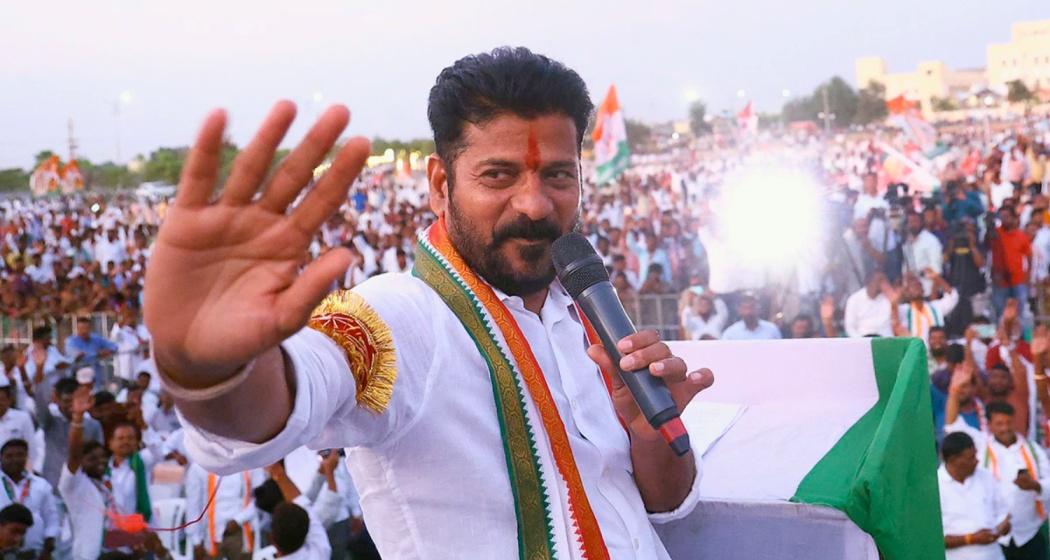
Telangana Chief Minister A Revanth Reddy. (File photo)
When A Revanth Reddy took oath as Telangana’s Chief Minister on December 7, 2023, ending a decade-long rule of the Bharat Rashtra Samithi (BRS), the occasion was brimming with hope, the mood was transformational and the mandate was unambiguous.
As the Congress government reached the halfway mark of its five-year term, the mood is now somewhat muted as the report card presents a mixed bag: hits and misses, bouquets and brickbats in equal measure.
As the grand old party rode to power on the crest of populist promises, collectively called the ‘Six Guarantees’ covering women, farmers, youth, the elderly and the poor, the state of their implementation and their impact on the ground would serve as a barometer to gauge the performance of the government.
Unfulfilled promises
The set of ‘Six Guarantees’, the signature initiative of the Telangana Congress, remains only partially implemented, and the gap between what was promised and what has been delivered is substantial.
Broadly, the six promises are:
1) Mahalakshmi: entails monthly financial assistance of Rs 2,500 to women; gas cylinders at Rs 500 and free travel for women in RTC buses.
2) Rythu Bharosa: annual financial assistance of Rs 15,000 per acre to farmers and Rs 12,000 to agricultural labourers; a bonus of Rs 500 per quintal of paddy.
3) Gruha Jyothi: 200 units of free electricity for all households.
4) Indiramma Illu: house sites to the poor and Rs 5 lakh financial assistance towards construction of houses.
5) Yuva Vikasam: financial assistance card worth Rs 5 lakh to students which can be used for payment of college fees (in addition to fee reimbursement), coaching fees, foreign college fees, overseas travel expenses, tuition fees, purchase of books and study materials, hostel fees and exam fees.
06) Cheyutha: a monthly pension of Rs 4,000 to senior citizens, widows, disabled persons, beedi workers, single women, toddy tappers, weavers, etc.; health insurance of Rs 10 lakh.
Barring free bus travel for women, most of the promises are either partially implemented or yet to be rolled out.
While critics point out that full implementation was promised within 100 days of coming to power, the Congress, on its part, pushed the blame on its predecessor’s poor fiscal management and claimed it has inherited a state in near-bankruptcy.
Though social welfare and rural development have been the major areas of focus, the alleged loopholes in the execution of the ‘Rythu Bandhu’ scheme and the failure to fully implement poll promises like the Rs 2 lakh crop loan waiver and Rs 2,500 monthly assistance to women under the ‘Mahalakshmi’ scheme have come under Opposition scrutiny.
Many other promises, such as financial assistance to tenant farmers under the Rythu Bharosa scheme, payment of unemployment allowance and gifting of gold to poor women at the time of marriage, remain unfulfilled.
An estimated Rs 1 lakh crore would be required every year to implement all the promises in full, a tall order for any government, particularly when state finances are under severe strain.
Even at the time of preparation of the poll manifesto, the question was never whether every promise could be kept immediately, but how intelligently and honestly the government would navigate the gap between aspiration and fiscal reality.
Also read: Steering the new science of negotiation in the age of AI
Financial crisis
Telangana’s finances are in dire straits, a fact the Chief Minister himself admitted on several occasions. His government is caught between acknowledging the crisis and managing the political optics of doing so. Heavy welfare spending and rising committed expenditure are driving much of the fiscal stress.
In an unusually candid admission, he disclosed in the Legislative Council that the state was borrowing Rs 4,000 crore from the RBI each month merely to pay employee salaries on the first of every month.
The CAG preliminary report for FY26 showed the state ending with a revenue deficit of Rs 9,235 crore and a fiscal deficit of Rs 77,762 crore—well above the approved borrowing ceiling of Rs 54,009 crore.
Revenue collections missed targets sharply. The government also contradicted its own earlier narrative: having repeatedly claimed it inherited Rs 7 lakh crore in debt from the BRS regime, the Budget documents for 2025–26 peg outstanding debt at Rs 4.51 lakh crore—of which the Congress government itself borrowed Rs 1.58 lakh crore.
This has created a credibility gap.
The pace of borrowing, combined with sluggish revenues, points to continuing fiscal stress that can adversely impact the development agenda.
Each year, the fiscal deficit has hovered around Rs 49,000–Rs 50,000 crore, indicating a structural imbalance between income and expenditure.
Soaring borrowings
The government’s dependence on borrowings has only deepened. In 2023–24, net borrowings and liabilities were Rs 49,589 crore. In 2024–25, they stood at Rs 48,322 crore.
Experts have warned that without corrective action, the state may find itself in a cycle where new borrowings are primarily used to service past debt. That would squeeze investments in infrastructure, health and education, slowing long-term growth.
Politics of vendetta
There are also allegations that the government has been resorting to vendetta politics.
The Chief Minister has ordered a series of probes aimed squarely at the alleged financial misdeeds and administrative irregularities of the previous BRS government, particularly targeting his predecessor K Chandrasekhar Rao and his son KT Rama Rao, popularly known as KTR.
An inquiry has been ordered into the handling of the irrigation sector by the BRS regime, particularly allegations of corruption in the execution of the Kaleshwaram irrigation project. A probe was also ordered into alleged irregularities in the power sector.
Proceedings have been initiated to prosecute KTR for his alleged role in the misappropriation of funds in the Formula E-Race, proposed to be hosted in Hyderabad. The alleged payment of Rs 55 crore to the race organisers by the Hyderabad Metropolitan Development Authority (HMDA), authorised solely by KTR in his capacity as the then Municipal Administration Minister, has now become the crux of the case.
Controversies
The Congress government’s decision to convert a vast stretch of under-utilised industrial estates in and around Hyderabad into high-value multi-use commercial zones has triggered a political row.
While the BRS and other opposition parties have dubbed it a ‘mega scam in the making’, the government has framed the move as a path-breaking initiative to transform Hyderabad into a global metropolis.
The government has approved the Hyderabad Industrial Lands Transformation Policy (HILTP)-2025, paving the way for large-scale conversion of ageing industrial estates located within and near the Outer Ring Road (ORR) into high-value, multi-use zones.
The policy, cleared through a Government Order issued recently, aims to unlock thousands of acres of industrial land that have become economically unviable, underutilised or incompatible with the city’s rapidly expanding urban core.
The establishment of the Hyderabad Disaster Response and Assets Monitoring and Protection Authority (HYDRAA) to remove illegal structures on lake beds, the Musi River Rejuvenation Project, accompanied by the demolition of houses along the riverbank, and the controversial land acquisition attempt at Lagacharla in Vikarabad for a pharma cluster have sparked protests and provided fresh ammunition to the BRS and BJP.
Another big setback for the Revanth Reddy government was the Supreme Court order striking down its attempts to commercially monetise forest lands within the University of Hyderabad.
