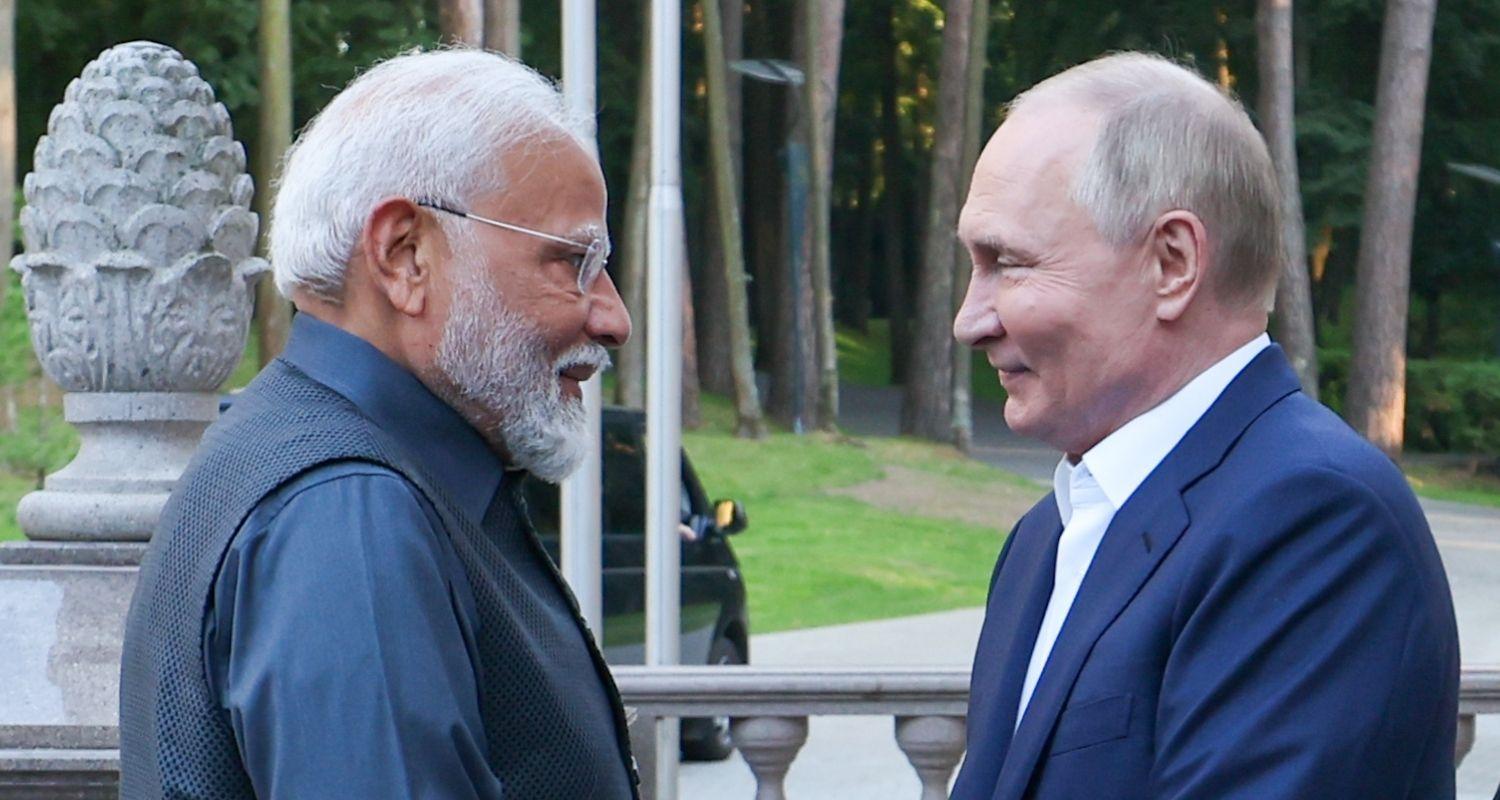
Russia’s President Vladimir Putin’s return to India after four years is significant for both capitals, not merely because of grand gestures, but because of the practical questions it brings to the table. Moscow’s approval of the RELOS agreement just before the visit showed that security cooperation remains the most reliable pillar of this relationship.
Recent developments like Moscow and New Delhi agreeing to jointly manufacture spare parts and components for Russian-origin defence equipment under the Make-in-India programme show that both sides are at least acknowledging the need for deeper cooperation.
For India, especially its armed forces, this move could ease long-term maintenance issues with Russian-supplied weapons from jets and helicopters to ships and missiles since spares will now be produced locally. For Russia, it reflects a shift, from supplying equipment to partnering in production, potentially opening the door for joint ventures and even exports to friendly third world countries under mutual approval.
But even this step does not mask the deeper structural gaps.
Well, the trade picture still speaks plainly. Bilateral trade may have crossed $65 billion, yet India’s exports to Russia are near $5 billion. That contrast can’t be brushed aside as a temporary glitch; it reflects an economic relationship weighted heavily in one direction.
Even Russia now acknowledges that this is unsustainable. Dmitry Peskov has said openly that Moscow wants to import more Indian products and shift to national-currency trade. Putin, too, has said cooperation needs to expand into technology, space, agriculture and more, with India’s own list of pharmaceuticals, machinery, marine products and processed foods.
These conversations have been repeated many times over the years. The challenge is not intent; it is delivery. A mobility pact may be one of the few concrete outcomes this time, easing movements for professionals and workers on both sides. India’s decision to expand its’ consular presence to Kazan and soon Yekaterinburg, along with ongoing FTA talks with the Eurasian Economic Union, shows Delhi wants to broaden the relationship. But these steps cannot compensate for the fact that private-sector engagement between the two countries is extremely thin.
This is the deeper structural problem. For decades, both sides have described their partnership as “special and privileged.” Defence ties remain strong, from the S-400 systems to nuclear energy cooperation but beyond that, the relationship must now adapt. Indian companies have gone global, however, Russian business presence in India remains limited. People-to-people links are weak, academic and research exchanges are minimal.
In short, the relationship is still carried almost entirely by governments, not societies or industries.
On Ukraine, India has taken a careful stance neither condemning Russia outright nor endorsing the invasion. But every major visit now carries an unspoken question: how does New Delhi balance strategic autonomy with global expectations?
Putin’s trip occurred just as peace efforts are intensifying in Europe. For India, this created both an opportunity and a diplomatic tightrope. A closer relationship with Russia has given India room to manoeuvre. But India cannot appear completely indifferent to international law, territorial sovereignty and humanitarian consequences of the war.
This balance will increasingly test India’s foreign-policy agility.
Also read: Putin dinner row: Govt and Opposition need to find middle path
Well, India and Russia’s relationship is often defined as one of the most stable global partnerships. And the numbers reflect stability. Since 2022, Prime Minister Narendra Modi and President Putin have spoken 22 times over the phone, a frequency that signals trust, political comfort and a level of direct communication rare in global diplomacy.
Asoke Mukerji, India’s former permanent representative to the UN, puts it, that the India-Russia relationship have always been sui generis, unique in character not shaped or pressured by India’s relations with other major powers.
A key reason this partnership has endured is also due to the absence of any historical baggage. India and Russia share no contentious borders, no history of wars, and no unresolved territorial disputes, factors that make their stability both an opportunity and, at time, a diplomatic challenge. With no immediate crisis binding the two, the onus falls on political leadership to actively give the relationship strategic relevance.
And that relevance is precisely what India and Russia must rebuild over the next decade. Because beneath the political warmth lies a widening gap between potential and performance. The partnership cannot merely rely on sentiment or inherited goodwill; it needs structural renewal as well.
The renewal must look like economic diversification, reduced defence dependence, more joint manufacturing, better logistics, people-to-people contact and transparent trade mechanisms.
This is no longer about reviving an old friendship, but engineering it into a contemporary one.
Russia, dealing with sanctions and limited markets, needs India economically. India, striving for multi-polarity and strategic autonomy, still values Russian support in defence, nuclear cooperation and global forums like the UNSC.
With both sides willing, this moment could mark the beginning of a new chapter built on clarity, not clichés, on interests, not inherited sentiment and on equal, modern cooperation rather than one-sided reliance. The relationship might finally gain the depth it has long lacked.
If not, it will continue as it is today—steady, familiar and far below what both sides claim to aspire to.
By Shyna Gupta

 Follow us