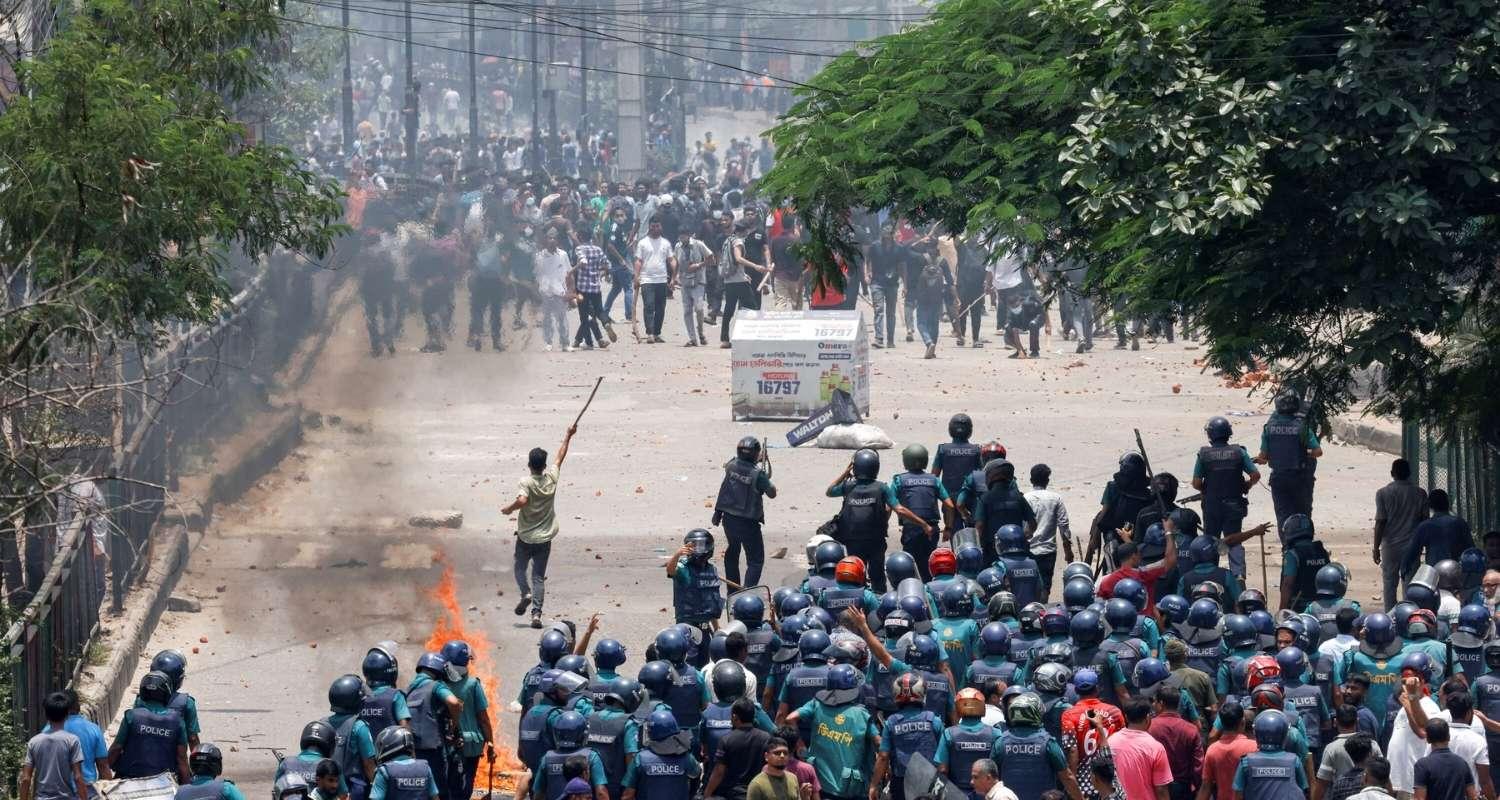
There is little doubt that the ongoing unrest in Bangladesh, driven by pathological hatred towards India, is sponsored and supported by Pakistan through its intelligence agency, the ISI. Pakistan appears to be “returning the favour” to India in vengeance for 1971.
It is ironic that the country which India helped to get liberated has now turned against it as a fierce adversary. Just 54 years ago, India liberated Bangladesh from Pakistan. Today, however, Bangladesh appears to be practically aligned with Pakistan against India. It is not just the political hostility, but the spread of Islamic extremism that poses a grave threat to India. West Bengal will always remain vulnerable to radical Islamic insurgency if the government in Bangladesh wants to do so. And there is little reason to believe that it may not do so.
The border between India and Bangladesh, unlike the western border with Pakistan, is highly porous. The movement of men and material remained virtually unhindered until the recent past. This is why West Bengal along with Assam witnessed a huge influx of infiltrators as refugees from Bangladesh, disturbing the demography in both states.
The 1971 developments in then East Pakistan, present day Bangladesh, were triggered by the Pakistani military establishment’s refusal to allow Sheikh Mujib ur Rahman to become Prime Minister despite his Awami League party getting a clear majority. Civil society in Bangladesh has always been radical, with a majority of population prioritising religious identity over linguistic identity. 1971 was an aberration that India capitalised on to divide its perennial enemy into two parts.
The liberation of Bangladesh, which split Pakistan into two, was then attributed to the rise of Bangla nationalism and the defeat of theocracy. However, in hindsight, everyone realises that in 1971 whatever happened was a momentary reaction over refusal to acknowledge the popular mandate.
Otherwise, Bengali Muslims were as vocal and aggressive in demanding and supporting Pakistan as elsewhere in undivided India before Partition. Rather, Punjabi Muslims favoured the secular Unionist Party over the Muslim League, while Bengali Muslims strongly supported the Muslim League. It was the then Bengal Prime Minister (modern equivalent of Chief Minister), Fazlul Haq, who moved the resolution for the creation of Pakistan in the 1942 Lahore session of the Muslim League.
To assert Muslim support for a separate Pakistan, its founder Mohammad Ali Jinnah organised the infamous “Direct Action Day” in Calcutta on August 16, 1946, which saw hundreds of non-Muslims, including Hindus and Sikhs, massacred by the ‘razakars’ (volunteers) of the Muslim League.
The selective killing of Hindus today should not come as any surprise for anyone. While massacres along the western borders during Partition were well documented and publicised, the killings in Bengal did not receive similar attention. Jamaat-e-Islami, a radical Islamic organisation, remained active even after the formation of Bangladesh and continues to be quite strong and influential till this day.
In fact, Jamaat-e-Islami never forgave Sheikh Mujibur Rahman for the creation of Bangladesh. This is not to suggest that he was any secular; his earlier political record reflected communal and radical tendencies. His revolt was mainly against Pakistan’s military dictatorship for denying him the prime ministership.
Pakistan has not forgotten the humiliation it suffered in Bangladesh. The historic and humiliating surrender of nearly 90,000 Pakistani army soldiers and officers continues to haunt its military establishment. It has been repeatedly trying to avenge it in one way or the other under Zulfikar Ali Bhutto’s doctrine of “bleeding India with thousand cuts”.
Pakistan Army and its intelligence service, the ISI, have tried it first in Punjab and then in Kashmir. They failed in both places. Now the ISI appears to be opening another front against India, this time on the other end of the subcontinent, Bangladesh.
No wonder the anti-government protests in Bangladesh in the name of fighting corruption and electoral malpractices turned into anti-India protests and the lynching of Hindus and targeting of their property and religious places.
Bangladesh harbours resentment towards India for sheltering its deposed Prime Minister, Sheikh Hasina, whom Dhaka accuses of treason. She has been sentenced to death in absentia, and Bangladesh has been seeking her extradition. Hasina is the daughter of Bangladesh’s founder, Sheikh Mujib ur Rahman. After his assassination, along with most of his family, Hasina along with her sister took refuge in India. Former Prime Minister Indira Gandhi personally ensured safety of both sisters. Eventually they returned to their country and Hasina took control of Awami League and rose to become the Prime Minister.
India’s policy towards Bangladesh has remained consistent. When the ruling BJP and the opposition Congress do not see eye to eye with each other on any issue, they have remained on the same page on Bangladesh and on providing shelter to Sheikh Hasina. And that is the right approach. Hasina’s family has seen such hostility before also when her father, along with many other relatives were brutally assassinated. The assassination was attributed to former Pakistan Prime Minister Zulfiqar Ali Bhutto who could not digest the creation of the new country. It is ironic that Bhutto was himself hanged by military dictator General Zia ul Haq.
The assassination of Sheikh Mujibur Rahman was widely attributed to forces backed by former Pakistani Prime Minister Zulfikar Ali Bhutto, who could not accept the creation of Bangladesh. Ironically, Bhutto himself was later executed by military dictator General Zia-ul-Haq.
Given the rise of Islamic extremism in that country, Bangladesh is likely to continue as a challenging trouble spot for India with a continuous challenge of infiltration and insurgency that can threaten peace in the border states like West Bengal and Assam.
Also Read: Sydney terror attack result of globalised anti-Jewish hate

 Follow us