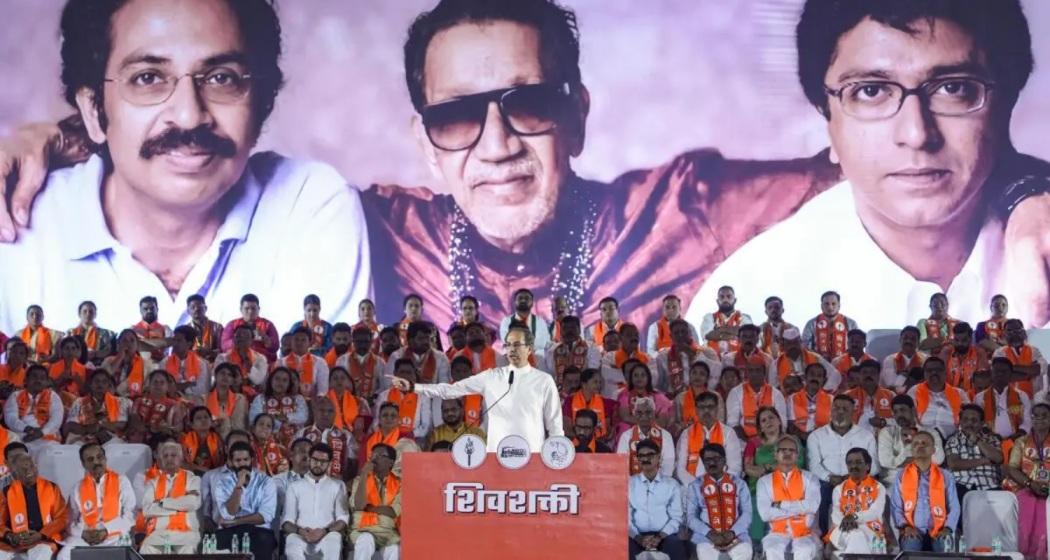
When Uddhav Thackeray, the son of Bal Thackeray, aligned with the Congress and the Nationalist Congress Party after ditching the Bharatiya Janata Party to become the Chief Minister of Maharashtra, little must he have thought that in the end it would prove to be a Faustian bargain. He and his party ended up damned and doomed.
For the Bharatiya Janata Party, the victory in Mumbai civic elections is the sweetest of all; sweeter than the 2024 assembly elections. The BJP has eventually managed to show Uddhav Thackeray his place. Mumbai was the last bastion the Thackeray family controlled for 25 continuous years. Uddhav must have also realised that he is not Bal Thackeray.
Losing Mumbai is the greatest loss for the Thackerays. It is not an ordinary loss. It is a loss of legacy. It is a loss of history. It was from here that the legendary leader Balasaheb Thackeray, popularly known as Bal Thackeray, started the Shiv Sena. It was so entrenched in Mumbai that no matter which dispensation ruled the state, the BMC always went along with the Sena for about three decades. That was the power and influence of Bal Thackeray, which outlived him, until his son, Uddhav, squandered it away by ideological compromises just to become the Chief Minister for a short while. For his short-term gain of becoming Chief Minister with the Congress and NCP support, Uddhav put at stake the survival of the Shiv Sena, which now faces an existential threat.
Actually, Uddhav lost Mumbai the day he aligned with the Congress and the Nationalist Congress Party to become the Chief Minister in 2019 after ditching the longtime ally, the BJP. Uddhav was wrong and unjustified at that time, as he did not want to concede the rotational space for the Chief Minister in the alliance. He not only ditched the BJP, but also the Sena’s ideology so vigorously preached and practised by his late father, and that too by aligning with the same parties his father was always stringently opposed to.
This was a classic case of Uddhav trying to bite more than he could chew. Imagine Bal Thackeray’s son aligning with the Congress to become the Maharashtra Chief Minister. It was a suicidal step. For becoming Chief Minister, Uddhav put at stake the legacy, the history and ideology on which Shiv Sena was founded. In politics, like in life, one has to be very accommodative. Short-term gains always feel tempting, but you end up paying a heavy price for them. Just to become Chief Minister, Uddhav lost everything in the bargain. Mumbai was the last bastion of his power, which he lost on January 16.
Shiv Sena’s core ideology was “ultra-Hindutva,” more aggressive and profound than the BJP. For example, while BJP leaders always maintained that they did not want the Babri mosque to be demolished and the ‘karsevaks’ went out of control, Bal Thackeray proudly asserted that he felt more proud when he was told that the blame for the demolition of the mosque was being put on the Shiv Sainiks. He was always aggressively unapologetic about his staunch Hindutva beliefs.
Shiv Sena’s ‘Marathi Manoos’ narrative was only the subtext of the Hindutva ideology followed by the Sangh Parivar. The Marathi Manoos should have included everyone irrespective of caste or religion. But that was not the case. The concept of Marathi Manoos excluded large sections of the Maharashtrian community on the basis of religion.
Also read: BJP breaches BMC fortress, registers big win in Pune
Separation from the Shiv Sena was the proverbial “blessing in disguise” for the BJP. Shiv Sena’s xenophobic pursuit of the concept of Marathi Manoos hit the very foundations of the Hindutva theme. Hindutva believes in overarching and all-encompassing principles, while Marathi Manoos shrunk it into a narrow definition.
While Hindutva includes all Hindus irrespective of caste, region, or language, Shiv Sena excluded all non-Maharashtrians, no matter whether they were Hindus or not. The BJP and Shiv Sena under Uddhav Thackeray aligning together was more paradoxical than the Congress-Shiv Sena alliance. Compared to that, Bal Thackeray espoused Hindutva in its real essence.
Once the Thackeray-led Shiv Sena broke away from the BJP, the non-Maharashtrian Hindus, particularly those from Gujarat, Bihar, and Uttar Pradesh, often targets of Shiv Sena activists, aligned more comfortably with the BJP, and the result was seen on Friday.
For Uddhav, rapprochement with his estranged cousin Raj Thackeray did not help either. In fact, it further entrenched their xenophobic image, distancing them from the majority of voters. Mumbai, after all, is a metropolitan city with a cosmopolitan culture, where sectarian and xenophobic ideologies are least likely to succeed.
Although the BJP and the Shiv Sena also did not fight the last BMC elections held in 2017 together, they were still alliance partners. The two parties entered a post-poll alliance before parting ways in the aftermath of the 2019 assembly elections, when Uddhav ditched the BJP and aligned with the Congress and NCP.
It will be the first time in history that the BJP, and not the Shiv Sena, will have its own Mayor in Mumbai. This establishes complete dominance of the saffron party over the all-important western state of Maharashtra and its capital. It indeed is a significant victory for the BJP and, at the same time, a great loss for the Shiv Sena led by Uddhav. His party is faced with an existential threat for which Uddhav has only himself to blame.

 Follow us