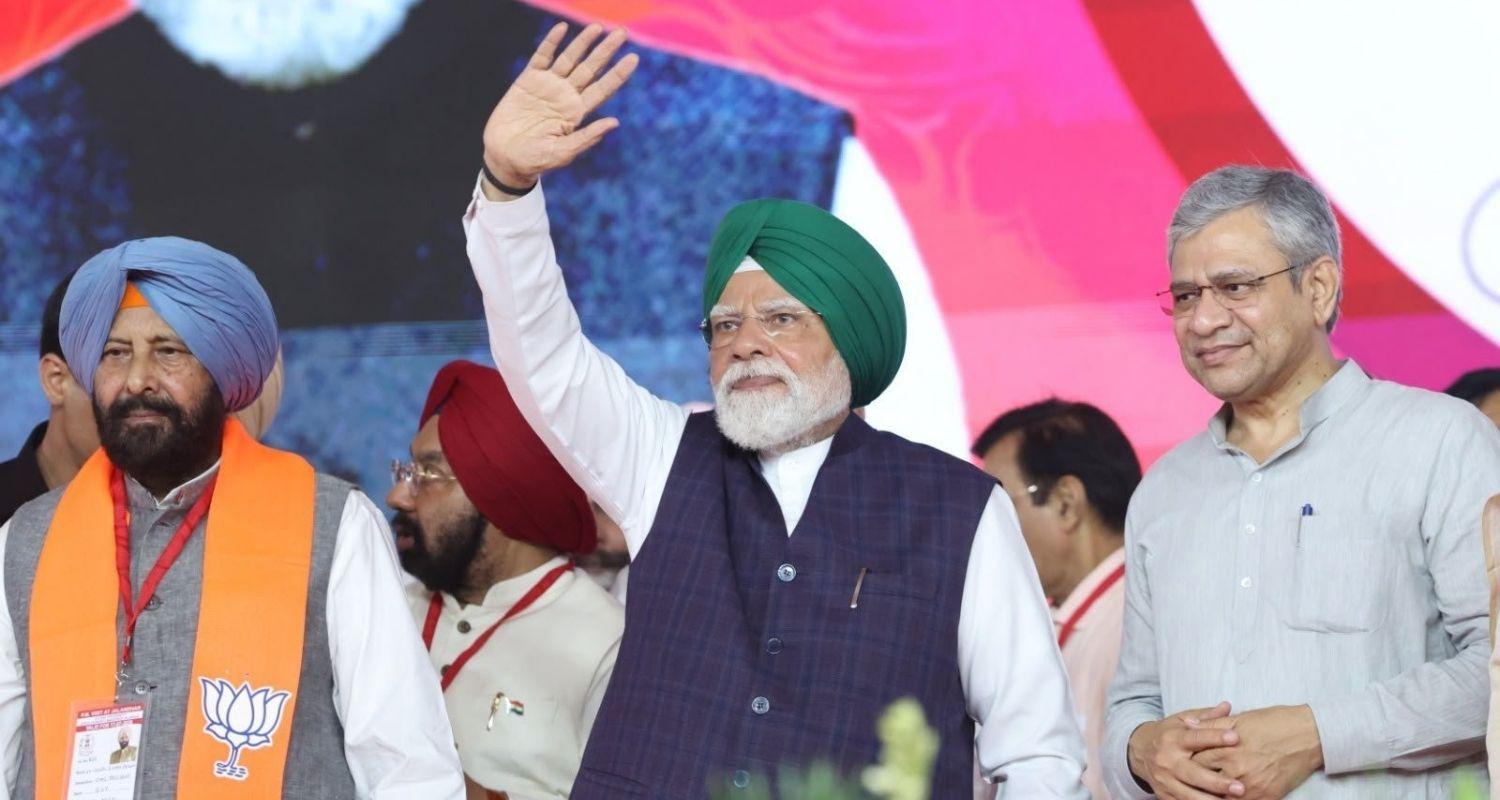
Whenever Prime Minister Narendra Modi visited Punjab, he wore a saffron turban. However, this time, he sported a green turban. There was a strong message behind this. Green symbolises Punjab's agrarian identity. The message was aimed at the powerful Jatt Sikh farming community, which is spread across the state and has always played a dominant role in Punjab and Sikh politics.
So far, the Jatt Sikh community has largely been seen as indifferent or, at times, even hostile towards the BJP. The chasm between the BJP and the community grew after the introduction of the three central agriculture laws, which were strongly resisted by Punjab and Haryana farmers.
In Punjab, the farmers turned it into a community rather than a 'panthic' issue. Although Prime Minister Modi withdrew the three laws with an apology, the Jatt Sikh community has remained largely unmoved and continues to be hostile towards the BJP, though perhaps not to the same extent as in the past.
For its part, the BJP has continuously been trying to send "green signals" to the community. The party appointed Kewal Singh Dhillon as its state president just four years after he joined the BJP, primarily because he belonged to the Jatt Sikh community. The party also recently appointed Harjeet Singh Grewal, one of the few Jatt Sikh leaders with a long association with the BJP, as the Chairman of the National Minorities Commission.
The sudden release of the movie Satluj is also being viewed in the context of the BJP's outreach to the Jatt peasantry. The movie has appealed to many Punjabis, particularly the Jatt Sikhs. The BJP appears to have taken a detour from its "hardline nationalist" agenda by allowing the maligning and vilification of those who fought terrorism and restored peace in Punjab. But then, politics and elections are the art of the possible, something the BJP has perfected and remains unchallenged till now.
The lack of support, almost en masse, from the Jatt Sikh community remains the only missing link in the BJP's strategy for Punjab. The party undoubtedly appears to be trying hard to bridge that gap. One advantage it has is that it carries no historical baggage against it. If the Congress could win two elections in Punjab despite the baggage of Operation Bluestar and the anti-Sikh riots of 1984, the BJP has every reason to be optimistic. Resistance to the BJP is based largely on the perception that it subscribes to the theory that Sikhs are part of the Hindu religion. The BJP, as well as its ideological fountainhead, the Rashtriya Swayamsevak Sangh (RSS), have repeatedly asserted that they regard Sikhism as a separate religion.
There was a time when BJP candidates were not even allowed to enter villages to campaign. However, those times have changed. The hostility witnessed in 2022 no longer persists to the same extent. Not only do people say that the BJP has nothing against the Sikhs, but there is also a growing realisation that the party, Prime Minister Narendra Modi in particular, has done a great deal for the Sikh community. This realisation is likely to stand the BJP in good stead in the coming days.
The BJP has already reached out to various 'deras' (sects) across Punjab, including the influential Dera Radha Soami and Dera Ballan. Prime Minister Modi paid a special visit to Dera Ballan in February. When he inaugurated the renovated Jalandhar Cantonment Railway Station the other day, he again met the Dera head, Sant Niranjan Das. The message was not lost on anyone. Modi also flagged off a special Vande Bharat sleeper train between Jalandhar and Varanasi, two important centres of the Ravidasia sect.
The BJP's relationship with Dera Sacha Sauda is already well known and needs no further mention. The Dera has a large following in the Malwa belt. In past elections, it has supported individual candidates. However, this time, the Dera head may not have that discretion and could well have to announce blanket support for the BJP for obvious reasons. The last time the Dera extended blanket support to a political party was in 2007, when it backed the Congress against the Akalis. Despite that support, the Congress lost and the Akalis returned to power, though the Dera's support helped the Congress perform impressively in the Malwa region, which was then considered an Akali bastion.
The BJP is buoyant about its performance in the 2024 parliamentary elections in Punjab, where it secured nearly 19 per cent of the vote share. During his rally in Moga in March, Union Home Minister Amit Shah declared that wherever the BJP secures an 18 per cent vote share, it goes on to form the government. The party appears serious and confident, and its growing presence is likely to be a concern for both the ruling Aam Aadmi Party and the Congress.
The BJP will no longer remain a marginal player in Punjab. It has a strong election machinery backed by huge resources and manpower, strong leadership, and the ability to manage and fight elections while paying attention to every micro and macro detail. Prime Minister Modi's decision to wear a green turban is just one example of that attention to detail.
Last but not least, there is a growing realisation across Punjab that the state needs a government that enjoys a friendly relationship with the Centre so that it can be bailed out of its financial and economic crisis.
Also read: PM unveils ₹5,470-crore projects in Jalandhar

 Follow us