
Trending:
Musi Riverfront Project: Development or disaster?
The choice before Telangana is stark: Will Musi become a model of equitable urban renewal? Or will it be remembered as a monument of betrayal, where beautification was pursued through destruction? Follow us
News Arena Network - Chandigarh - UPDATED: April 2, 2026, 02:33 PM - 2 min read
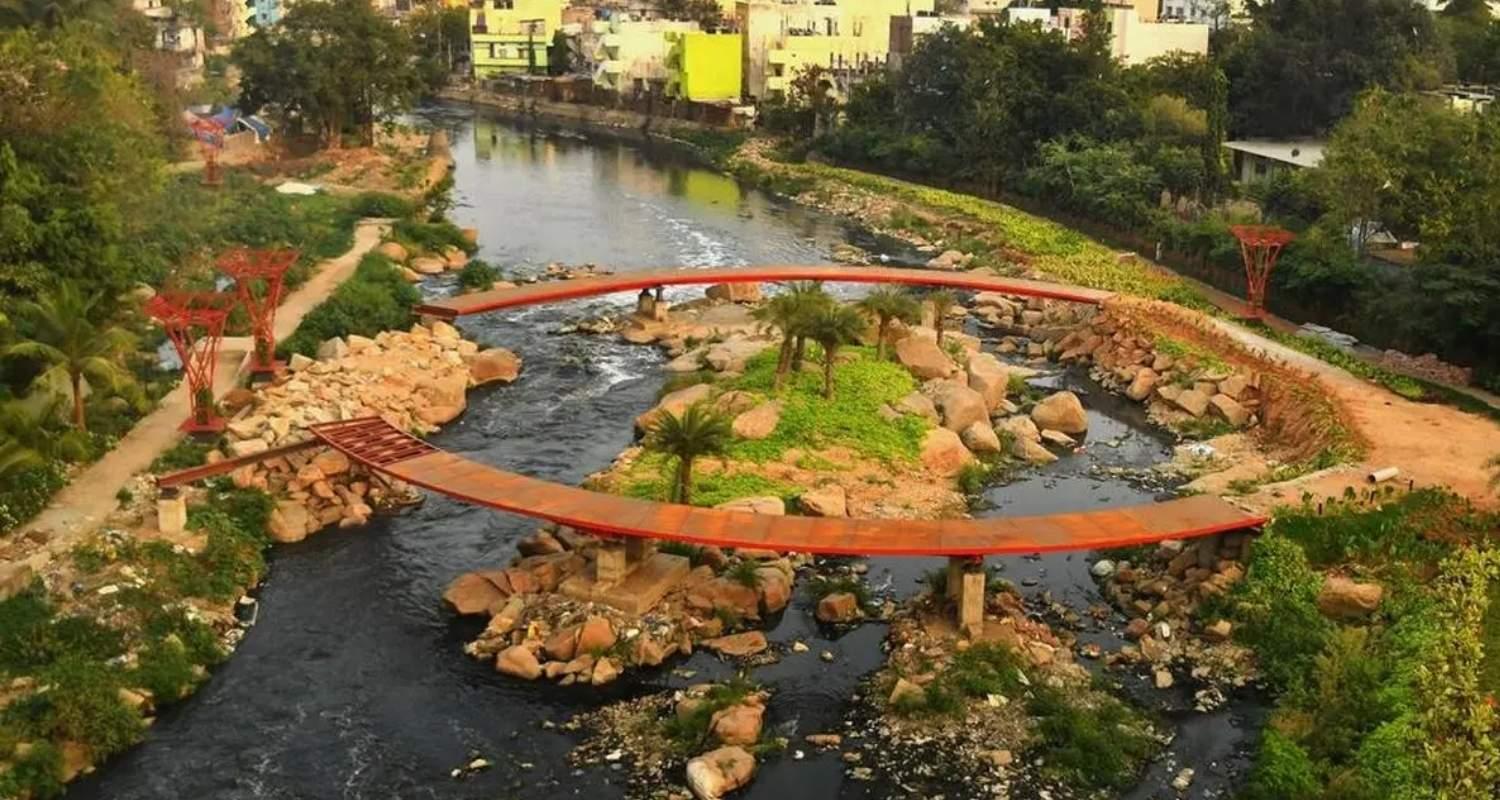
Hundreds of structures have come up on the river bed and the buffer zones over the last few decades. Removing these encroachments has become a major challenge for the government.
“Development versus environment” has been a contentious theme in India, often evoking a binary debate that follows a standard template: Those in the government chant development mantra to push for the ambitious, multi-crore projects while the opposition parties, civil society organisations and the environmental groups invoke doomsday scenarios to oppose them.
Musi Riverfront Development project, the flagship initiative of the Congress government in Telangana, is following a similar pattern.
Despite conceiving the project when it was in power from 2014 to 2023, the Bharat Rashtra Samithi (BRS), now in the opposition, is fiercely opposing it, dubbing it as a ‘real estate scam to benefit the ruling party leaders.’
The project is aimed at rejuvenating and beautifying Musi river that flows through Hyderabad and adjoining districts.
In the first phase, the government proposes to develop the 55-km-stretch of the Musi River in Hyderabad on the lines of Sabarmati Riverfront Project of Gujarat and Hooghly Riverfront Project of Kolkata.
As part of Musi riverfront project, a tourism circuit will be designed by connecting the historical buildings – Charminar, Taramati Baradari and other tourist places situated along the Musi catchment areas.
Displacement concerns
The project has run into trouble over the displacement of those living along the Musi basin and allegations of inflated costs.
Ironically, a state steeped in debt is seeking to clear encroachments along 46 colonies to release high-value riparian land. Moreover, Phase 1 of the project alone is estimated to cost Rs 6,500–7,000 crore.
However, there is no published Operation and Maintenance (O&M) financial model nor has the government identified a dedicated revenue. No institutional budget allocation has been proposed. International riverfront projects that succeeded did so because O&M was designed into financial architecture from day one.
Questions are being raised over how the government planned to mobilise nearly Rs 1.5 lakh crore for the project while citing lack of funds to implement poll guarantees.
Real estate venture
It is alleged that the government is undertaking large-scale land acquisition in the name of river rejuvenation to benefit private real estate companies.
Notices were being issued to thousands of families even in areas up to five kilometres away from the river, creating panic among residents.
The government notified about 3,297 acres affecting nearly 10,000 households in its gazette notification, but has now informed the House that only about 1,400 houses would be impacted.
Hyderabad deserves development, but not at the cost of deception, the opposition parties and social activists argued. River rejuvenation is essential, but not by flooding citizens out of their homes.
The choice before Telangana is stark: Will Musi become a model of equitable urban renewal? Or will it be remembered as a monument of betrayal, where beautification was pursued through destruction?
The BRS and other opposition parties have thrown their weight behind the people whose houses face the threat of demolition to make way for the project.
Hundreds of structures have come up on the river bed and the buffer zones over the last few decades. Removing these encroachments has become a major challenge for the government.
The Musi Riverfront Development Corporation Limited (MRDCL) officials had conducted a drone survey and identified 10,600 houses and structures along the 55 km stretch. These structures were in the riverbed and buffer zone limits and had to be relocated.
However, the Managing Director of MRDCL and secretary of the Municipal Administration and Urban Development Dana Kishore has assured that not a single family would be evicted forcefully and all oustees would be provided two-bedroom apartments, each worth Rs 25 lakh to Rs 30 lakh.
Notices to people
The MRDCL has issued a notification asking the affected property owners to approach the corporation or the Greater Hyderabad Municipal Corporation (GHMC) and express their willingness for the issue of Transferable Development Rights (TDR) in lieu of surrendering their properties in the Maximum Flood Level (MFL) or Buffer zones of the River.
Also read: Kaleshwaram project: CBI probe, masterstroke or strategic error?
The MRDCL is planning to develop the Musi Riverfront project spanning 55 kilometers from Gandipet to Gowrelly covering 46 villages in 14 mandals of Rangareddy, Hyderabad and Medchal Malkajgiri.
It has proposed a comprehensive development covering a 50-metres buffer area on either side along the river.
The entire project has been divided into five zones. The government has engaged Meinhardt Singapore Private Limited, Cushman and Wakefield India Private Limited and RIOS Design Studio Private Limited consortium to prepare an “Aggregate Master Plan for Musi Riverfront Development” project.
The landowners from Himayathsagar to Gandhi Sarovar (Phase I A) and Osman Sagar to Gandhi Sarovar (Phase IB) can avail of the TDR benefits in lieu of voluntarily surrendering their affected lands.
The government had announced that the Asian Development Bank (ADB) had agreed to fund Rs 4,100 crore for the Musi Rejuvenation project. In addition, the State government had also approached the Ministry of Jal Shakti for funding Rs 3,188 crore for the project under the National River Conservation Plan.
India’s biggest scam
The BRS has dubbed the project as the country’s biggest scam, alleging that it is being used by the Congress leaders to funnel funds into the party’s election campaigns across various States.
Questioning the decision to escalate the project cost to Rs 1.50 lakh crore, it warned that it would be a disaster.
The government is drawing up plans on the lines of London’s Thames project. As part of it, recreation zones, public plazas, children's theme parks, and entertainment zones will be developed.
The Musi River is an integral part of Hyderabad’s history; it reflects the city’s very soul. Protecting the river is, in essence, protecting the city itself. Once a vibrant source of sustenance and a major tourist attraction, the Musi has, due to decades of neglect, encroachment, and the influx of sewage, degenerated into a cesspool. Today, there is a universal aspiration among the public to see this river rejuvenated.
Following the formation of Telangana in 2014, efforts to restore the Musi gained momentum. With the establishment of sewage treatment plants, the foul odour from the river has significantly diminished in several areas.
As part of its urban infrastructure initiatives, the previous BRS government formulated a comprehensive plan to revitalise the river, allocating Rs 16,000 crore. Under this, beautification works spanning approximately six kilometres in the Uppal and Nagole areas were completed.
This project included sewage treatment plants, expressways, check dams, parks, and cycling tracks. A strategy was devised to channel fresh water from the twin reservoirs, dating back to the Nizam era, and utilise waters from the Krishna and Godavari rivers when necessary. The overarching goal was to restore the river to its former glory.
Massive cost
However, the massive Rs 1.5 lakh crore budget proposed by the current government has raised serious concerns with intellectuals, economists, and the general public raising a pertinent question: if a mega-project like ‘Namami Gange’—which spans several hundred kilometres—costs Rs 42,000 crore, why does the Musi—stretching just 55 km—require Rs 1.5 lakh crore?
Any development initiative must ultimately serve the people. However, the decision to demolish the homes of thousands of poor families under the guise of the ‘Musi Project’ has met with strong opposition. Affected residents and opposition parties argue that issuing sudden notices under the pretext of a ‘buffer zone’ without conducting a Social Impact Assessment and consulting stakeholders is unjust.
No other riverfront development project has ever involved land acquisition on such a massive scale. The proposed acquisition of 3,300 acres has raised fears that the project prioritises commercial development over environmental restoration.
The government’s strict stance on demolishing homes of the poor, contrasted with its apparent leniency toward influential individuals and developers, raises questions about fairness.
Allegations that the project is driven by real estate interests—particularly regarding the acquisition of 3,300 acre—have gained traction. Excessive spending on consultancy firms, coupled with a lack of transparency, has further complicated the situation. If this initiative is truly being undertaken for the benefit of the city and for the rejuvenation of Musi, why not adopt the earlier Rs 16,000 crore plan, which avoided public displacement?
Lessons from other projects
In Ahmedabad’s Sabarmati Riverfront project, a relatively small number of people were relocated and provided improved housing. Of the 202 hectares reclaimed, only 14 per cent was sold to private developers; the rest was developed for public use, specifically for the creation of parks, roads, and public plazas. The first phase of that project, spanning 11 km, was completed without imposing a financial burden of even a single rupee on the government. Similarly, Pune’s Mula-Mutha Riverfront project, costing Rs 4,727 crore over 44 km, focuses on green infrastructure, urban forests, and flood-resilient design.
In Seoul, the Cheonggyecheon Stream restoration—spanning 10.9 km—was completed at a cost of approximately Rs 3,100 crore and stands as a model of sustainable urban renewal. Ironically, a Congress government delegation, comprising ministers, had visited the city to study the project.
Riverfront development projects undertaken in recent times have emphasised environmental conservation, providing citizens with a healthier natural environment. In contrast, the Musi project appears to prioritise land acquisition and commercialisation, including plans for a “night economy”.
The rejuvenation of the Musi is not merely an infrastructure project; it is deeply tied to the identity and sentiments of Hyderabadis. While cleaning the river and preventing floods are essential, such efforts must not come at the cost of human suffering. Saving the river is tantamount to saving the city itself. And saving the city implies safeguarding its people, their habitats, and their homes.
