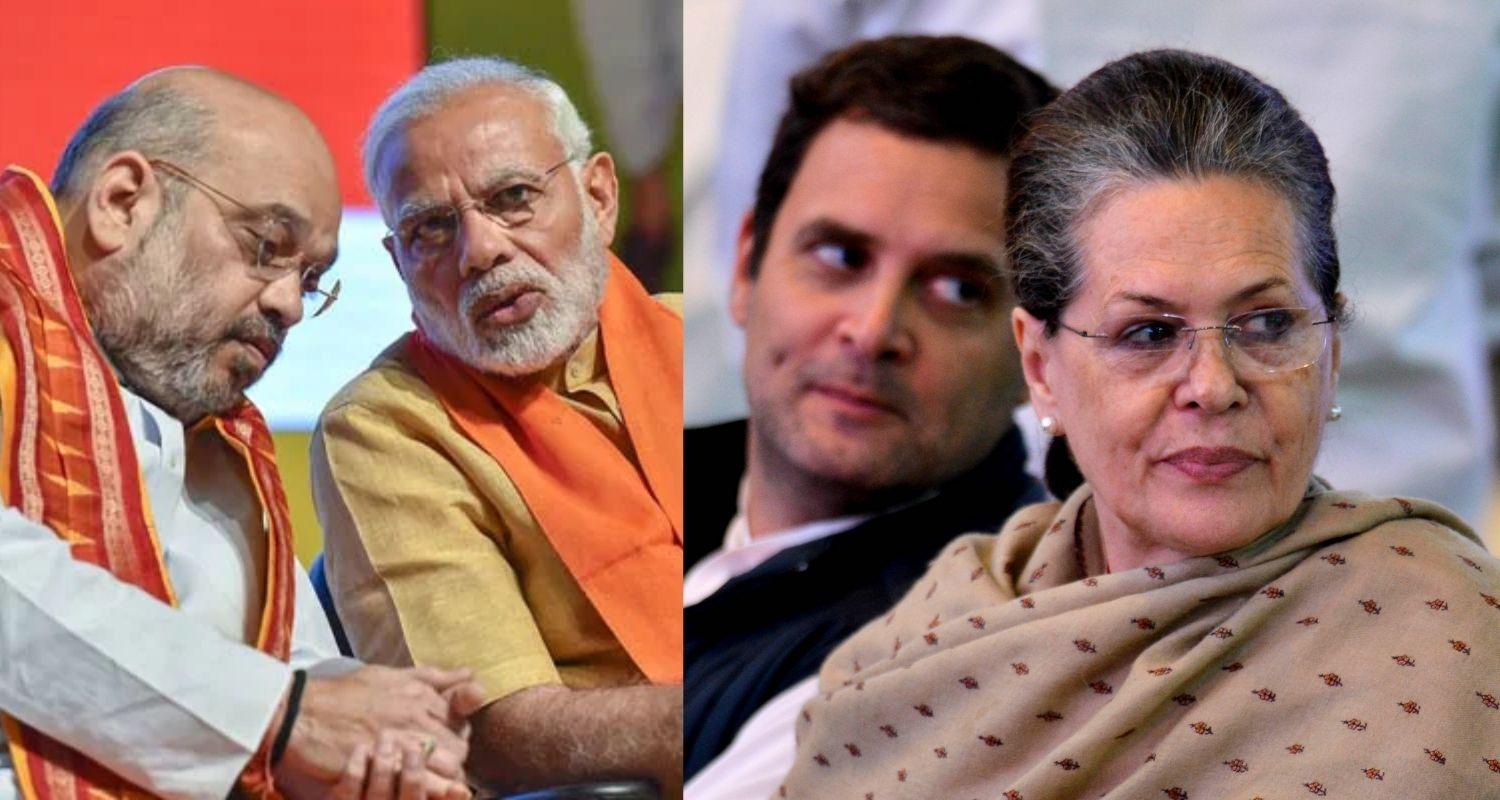
Recently, veteran Congress leader Digvijaya Singh created a storm by suggesting that there was too much centralisation of power in his party. He drew comparison between his party and the Bharatiya Janata Party, which according to him, does not have over-centralised power. He also posted an old picture of Prime Minister Narendra Modi sitting on the floor while LK Advani and others were occupying chairs.
There indeed is over-centralisation of power and authority in the Congress. But the Congress is not an exception when it comes to over-centralisation of power; all political parties are like that. The BJP is probably more centralised today than the Congress. So are other family or personality driven parties like the Aam Aadmi Party, Shiromani Akali Dal, Trinamool Congress, Samajwadi Party, Rashtriya Janata Dal and Dravida Muntera Kazgham.
Shiromani Akali Dal, however, was not like that in the past. It became a family driven party in the recent past when the party came under the control of the powerful Badal family.
But parties like the AAP, TMC, SP, RJD or DMK are not affected by over-centralisation since these are all like “one man/woman” show. In fact, the strength of these parties lies in centring all authority in a single person with whom the fate and destiny of the party is intertwined. There are no competitors or challengers to the power within the party.
This also has the grave risk of the party declining, if not dying instantly, along with the leader around whom all power and authority is centralised. The RJD in Bihar and Indian National Lok Dal in Haryana are important examples. The two parties once having stalwarts like Lalu Prasad Yadav and Om Prakash Chautala as their leaders have declined to insignificant players after the leaders got weakened for multiple reasons. Incidentally, both the leaders had to spend a long time in jail after getting convicted in different scams.
The Congress party’s problem is now proved, accepted and acknowledged. And the problem in the Congress is not over-centralisation alone. The party, like the regional and family driven parties, has also been centred around a single family, where fortunes of the entire organisation have been linked with the fate of the family. If there must be a president, it has to be from the family. Even when a president was “elected” from outside the family, there was hardly any doubt in anybody’s mind as to who elected him and who is actually in control of the things in the organisation.
Over-centralisation works as long as the “power centre” is strong and powerful. The Congress is at its weakest this time. No matter how much “power” is centred round the person in command, as long as it does not have enough punch and bite, it serves no purpose. Take the example of Karnataka and Telangana where both the chief ministers are over-asserting themselves and overplaying their cards in the safe knowledge that they may not be harmed whatever they do. Had there been a perception that the central leadership is strong and powerful, no chief minister would dare to go his own way.
Also read: Digvijaya bells the cat in Congress
In fact, Digvijaya Singh’s advice should be heeded equally in the BJP quarters as well. That everything is going on well and every move is leading to success does not mean that it will hold on forever. There is as much centralisation in the BJP as is in the Congress. Everything seems and sounds good as the party is in power right now and has a charismatic leader in Prime Minister Narendra Modi as its face.
No political party can solely survive on the charisma of a single leader forever. The party will need to be strengthened at the grassroots levels along with strong and powerful regional leaders capable of delivering. The BJP as an organisation appears to have grown too much dependent on Prime Minister Modi.
Like the current plight of the Congress is due to a combination of many factors, the massive strength of the BJP is also a combination of many forces and factors. These factors are never constant but variable for both the situations. Like the Congress has to learn a lot from the BJP about how to strengthen the organisation, the same is the case for the BJP that it must take cautionary lessons from the Congress as how not to weaken the organisation.
Over-centralisation is one of the main reasons, though not necessarily the only reason, that eventually leads to the decline and downfall of political parties, which is never good for the democracy and country.
Indian political system has evolved and emerged in such a way that the political parties, barring a few exceptions, end up as private proprietorships of individuals and families. Besides over-centralisation, it also makes political participation and representation limited and restrictive, besides exclusive discretion of a select few who do not like to share the power with anyone else after having grabbed it.

 Follow us