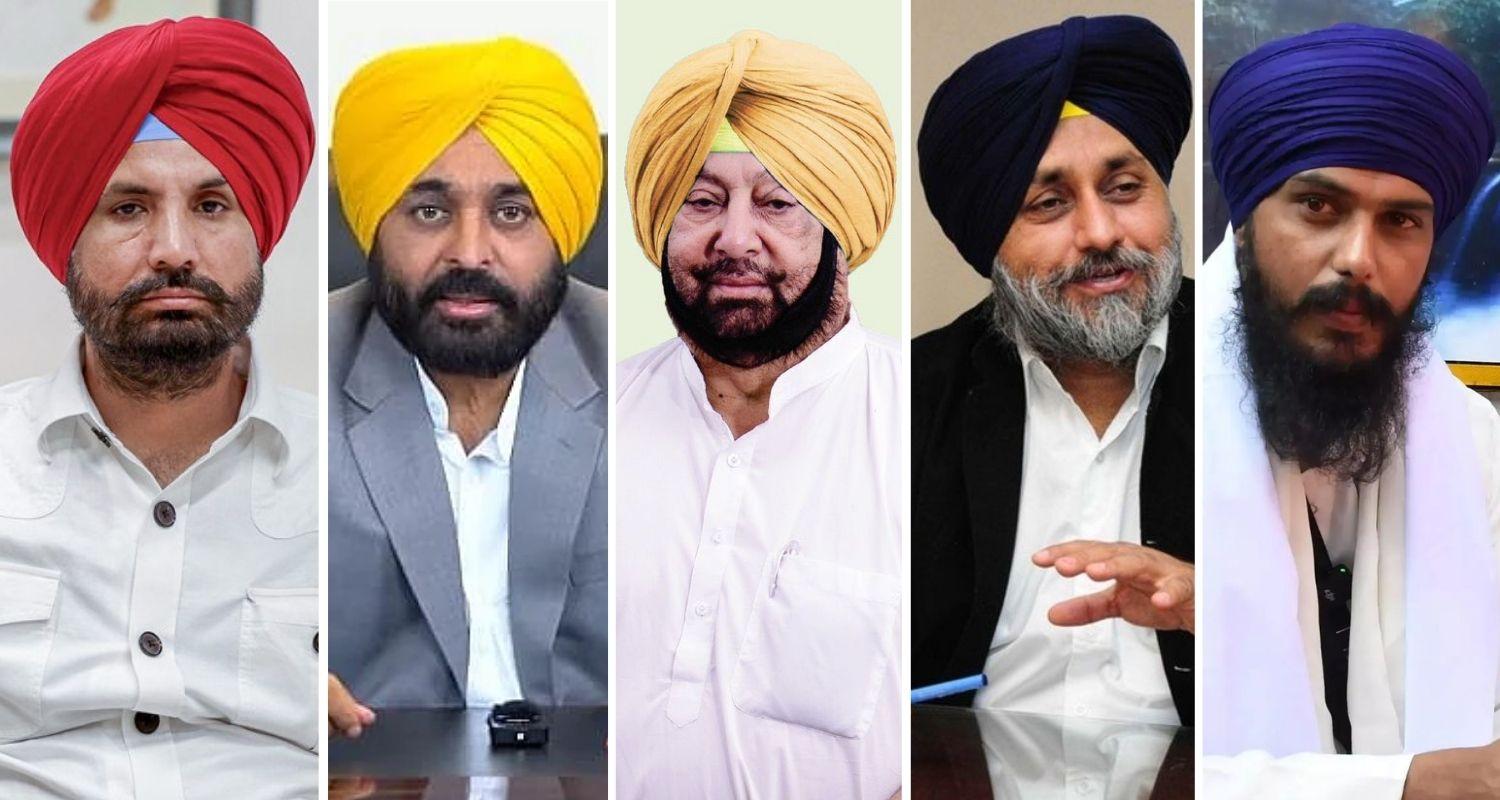
Punjab, in 2027 assembly elections, may see a multi polar five-cornered contest, if the situation continues as it prevails right now.
There is continuing uncertainty about the Congress leadership in Punjab. While the Bharatiya Janata Party settled the leadership issue, it caused multiple ripples. The Shiromani Akali Dal is trying to regroup itself amidst a stiff challenge from the ruling Aam Aadmi Party. The AAP also has suffered a severe setback with desertion by seven Rajya Sabha MPs who joined the BJP.
With state assembly elections just seven months away—if these are not advanced due to the census—the political parties in the state should be busy designing and strategising their campaign. But that does not seem to be the case as the four major parties—the Congress, the AAP, the BJP and the Akali Dal are still far from getting into the election mode. Besides, there is a fifth player, Waris Punjab De, a group of radicals with Lok Sabha MPs and one MLA in support.
Also read: Punjab parties can ignore BJP challenge at their own risk
The Congress has so far not settled the leadership issue, which has led to uncertainty within its ranks. Incumbent state president Amarinder Singh Raja Warring has been in the saddle since 2022. He was appointed immediately after the elections. His performance has been reasonably good in the Parliamentary and the municipal corporation elections. The Congress, under his leadership, won seven of the 13 Parliamentary constituencies in Punjab. The ruling AAP won three, the Akali Dal one and the independents won two.
Although the Congress could not appoint any mayor in the four major municipal corporations of Patiala, Jalandhar, Ludhiana and Amritsar, it managed to win the maximum number of wards.
Among the five contenders for the chief ministerial position in the Congress, Warring is the youngest. The others include Charanjit Singh Channi, former chief minister, who served for six months after Capt Amarinder Singh was unceremoniously removed; Partap Singh Bajwa who considers this to be his last chance; Sukhjinder Singh Randhawa, former deputy chief minister, and Rana Gurjeet Singh.
Although being the PCC president does not guarantee the chief ministerial position, it does improve the probability. That is why Warring’s rivals are keen to get him replaced. Although AICC general secretary in charge of Punjab Bhupesh Baghel has repeatedly asserted that there will be no leadership change, for quite some time there are reports in the public domain that Warring may be replaced. This has led to a lot of uncertainty. The leadership needs to clarify it at the highest level and even in case it proposes any change, it must do it immediately.
Also read: BJP’s radical outreach may have implications in Punjab
There is again uncertainty on part of the Bharatiya Janata Party about its alliance with the Shiromani Akali Dal. The two parties have remained alliance partners for a long time but parted ways during the anti-farm law agitation in 2020. Both the parties have fared badly after contesting independently, both in the assembly as well as the Parliamentary elections.
The senior BJP leadership has been maintaining that the party will contest on its own in all the 117 assembly segments. That is quite an ambitious target as the BJP has yet to find roots in most of the countryside across the state. A large section of the party leadership in Punjab, including Capt Amarinder Singh, is strongly in favour of an alliance with Akalis. The two of them together can be a formidable force, but if they contest separately, none of them stands any chance.
While the public posturing by senior leaders has been that the party will contest all the seats, privately some of the leaders admit that the option of going for an alliance with the Akalis is not closed. For the Akalis also, contesting alone will be the most difficult proposition.
Also read: Kewal Dhillon: BJP’s choice surprising but calculated
For the ruling AAP, the picture is not rosy either. In the 2024 general elections, it won only three of the 13 seats with a vote share of 26 per cent, little less than the Congress. It led from 34 assembly segments, a fall of 58 seats from its 2022 tally. Besides, the exodus of seven RS members to the BJP, six of them elected from Punjab, has been a severe setback for the party. Added to all this is anti-incumbency, which its rivals do not face. Moreover, barring once, Punjab has always replaced the incumbent government.
There is a fifth force in Punjab, represented by Waris Punjab De, formed by the supporters of jailed Khadoor Sahib MP Amritpal Singh, who won in 2024 while incarcerated. Another independent MP Sarabjeet Singh Khalsa from Faridkot is also aligned with the Waris Punjab De. Sarabjit is the son of one of the assassins of Prime Minister Indira Gandhi. These two MPs may not be able to repeat their 2024 performance, but they will definitely be a factor in at least two dozen Parliamentary constituencies. Besides, senior Akali leader and three-time MLA Manpreet Ayali has also joined this party.
Till now, Punjab has never thrown a hung verdict. However, given the situation prevailing right now, with a four or five-cornered contest in the offing, the outcome is going to be quite uncertain. Mostly, it melts down to two or three-cornered contest only as some players get eliminated by the final round, in the existing scenario, that looks quite unlikely.

 Follow us