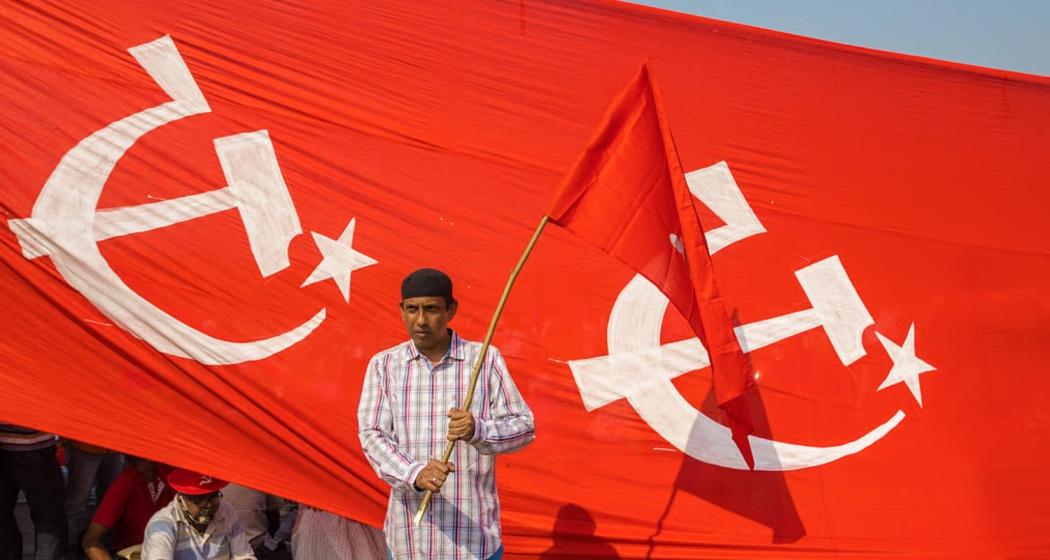
Not long ago, communist ideology had an all-pervading impact on Indian society, be it in public policy, academia or the media. Widely seen as public intellectuals aligned with the causes of the poor and working classes, leftists had long ensconced themselves in a bubble and enjoyed a disproportionate influence over public discourse. Any dissenting voice would be dismissed as regressive or bigoted.
However, a tectonic shift has now altered the country’s political landscape.
The steady decline of communist parties, which began more than a decade ago, has reached its nadir. For the first time in over 50 years, Left parties are not in power in any state. With the defeat of the Pinarayi Vijayan-led Left Democratic Front (LDF) government in Kerala, the decimation is complete.
The southern state was the last bastion to fall, following electoral losses in erstwhile strongholds such as West Bengal and Tripura. Ironically, Kerala was India’s first communist-ruled state, from April 1957 to July 1959, before being dismissed by the central government.
The Left, once the third-largest bloc in Parliament and in power in three states, has now virtually vanished from the country’s political landscape.
Dollops of dogma
The depletion is not just about numbers in legislatures but also about ideas and their relevance.
The fall has neither been dramatic nor sudden, nor the result of a single catastrophic event. It is the culmination of a series of lapses and tactical mistakes. Signs of decay had been visible for years, but the ideological rigidity of the party apparatchiks prevented meaningful internal reforms.
A clear disconnect with the aspirational middle class, continued peddling of worn-out Cold War-era narratives fuelled by anti-Americanism, failure to recognise the role of private enterprise in wealth creation and distribution, hostility towards the corporate sector, and opposition to new technologies and major projects are among the factors that contributed to the Left’s declining relevance.
Left parties also repeatedly failed to promote popular regional leaders with a strong grassroots connect. Instead, central leadership dominated by rigid ideologues dictated the party line and enforced it strictly.
A classic example was how the CPI(M) handled veteran leader and West Bengal Chief Minister Jyoti Basu. He had the opportunity to become Prime Minister in 1996 following a fractured mandate, but the party rejected the idea, a move Basu later described as a “historic blunder”.
Also read: CPIM opposes ban on 25 books in J&K
Disconnect with the middle class
Once considered a natural ideological attraction for the youth, communism lost its appeal in the post-liberalisation era. The aspirational generation has increasingly viewed Left ideology as outdated and disconnected from contemporary realities.
From mobilising protests against computerisation in banks and public sector undertakings to resisting economic reforms, Left parties have often refused to adapt. Their failure to acknowledge the role of caste in political mobilisation has also been a significant lapse. A lack of imagination and a shortage of young leadership have further weakened the movement.
A gerontocratic structure, in which senior leaders held on to power and limited opportunities for younger members, led to organisational stagnation. Meanwhile, India’s rapid economic growth made traditional anti-capitalist ideology appear increasingly anachronistic.
Economic liberalisation in 1991 opened India to global capital, expanded the footprint of multinational corporations and reshaped the workforce. The traditional trade union leadership failed to grasp this shift in class composition, continuing to rely on outdated rhetoric.
Former CPI(M) general secretary Sitaram Yechury had candidly admitted that the party had “lost touch” with ground realities in its strongholds. Known for his pragmatic approach, he acknowledged that while the party retained credibility on economic issues, it failed to inspire confidence on social justice concerns.
He also admitted that the party’s top-heavy, overly centralised structure caused resentment within lower ranks, undermining internal democracy.
Kingmakers
In the decades following independence, communist parties played a significant role in shaping India’s economic direction. At one point, they were key power brokers in national politics.
With over 60 seats in Parliament, they provided crucial outside support to the UPA government in 2004 and claimed credit for shaping welfare policies such as MNREGA. Their withdrawal of support over the India-US nuclear deal marked the peak of their influence.
However, the decline accelerated in 2011 when the Left Front lost power in West Bengal, ending a 34-year rule. The defeat in Tripura in 2018 further weakened their position.
Now, questions arise as to whether the sun has set on Indian communism.
The Left must reinvent itself to remain relevant. Its challenge lies in shedding ideological rigidity, adapting to contemporary realities and nurturing new leadership.
As Shashi Tharoor observed, “The Indian Left has struggled to find a new vocabulary for a ‘New India’. To a young coder in Gurgaon or a delivery driver in Kolkata, rhetoric opposing liberalisation or capitalism can sound less like protection from exploitation and more like a barrier to opportunity.”
The Left must move beyond its 20th-century framework and reposition itself as a social democratic force suited to 21st-century India.

 Follow us