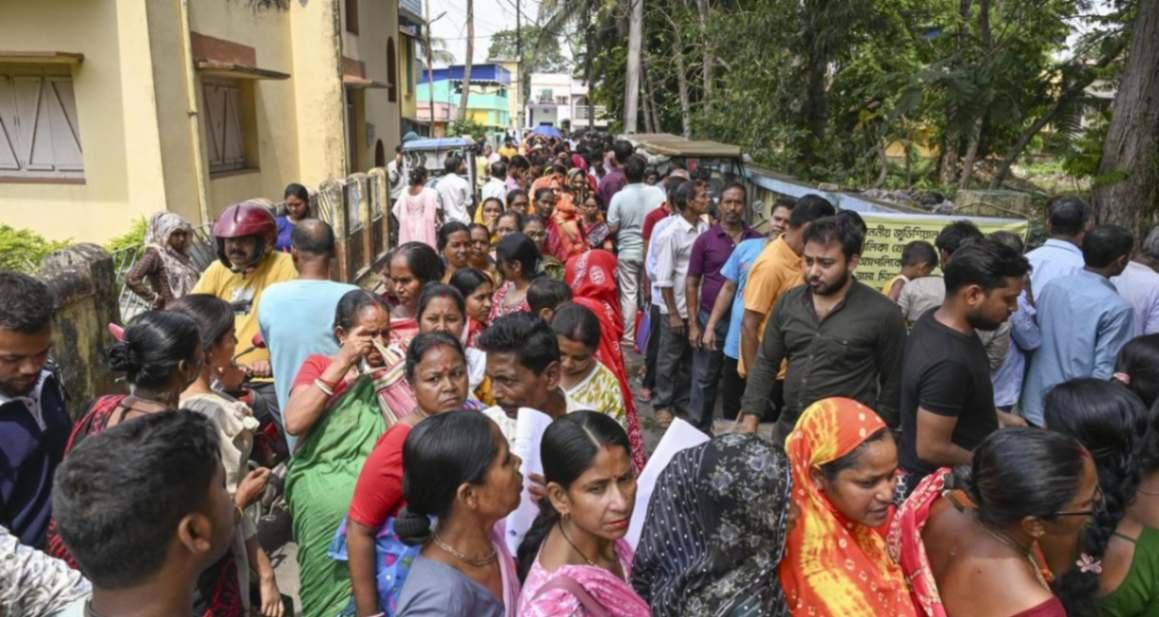
Record voter turnout since Independence in the states of West Bengal and Tamil Nadu during Assembly Polls 2026 on April 23 became the talk of the nation. While the ruling parties in both the states were fighting to stop the saffron wave, the turnout — in the most acceptable voter-mandate equation — signals something which would not go down well either with the Trinamool Congress or the Dravida Munnetra Kazhagam.
More voter turnout suggests anti-incumbency. However, with changing times, this formula is losing its relevance. As in several cases, large voter turnout has not always resulted in calling the curtains for the ruling party in the state.
As far as Bengal is concerned, it is viewed as the ‘ultimate frontier’ in the East for the Bharatiya Janata Party. Hence, the number of rallies, frequency of party’s top brass campaigning in the state and the duration of campaign made Bengal appear as the BJP’s top-notch priority among four states and one Union Territory that went to the polls this year.
In an attempt to give a benefit of doubt to the saffron party, one can justify the duration of the campaign. The other three states and one UT voted in single phases, so the party did not have much time to divert its forces there. But, West Bengal was going to polls in two phases, the saffron clan, hence, came down with its full might. So — on a positive note — the BJP had the opportunity over choice. But was the ‘opportunity’ created by ‘choice’? The answer to this can remain open-ended!
Cut to the poll-participation aspect in West Bengal. The state has always maintained a positive trend in this regard. In 2011 — when CM Mamata Banerjee ended the Left regime’s 34 years of rule in the state — the turnout percentage of voters was 84.33. It was 86.25 per cent in 2016, when Mamata was re-elected to power. In 2021, Mamata being elected as the Chief Minister for the third consecutive term was supported by the electorate with the voting percentage recorded at over 80. And in 2026 (Phase-1), it crossed 90 pc.
The people of Bengal, unequivocally, know how to celebrate the festival of democracy. And are 'simultaneously' volatile enough to defy the perceived calculation behind voter participation and mandate.
The ‘fear’ factor
This time, the spectrum of West Bengal’s politics had a ‘wildcard’ entry in the form of SIR (Special Intensive Revision). A tool, which appeared like a double-edged sword. It had the capability to harm the TMC by portraying it to be the party, which feeds on fake voters, thereby encouraging illegal migrants who are creating a dent in the rights of the state’s citizens.
The TMC, on the other hand, did not miss the opportunity to use this in its favour where it labelled the mammoth exercise as a means to harass locals and common people by striking off their names from the voter list.
While both the primary contenders of West Bengal 2026 poll battle have used the measure to gain brownie points for themselves, the SIR appears like a wake-up call for those who were reluctant to ever exercise their adult franchise.
The perceived ‘fear’ of losing out on one’s citizenship or getting their names deleted from the electoral list brought them to the polling booths. The SIR, henceforth, could have come up with its own share of pros and cons for the TMC and the BJP. However, it worked as the impetus for the reluctant voters, thereby leading to record turnout. It can be projected that the voters of Bengal would not disappoint the Election Commission in the second phase of polling on April 29.
BJP’s Bengal campaign lost the plot?
Among political analysts, whether or not the BJP ‘lost the plot’ in Bengal is currently the subject of debate. While the party’s campaign was more aggressive and high-profile, several factors suggest their strategy struggled to pave its way, failing to capitalise on the anti-incumbency factor in the state.
The SIR exercise was intended to be the BJP’s strongest card. However, it can backfire.
The deletion of 9.1 million names, almost 12 pc of the electorate — in the 2021Assembly polls, there were 7.34 crore eligible voters — allowed the TMC to frame the BJP as an ‘anti-Bengali’ force. Even if the deletions were administrative, the perception of ‘political genocide’ — as mentioned by many — may have unified the minority and border-district voters in a way the TMC alone could not have managed.
Reports claiming that 63 pc of the deleted voters were Bengali Hindus may have complicated the BJP’s narrative. This shows that instead of only targeting ‘infiltrators’, the exercise hit the BJP's own potential base, leading to confusion and resentment in key pockets of the state.
While the BJP brought in heavyweights, namely, Prime Minister Narendra Modi, Amit Shah, Yogi Adityanath and some others, this suggested a ‘vacuum’ in their local leadership. Owing to this, the TMC’s bohiragoto (outsider) campaign — labelling BJP leaders as people who do not understand Bengal’s culture — seemed to stick more effectively in 2026.
In Kerala and Tamil Nadu, the BJP stressed on a ‘development-first’ pitch. In Bengal, they again pivoted heavily back to polarising identity issues. For certain segments of the youth and urban voters may have focused on jobs and the RG Kar issue, the shift back to ‘Mandir-Masjid’ rhetoric may have felt like a step backward.
The historic turnout in Phase-I, thus, can be often interpreted in two ways. First, the high turnout in Bengal favours the incumbent (TMC) which is driven by a sense of fear and protection of one’s rights, suggesting that the high voter turnout was a defensive reaction against the SIR.
Second, the BJP, conversely, argues that the high turnout is an ‘anti-incumbency’ wave as voters, finally, aim to ensure a ‘double-engine’ government in Bengal.
The BJP targeted the TMC on corruption. However, they struggled to counter the tangible impact of the TMC’s welfare schemes such as ‘Lakshmir Bhandar’, ‘Swasthya Sathi’, ‘Kanyashree’ and others, thereby engaging in negative campaigning rather than focusing on substantive issues.
By focusing more on the ‘illegal migrant’ issue than on a concrete ‘alternative welfare’ model, the BJP may have failed to sway the voters. Now, whether or not, this was a tactical miscalculation, the answer to this will ultimately lie in the May 4 results.
Also read: No infiltrators in Bengal after BJP win: Amit Shah

 Follow us