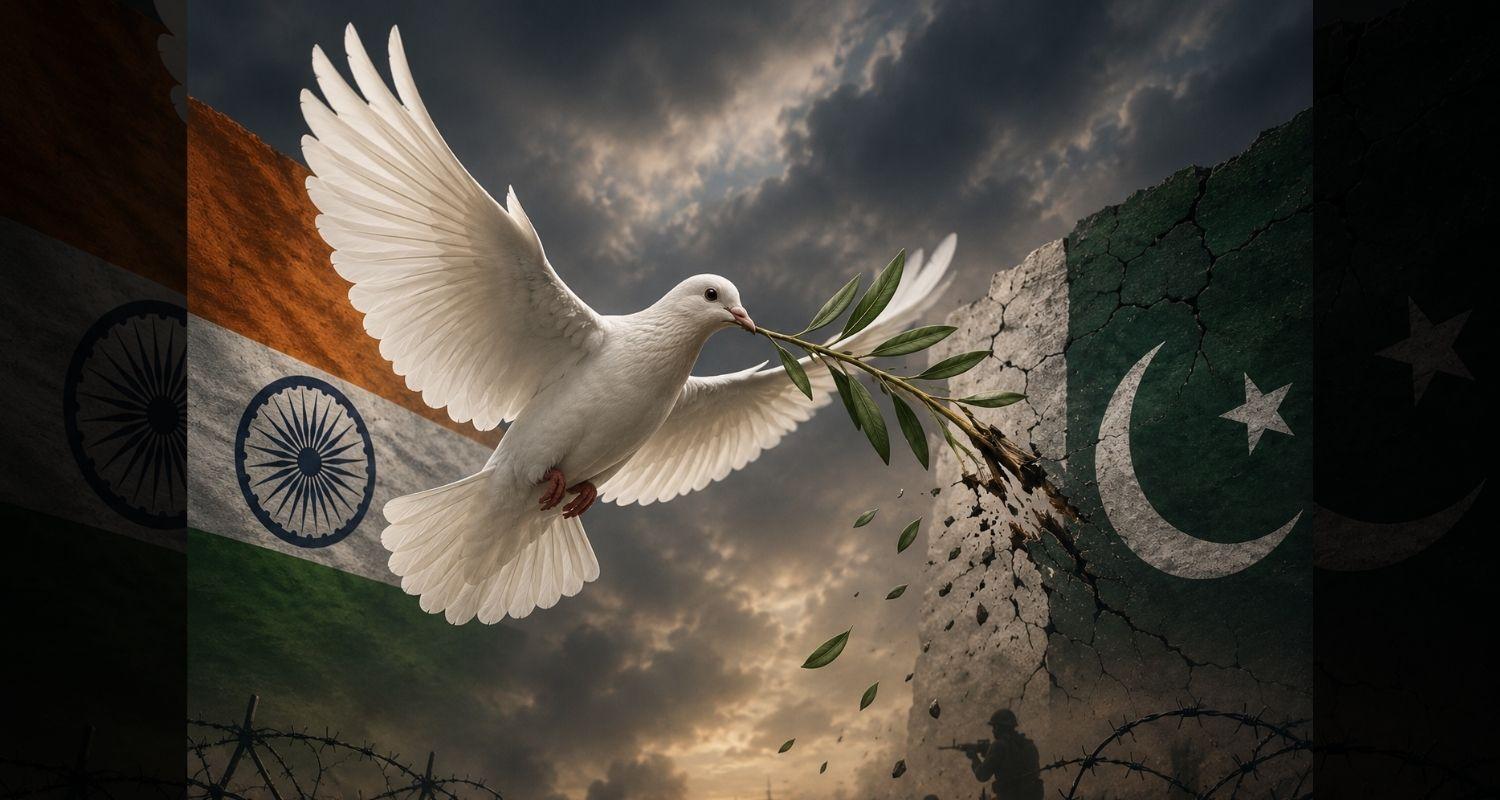
Writing letters to the Indian and Pakistani Prime Ministers urging them to initiate dialogue to restore peace makes good headlines, but it is not workable. It never will be, as long as someone like Asim Munir, aka Mullah Munir, the self-anointed Field Marshal of Pakistan, is at the helm. And there will always be someone like him at the helm in Pakistan who will never let peace prevail between the two countries. Munir, given his special proximity to US President Donald Trump, who describes him as his "Favourite Field Marshal", will never let any peace proposal even be considered, let alone see it through.
The harsh reality is that Pakistan’s military establishment has never come out of its pathological hostility and hatred towards India. Mullah Munir makes no secret of it. His infamous address to Non-Resident Pakistanis, just a week before the Pahalgam terror attack, is reflective of the policy he wants to pursue towards India. It is good that the current Indian establishment has realised that there is no scope for peace with Pakistan. A country that was born out of deep hatred for Hindus is surviving on that hatred. As Mullah Munir said in his speech, Hindus and Muslims are two separate people and cannot live together.
The current push for "peace talks" apparently emanates from the pressure Pakistan has started feeling after India put the Indus Waters Treaty in abeyance. India has rightly hit Pakistan where it hurts the most. The Pakistani government and civil society have grown so desperate that there are talks of even resorting to nuclear blackmail if India does not allow the flow of water to Pakistan. The "peace proposal" initiated by the, so far unknown, Centre for Peace and Progress does have a reason, and that reason is India's unilateral suspension of the Indus Waters Treaty.
The Indus Waters Treaty has actually been unfair to India. Under the treaty, Pakistan gets about 80 per cent of the water, while India gets only 20 per cent. Besides, the treaty, signed in Karachi by Indian Prime Minister Pandit Jawaharlal Nehru and Pakistani President Ayub Khan in 1960, was heavily biased against India. The treaty was mediated by the World Bank. Under the treaty, India gets water from the Ravi, Beas and Sutlej rivers, while Pakistan gets water from the Indus, Chenab and Jhelum. Besides, India also agreed at that time to make a massive contribution of 600 million pounds for the construction of canals and headworks in Pakistan.
The treaty was expected to generate goodwill between the two countries. But within less than five years, Pakistan started infiltrating insurgents into Kashmir, leading to the Indo-Pak War of 1965. India should ideally have suspended the treaty then and there. Instead, India not only allowed the flow of water but also continued making the instalments of the promised contribution even after the war.
It is for the first time that India has actually suspended the Indus Waters Treaty in the 66 years of its existence. Pakistan apparently never imagined that India could resort to such a measure, and it continued to abet terrorism in states like Punjab and Jammu and Kashmir, and it still continues. India suspended the treaty only after the Pahalgam terror attack that was orchestrated by Pakistan, with a curtain-raiser by Mullah Munir just seven days before the attack during his address to Non-Resident Pakistanis.
Indian Prime Ministers have always extended an olive branch to Pakistan from time to time. Prime Minister Atal Bihari Vajpayee travelled to Lahore by bus to meet his Pakistani counterpart Nawaz Sharif in 1999. While Vajpayee and Sharif were trying to build bridges, Pakistan’s then military chief, Pervez Musharraf, was planning the Kargil incursions and attack, which led to a direct conflict between the two countries.
Even Prime Minister Narendra Modi made a surprise visit to Lahore in December 2015 to greet Prime Minister Nawaz Sharif at his daughter's wedding. It was one of the greatest gestures of friendship. But again, this was reciprocated with terror attacks within less than a year in Uri and later in Pulwama. Modi had also invited Sharif to his swearing-in ceremony in 2014.
It is quite possible that Pakistan's political establishment may not be behind all this and that it is the military establishment that is orchestrating such a terror campaign against India. But that is no consolation for India and no reason to make any peace moves towards Pakistan. It is not just Mullah Munir, an ultra-orthodox Islamic extremist who is so radically hostile towards India; every Pakistani general has been like that.
It is not that the Pakistani political establishment will necessarily like to have peace with India. Even if it wants to, its own survival will be threatened. This is a harsh reality that everyone in India needs to accept: with Pakistan, there cannot be any peace. Pakistan will always be a rogue and hostile nation ruled by rogues like Mullah Munir. Hence, any attempt or suggestion to initiate peace will not only prove the complete naivety of those proposing it but will also be self-defeating.
No matter how much goodwill India shows towards Pakistan, its military establishment will always remain hostile towards India, especially when its army chief has become the favourite of the US President.
Also read: Pakistan objects India’s decision to revoke Indus Waters Treaty

 Follow us