
Trending:
Telangana caste survey reveals stark social disparities
A Telangana caste survey shows deep social disparities, revealing that poverty is closely tied to caste, with SCs and STs significantly more deprived than upper castes across income, education, housing and employment indicators. Follow us
News Arena Network - Chandigarh - UPDATED: April 18, 2026, 03:55 PM - 2 min read
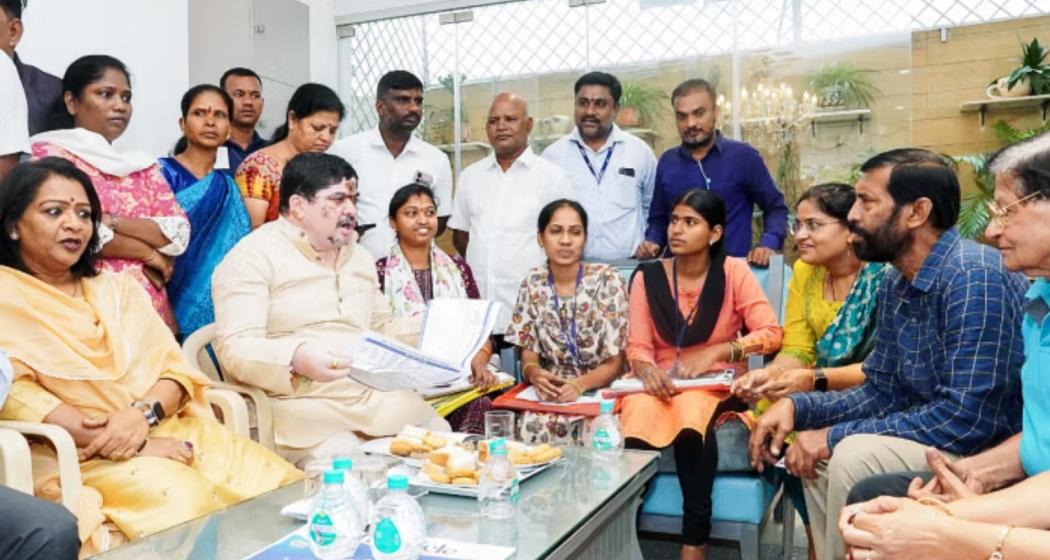
Telangana Minister Ponnam Prabhakar (with documents in hands) participate in a caste survey in Hyderabad. (Photo: ANI)
In his seminal work, “Annihilation of Caste”, Dr B R Ambedkar had argued that it was impossible for India to be a real and functioning democracy as long as the caste system was allowed to persist.
Nearly nine decades later, his prescription is still relevant for the country, as widening social disparities pose a major challenge to policymakers. A comprehensive caste survey and an analysis of its findings, commissioned by the Telangana government, have revealed stark realities of caste hierarchies in the state.
At a broader level, the Socio, Economic, Educational, Employment, Political and Caste (SEEEPC) survey has demolished a popular notion that poverty has no caste and that economic uplift alone is sufficient to address inequality. The findings have revealed that poverty is structurally, systematically and measurably aligned with social identity.
Covering nearly 3.55 crore individuals across 242 castes, this was the first comprehensive door-to-door caste survey of its kind in independent India. Its findings, analysed by an Independent Expert Working Group (IEWG) led by retired Supreme Court judge Justice B Sudershan Reddy, go well beyond a headcount.
They diagnose what the report calls the “disparity illness” of Telangana society, quantifying deprivation not just by income but across housing, education, employment, land ownership, access to credit and exposure to social discrimination.
One of the key findings is that the scheduled castes and scheduled tribes in the state are three times more backward than the upper castes.
Survey findings
Backward Classes (BCs) form the single largest social group in the state, accounting for 56.36% of the population. Scheduled Castes make up 17.4%, followed by Scheduled Tribes at 10.4% and General or Other Castes (OC) at 11.9%.
Among individual communities, the Madiga community, a sub-sect among the SCs, is the single largest caste group with 36.54 lakh people, constituting 10.3% of the population.
The Sugalis or Lambadis, also known as Banjaras, are the dominant Scheduled Tribe group at 24.02 lakh, comprising nearly 65% of the entire ST population in the state. The Yadava (Golla) community accounts for 20.17 lakh (5.69%), while the Reddy community, the most prominent among OC groups, numbers 17.06 lakh or 4.81% of the population.
The total Muslim minority population stands at 44.57 lakh, comprising 12.56% of Telangana’s population. Of these, 35.76 lakh are classified as Backward Class Muslims, primarily under the BC-E sub-category, with the Shaik community being the largest identifiable group within it.
Also read: Congress walks into BJP trap over delimitation
Backwardness Index
The experts’ group identified backwardness through a parameter called the Composite Backwardness Index (CBI), a statistically derived score ranging from 0 to 126, built from 42 equally weighted parameters across eight broad categories: education, occupation, living conditions, income, land and assets, gender, social discrimination and access to finance.
While the state average CBI score stands at 81, as many as 135 of the 242 castes, accounting for 67% of the total population, scored above this average, meaning they are worse off than the average Telangana citizen.
While SCs and STs are found to be three times more backward than OCs on this index, BCs are 2.7 times more backward. “On a population basis, 99% of STs, 97% of SCs and 71% of BCs fall below the state average in terms of social development,” the report said.
The SC Dakkal community recorded the highest CBI score of 116, making it the most deprived community in the state. The BC-A Pitchiguntla community followed at 110.
The expert group isolated households earning below Rs 1 lakh annually — the survey’s definition of the extreme poor — and then examined their outcomes across caste categories.
The results show that among this group of extreme poor, the CBI score for a Scheduled Caste family stands at 49, more than three times the score of 16 recorded for a General Caste family at the exact same income level.
This means that even among households that are equally poor by income, a poor SC family is significantly more likely to live in substandard housing, lack access to English-medium education, depend on informal moneylenders for credit, and face barriers to social mobility that their General Caste counterparts at the same earnings level simply do not encounter. Social identity remains a fundamental and independent barrier to development.
Visible face of deprivation
Housing quality is one of the most direct indicators of long-term socio-economic stability, and the survey data reveal a stark divide in the physical conditions in which different communities live.
While 78.4% of General Caste households in urban Telangana reside in flats and apartments, SC and ST populations are disproportionately concentrated in huts and asbestos dwellings. SC households exhibit a rate of substandard housing roughly three times higher than that of OC households.
Access to basic amenities compounds this gap further. While 82% of General Caste households have tap water within their homes, only 54% of SC households share this access.
The educational divide documented in the survey is quite stark.
One-third of General Caste children attend private schools. Fewer than 10% of SC and ST children have the same access.
While 66.3% of General Caste youth have been educated in English medium, only 36.6% of ST youth and 40.7% of SC youth have had the same access.
For SC and ST communities, state-funded residential Gurukulam schools remain the primary, and often the only, vehicle for professional aspiration. While these institutions provide a necessary safety net, they have not historically delivered the competitive edge required to break into the private sector at scale.
Over 56% of the state’s population has not studied beyond the 12th standard. Among SCs, the figure is 62.7%, and among STs it is 56.7%, effectively locking large sections of these communities out of skilled professional employment before they even enter the job market.
The occupational data in the survey offer the most direct evidence of structural inequality. The type of work a community predominantly engages in reflects, with striking consistency, its historical access to education, capital and social mobility.
Across the state, 45.7% of the SC workforce and 40.6% of the ST workforce are daily wage labourers. Among General Caste workers, the figure is 10.9%.
Agricultural labour, even within urban boundaries, remains a defining condition for marginalised communities. State-wide, 32.9% of STs and 31.7% of SCs work in agricultural labour, compared to just 5.5% of General Caste workers.
Child labour data add a further dimension of urgency. Approximately 89,000 children under the age of 18 are engaged as daily wage workers. The incidence is highest in the ST Kolam community at 7.2%, and SC Madiga children account for 14% of all child labourers in the state.
Small land holdings
The 178-page report of the expert panel disclosed that SCs have the highest proportion of small landholding households at 90.5%, followed by Backward Classes (BCs) at 85%, suggesting that most families in these groups rely on marginal plots that are often less productive and economically unsustainable.
In contrast, Other Castes (OCs) report a lower share of small holdings at 69.1%, indicating relatively greater ownership of medium and large land parcels. This structural advantage translates into better agricultural output, asset accumulation and financial resilience.
The disparity becomes more pronounced in the ownership of large landholdings, defined as more than 20 acres. The survey shows that 4.4% of OC households own such large tracts, the highest among all groups. Backward Classes and Scheduled Tribes account for 2.9% and 2% respectively in this category, while Scheduled Castes lag significantly behind at just 1%.
Though the overall share of large landholders is small, the comparative gap highlights persistent structural inequality. It said OCs are nearly twice as likely to own large landholdings as Scheduled Tribes, underlining their continued dominance in agrarian assets.
