
Trending:
TMC trying to make it Bengal versus Gujarat
The TMC has been in power in West Bengal for three terms now. It is faced with a strong anti-incumbency sentiment after 15 years of rule. Follow us
News Arena Network - Chandigarh - UPDATED: March 30, 2026, 06:38 PM - 2 min read
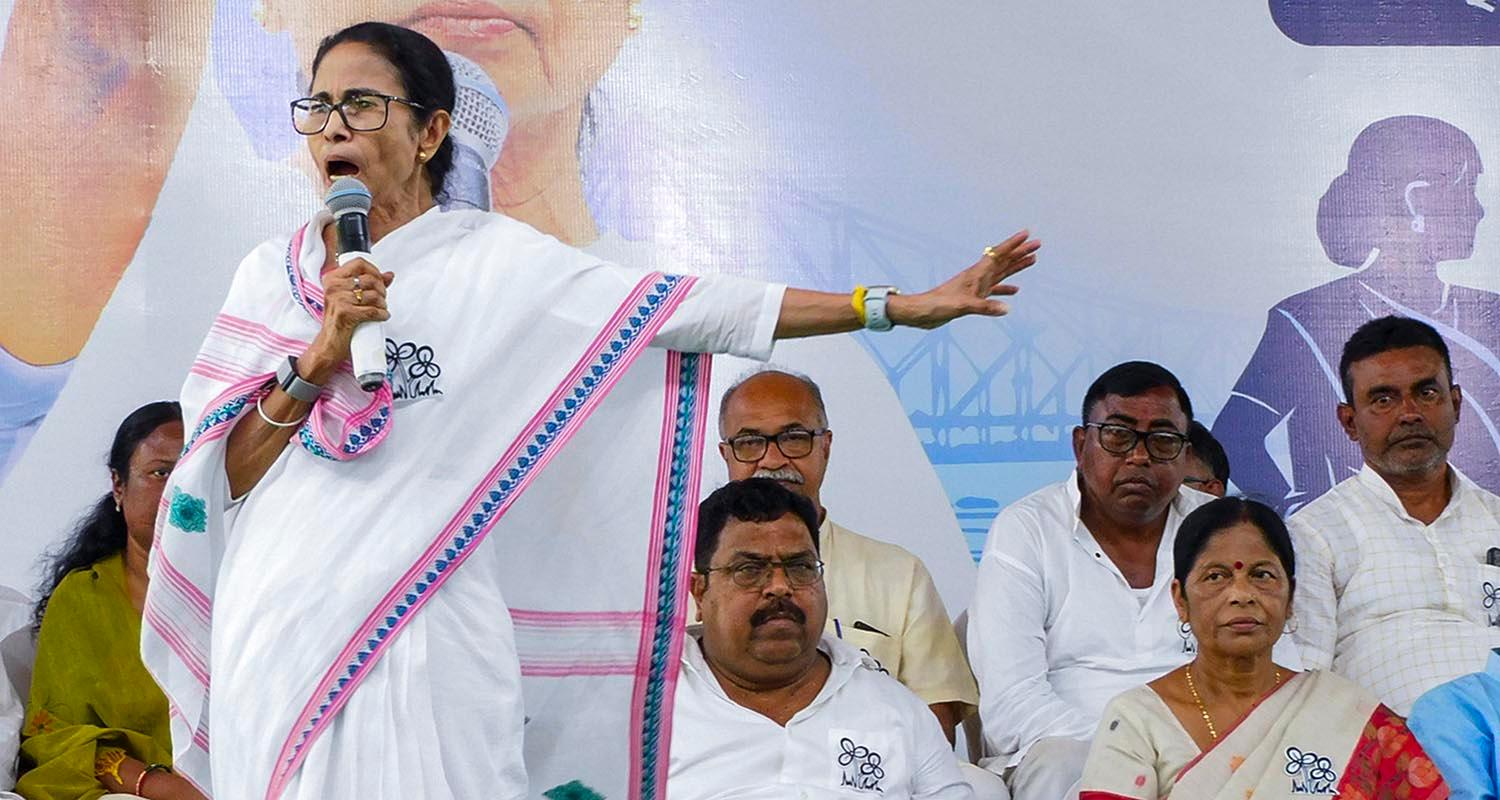
Trinamool Congress leader Mamata Bannerjee.
Recently, the irrepressible Trinamool Congress MP Mahua Moitra went too far in projecting the ensuing assembly elections in West Bengal as a battle between ‘Bengal and Gujarat’. Her parallels were obvious. While on the one hand she put Bengal, represented by her party, and its leader Mamata Bannerjee, on the other side she put Gujarat, obviously meaning Prime Minister Narendra Modi and the union Home Minister Amit Shah.
It was quite characteristic of Moitra targeting an entire state and its community, and belittling their contribution to the freedom struggle of the country. She conveniently forgot that the country's freedom struggle was led by none other than a Gujarati, Mahatma Gandhi, and consisted of so many great stalwarts. Obviously, Bengal had an equally unparalleled contribution with towering thought and political leaders like Rabindranath Tagore and Subash Chander Bose, just to name only two.
Also read: Strong rebuttal to allegations by Swamy, Kishwar
Moitra was speaking for her party, the Trinamool Congress and its leader Mamata Bannerjee. The TMC has been in power in West Bengal for three terms now. It is faced with a strong anti-incumbency sentiment after 15 years of rule. The party, which came into power with great promises, does appear to be tired and worn out. There is a visible feeling of fatigue. It no longer enjoys the clean and corruption-free image. It has ended up being known as the other version of its predecessor Left Front government, which ruled the state continuously for 34 years.
The Bharatiya Janata Party, which has been desperately trying to replace her for a long time, is giving its mission the final push. The party is playing on the anti-incumbency sentiment against the TMC, which appears to be finding resonance among the people. Besides, she is being challenged by her estranged party MLA Humayun Kabir, who has formed his own party Aam Janata Unnayan Party (AJUP) and has aligned with All India Majlis-e-Ittehadul Muslimeen of Asaduddin Owaisi. She fears that her firm hold on the minority Muslim votes is weakening and loosening.
The TMC appears to have come up with the idea of projecting the BJP as a party of ‘Gujaratis’ only. That explains Moitra’s vitriolic attack, not on the BJP but against the Gujarati community as a whole. This was obviously a clear attempt to turn these elections as a fight between Bengalis and Gujaratis, while placing the Bengalis at a higher pedestal, and being scornfully and disdainfully dismissive about the Gujaratis.
She suggested that the Gujaratis had almost zero per cent contribution towards the freedom struggle. While forgetting Mahatma Gandhi, she referred to Veer Savarkar, claiming that he only wrote letters of apology. Savarkar, in fact is not a Gujarati, but a Maratha. She was factually incorrect on that as well.
There is nothing new for the family-driven, one-man/woman parties invoking petty and xenophobic sentiments, once they feel challenged and threatened. The Shiromani Akali Dal does the same thing in Punjab. The DMK does it in Tamil Nadu and the People’s Democratic Party in Kashmir. This is the last resort of such parties because at stake is not only their government, but the very existence.
Political parties like the Trinamool Congress survive with power only. Once these parties are out of power their existence is at stake. If the TMC loses this election, it runs the risk of meeting the same fate as that of the Bahujan Samaj Party. The BSP had tried to project itself as the voice of the Dalits and identified majorly with that community only.
The same way, as a last resort, the TMC is now trying to resort to the threat to the ‘Bengali identity’ from ‘Gujaratis’ and in the process belittling an entire community. This is so rare. While the smaller and regional political parties do resort to the regional and sectarian sentiments identities, they do not place themselves openly against anyone, the way Moitra tried to place the Bengalis against the Gujaratis.
The TMC must be worried that people of Bengal are staunch and proud nationalists. While they guard and protect their Bengali identity, they can, as they always have, die for the country, as Moitra said it herself. Resorting to the idea of ‘local identity’ may serve some purpose in some other states, but in Bengal it can be a double edged sword.
It may also boomerang as there is no clash between the Bengali identity and the Indian identity as a whole. The great ideologues and stalwarts like Swami Vivekdananda, Tagore, Bose, Aurobindo Ghosh, Bankim Chander Chatterjee and others never made any difference between the two, which the Trinamool Congress is trying to do, and that too in an absolutely uncouth and rude manner.
As long as the TMC and Bannerjee pushed the Bengali identity and ‘Bengali Asmita’, nobody had any problems. But when one of the prominent and vocal MPs, Moitra dragged the people of Gujarat, it was unusual and unacceptable. The TMC in its campaign video, the ‘Fighter Didi’ claims threat to the Bengali identity that it is being snatched away via things like NRC and CAA.
In identity politics, there necessarily has to be an element of threat for an enemy. There is neither any threat to the Bengali identity and nor is there any enemy. While Moitra has tried to create the ‘enemy’ in the ‘Gujaratis’, it is unlikely to get any resonance anywhere, with greater chances of getting boomeranged.
