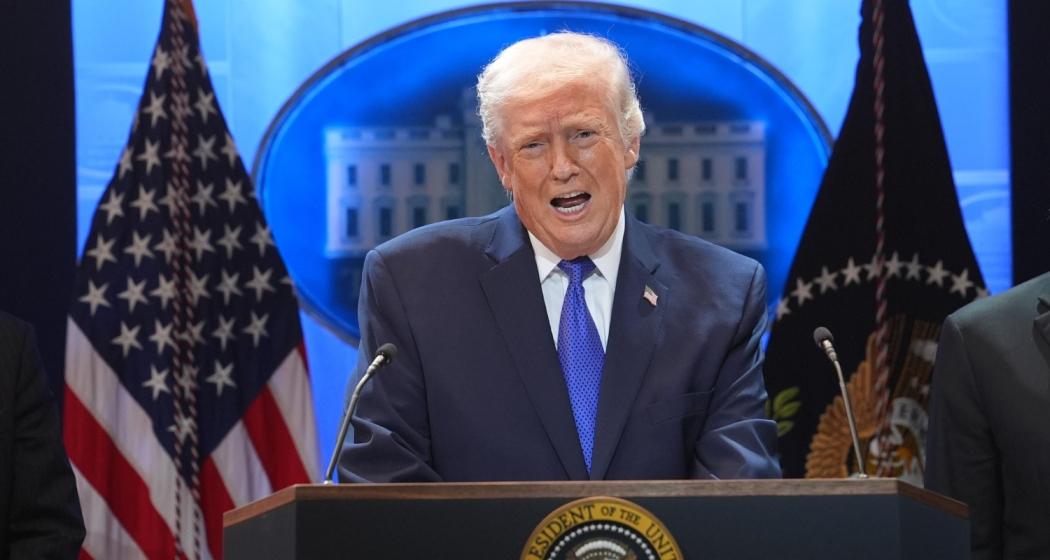
The only predictable thing about US President Donald Trump is that he is unpredictable. In the midst of his country’s and Israel’s war on Iran, he made an unexpected announcement that the US was considering “winding down” its military operations.
“We are getting very close to meeting our objectives as we consider winding down our great Military efforts in the Middle East with respect to the terrorist regime of Iran,” Trump wrote on his social media platform Truth Social. This is the first time that President Trump has hinted at a possible retreat from the war that nobody wants and whose outcome nobody, including Trump himself, knows.
Trump has suggested that the US would step back once Iran is no longer a threat. In the same post, he said the US was “getting very close to meeting our objectives”, which, according to him, means decapitating Iranian defence forces and completely destroying Iran’s capability to build a nuclear bomb.
There are strong reasons, both global and domestic, for Trump to climb down. Initially, he had asserted that there must be regime change in Iran before any negotiations could begin. After Iran rejected offers for talks, despite its top leadership being targeted, Trump adopted an aggressive posture and abandoned negotiations. Meanwhile, the Iranian regime remains intact, with popular support within the country reportedly growing after the US-Israel attack.
Trump has not maintained a consistent stand on negotiations. Also, Iran has had little reason to trust the US, given past experiences. While negotiations were ongoing, and Iran had agreed to several terms, the US and Israel still attacked the country.
Domestic pressure is already building within the United States against Trump over the war. Even his ‘MAGA’ (Make America Great Again) constituency is divided over his stance. Some of his supporters are turning into critics. With midterm elections approaching, the political stakes are high. Trump has said on record that if Republicans lose the House majority, Democrats will impeach him.
His chief of the National Counterterrorism Centre (NCTC), Joe Kent, resigned, issuing a scathing indictment of Trump’s claims that Iran posed a threat. In his resignation letter, he stated that Iran posed no imminent threat to the US and blamed Israel for dragging Washington into the conflict.
Beyond domestic pressures, Trump faces external challenges. Most NATO countries have refused to support his Iran campaign. Although the United Kingdom has now agreed to allow its territory to be used for launching attacks, it was initially reluctant. Trump had criticised British Prime Minister Keir Starmer, but later remarked that support was no longer required after the war had effectively been won.
US allies in the Middle East, including the UAE, Saudi Arabia, Qatar and Oman, also do not favour prolonged hostilities. Iran has already inflicted damage on oil-producing capacities, pushing crude prices to nearly $100 per barrel from around $63 before the war. Energy supplies have been disrupted, global stock markets have declined, and there are growing fears of inflation.
Iran continues to control the Strait of Hormuz, through which nearly 20 per cent of the world’s oil passes. It has selectively allowed some countries to move ships through the route. Trump has even offered concessions on Iranian oil to stabilise prices. Earlier, the US had given concessions on Russian oil imports despite sanctions linked to the Ukraine war.
From the outset, the US has not provided a convincing explanation for attacking Iran, which, it claims, posed a threat. Washington has alleged that Iran was developing nuclear weapons, despite contrary assessments by international observers. This echoes earlier claims about Iraq under Saddam Hussein.
Iran remains sceptical about any quick end to hostilities. Its foreign minister has said the US is unlikely to halt the war soon. Iran continues attacks on US allies and military bases in the Gulf. Some US media reports have suggested strikes on US-UK joint facilities in Diego Garcia in the Indian Ocean.
Despite public statements, there appears to be a growing realisation within the US defence establishment that defeating Iran will not be easy and will come at a significant cost. Defence Secretary Pete Hegseth has reportedly sought $200 billion for the war effort. There is likely to be resistance to such spending, along with concerns over casualties. Thirteen US troops have already been killed.
Under these circumstances, it is understandable why Trump has, for the first time, hinted at a retreat. While he may have initiated the conflict impulsively, bringing it to an end may not be entirely within his control.
While some argue that Iran posed no threat to the US or others, what is increasingly evident is that the war between the US and Israel on one side and Iran on the other threatens global energy and food security.

 Follow us