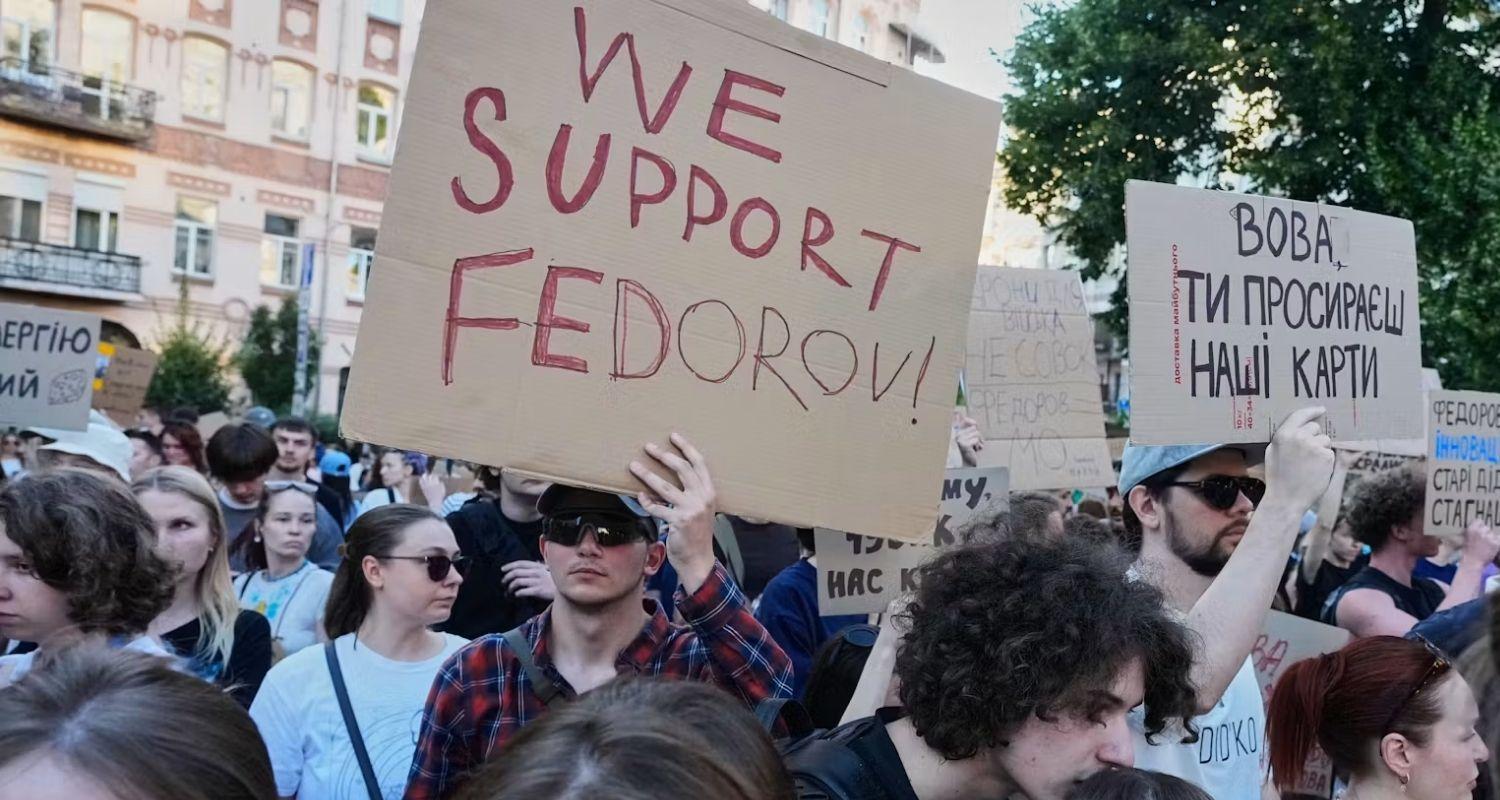
Ukraine is experiencing its largest domestic protests since Russia’s full-scale invasion in February 2022. The spark to the unrest was the summary dismissal on July 15, 2026, of the country’s youthful defence minister, Mykhailo Fedorov, appointed just six months ago.
Fedorov, seen as charismatic and tech savvy, was already viewed by some as a leading light for change, with a reformist message that chimed with many Ukrainians. So, his ouster – the consequence of a clash with Oleksandr Syrskyi, the head of the country’s armed forces and part of the older guard — tapped into a generational clash over how best to defeat Russia.
Frustrations, though, have been building in Ukraine for some time, including over contentious recruiting methods and corruption allegations. Indeed, the latter was the primary reason for demonstrations in Ukraine in the summer of 2025.
Wars are by nature national emergencies, during which politics as normal is often suspended. Before the war and especially after 2014, Ukraine had a lively democracy and public sphere. After the 2022 invasion, Ukraine introduced martial law, placed its television stations under central government control and suspended elections.
For Ukraine, these protests raise important questions about public unity, corruption and the agility of the military-industrial establishment to fight a war now in its fifth year. A new polling data, gathered by the Kyiv International Institute of Sociology (KIIS), provides important context to the current demonstrations, and insights into the wartime priorities of ordinary Ukrainians. From June 9 to 26, 2026, researchers surveyed 1,801 people across the country in a computer-aided-telephone survey.
Here are three findings from that survey that provide a broader context to the demonstrations.
1. Anti-corruption agencies and the media need protecting
Ukraine may be at war but fighting corruption at home and maintaining media freedom still matter a great deal to Ukrainians.
Mindful of last summer’s attempt by President Volodymyr Zelenskyy to scrap the independence of two of Ukraine’s anti-corruption agencies, ordinary Ukrainians were asked if they felt these agencies “should be safeguarded” even with Ukraine at war with Russia. Researchers also asked if they felt the same about “freedom of the press and media.”
About half of Ukrainians think that anti-corruption agencies should be safeguarded a lot during the war. An additional 26 per cent of Ukrainians said they should be safeguarded a little. Only a minority (16 per cent) think that anti-corruption agencies should not be safeguarded at all.
Likewise, Ukrainians believe in the vital role of journalism.
Despite war-time media restrictions, Ukraine retains a robust online public sphere and a free press. Indeed, it played a role in mobilising Ukrainians against the unpopular dismissal of Fedorov.
Also read: Decoding Russia’s strategy of nuclear terror in Ukraine
The protests are in keeping with the poll which finds that a strong majority (62 per cent) of Ukrainians think that freedom of the press and the media need to be safeguarded a lot. Only about 5 per cent do not think it should be safeguarded at all.
2. Fighting corruption during wartime matters
Previous polling by KIIS revealed that the war with Russia and corruption were what Ukrainians considered the most serious problems facing the country. Researchers decided to follow up by asking Ukrainians what they would rank first as the bigger problem: “Russian aggression” or “government corruption, including around mobilisation.”
The results were surprising. Although the most common response was Russian aggression (49 per cent), more than a third of respondents ranked government corruption tied to mobilisation as the country’s top challenge. Another 14 per cent said Russian aggression and corruption were equal concerns.
Public opinion research elsewhere reveals that many Ukrainians still optimistically view the war against Russia as a fight for a future in which Ukraine is an established democracy within the European Union. In this sense, the values evident in the survey responses may be what makes the war meaningful for many Ukrainians.
Even during an exhausting war which of late has seen increased Russian attacks on civilians, Ukrainians prioritise domestic reforms and democratic accountability like fighting corruption.
3. Ukrainians oppose drafting younger men
Although manpower is seen as essential for Ukraine’s war effort against a larger Russian adversary, the process of getting new military recruits has proved contentious.
Ukrainian military authorities have sometimes used violent methods to enforce military service, and the lowering of the draft from 27 to 25 in April 2024 was unpopular.
Researchers asked whether Ukrainians agreed that it “was time to draft all young Ukrainian men into military service.” A clear majority of respondents disagreed with this sentiment, with more than a fifth objecting “very strongly.” Less that 8 per cent fully agreed.
What this indicates to researchers is a strong societal consensus that Ukraine should continue to protect its adolescent and young men from military mobilisation, despite the persistent recruitment crisis facing its military.
One of the attractions of Fedorov to young people was that his preference for unmanned drones over on-the-ground combat forces offers a promise of Ukrainian victory without large-scale casualties. Syrskyi, by contrast, is associated with Soviet-style attritional warfare. Fairly or not, the latter acquired the nickname “the butcher” some time ago.
Fedorov’s promise of victory through technological transformation to support drone warfare may be an illusion. But his very public attack on Ukraine’s current military-industrial establishment posed a serious challenge to its legitimacy and public support. A figure with close ties to Silicon Valley and political ambitions, Fedorov is a disrupter in the mold of many contemporary tech figures.
Whether his polices ultimately serve the cause of Ukraine at this consequential moment in its war with Russia is an open question. But the demonstrations that followed his dismissal nonetheless suggest the multitude of ways Ukrainians view democracy and freedom at home and abroad.
Via The Conversation

 Follow us