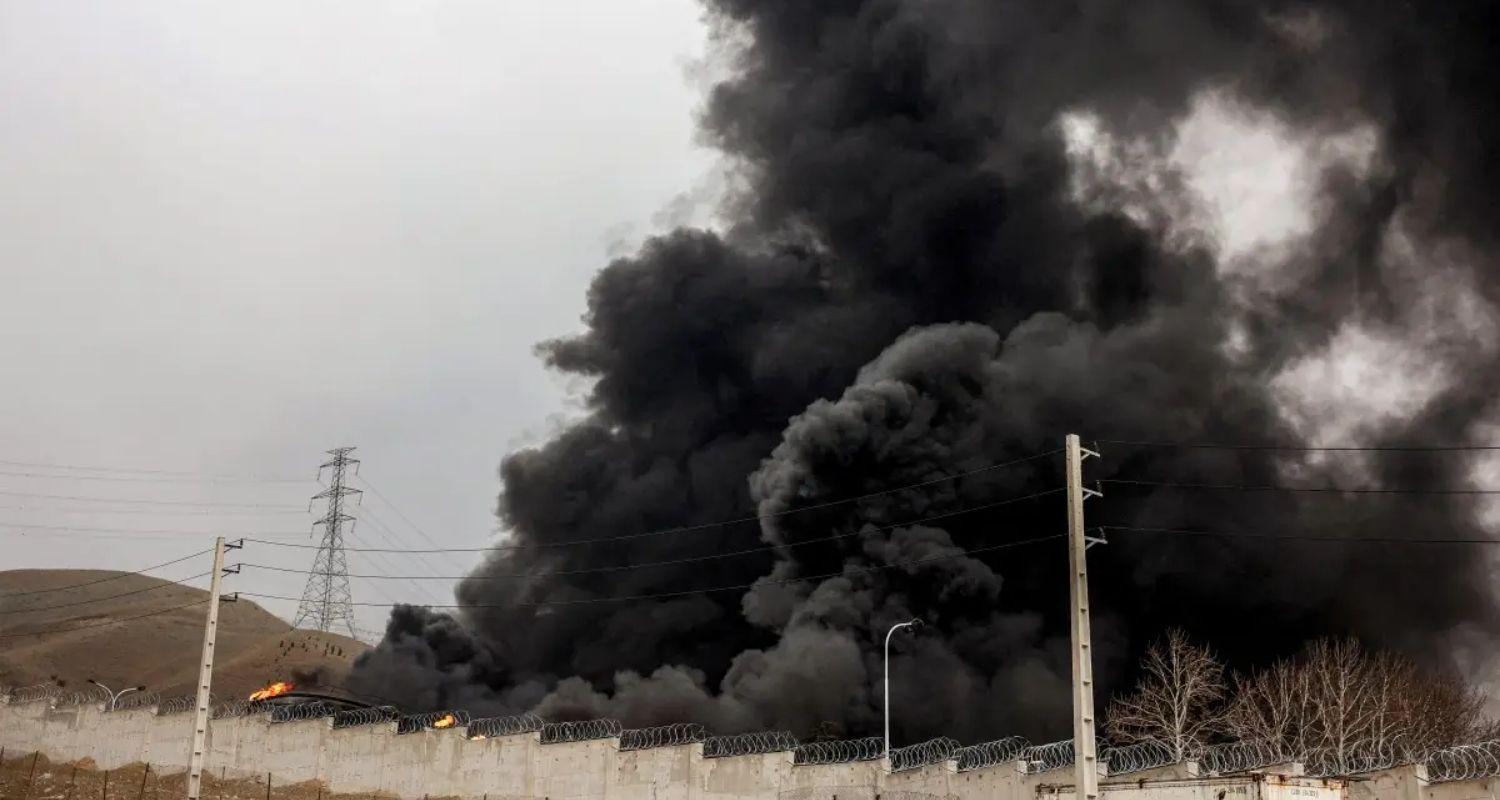
A war in any corner of the world sends the news media and socials into a tizzy, taking stock of gold prices, stock markets and global economies. However, the far bigger consequences of a war remain an afterthought—the environmental impact.
It is estimated that in the first 14 days of the war on Iran, over 5 million tonnes of carbon dioxide equivalent (CO₂e) was emitted. Figuratively speaking, that’s more than a year’s worth of emissions from Iceland.
That is not the only shocking trivia thrown by analysis involving researchers from Queen Mary University of London, Lancaster University and the Climate and Community Institute. According to the study, the emissions during the said period are equivalent to the annual output of around 1.1 million petrol cars, with associated climate damages exceeding $1.3 billion. The collaborative research examines direct and indirect emissions generated between February 28 and March 14, 2026, including the carbon footprint of military operations, warfare, damage to infrastructure, oil and fuel facilities.
Quantifying the damage
Strikes on fuel depots have caused black acid rain in Tehran, coating lungs and crops alike in toxic soot and emitting about 1.9 m tonnes of (CO₂e). Reportedly, the rate at which the war is going, it is likely to nearly drain the global carbon budget of 84 countries combined.
Dr Benjamin Neimark, Reader in International Political Economy at Queen Mary University of London, said, “Emissions from armed conflicts remain largely invisible in global climate policy. They are rarely counted, rarely reported and rarely discussed.” He further stressed how, “without proper accounting we are underestimating the true drivers of climate change and missing a critical part of the picture.” The picture is truly a horrific one.
A statement released by the United Nations Environment Programme (UNEP) echoes the concerns of those assessing the climate aftermath of the war. The strikes on infrastructure, desalination plants, release of heavy metals and chemicals, long term damage to ecosystems can never truly be quantified in numbers but will be felt for generations to come.
Speaking of fossil fuel
A lot of the wars in modern history can be traced back to the fight for dominance of fuel resources. Several political analysts have pinned the US-Israel war on Iran also as really a war to dominate fossil fuel production. Ironically, the analysis estimates that between 150m and 270m litres of fuel were consumed by aircraft and support vessels in the first two weeks of war.
As Dr Fred Otu-Larbi of Lancaster University said, about the analysis, “What this shows is that alongside the human costs of conflict, the environmental cost of war is not a distant or secondary issue. It is immediate, measurable and on a scale comparable to the annual emissions of entire countries.”
Also read: Israel’s nuclear role amid war with Iran
This hasn’t been the first analysis showing how carbon emissions from war need to be considered with the same seriousness as human and economic damage, if not more.
As per a study published in One Earth, Israel-Gaza conflict carbon emissions amounted to 33.2 million tonnes. Most of the analysis identifies the climate impact of armed conflict by factoring in destruction to infrastructure, fuel use, burning and destruction of oil facilities, water resources, missiles and drone use.
The writing on the wall
According to Scientists for Global Responsibility, the global military sector is a significant contributor to climate change, roughly 5.5 per cent of the global total. These are conservative estimates as they exclude the emissions from armed conflicts. But why is a significant contributor to environmental damage not included in mandatory disclosures?
According to the United Nations Framework Convention on Climate Change (UNFCC), reporting on military emissions is voluntary and at the discretion of the nations. This lacuna in global climate policy has been the reason military emissions of countries have been rising but reporting on them has been getting worse, opaque and in some cases nearly absent.
A 2025 analysis of the military emissions data, reported to the UNFCCC by several countries, reveals that the top three spenders; the US, China and Russia are either not submitting the data or at best, submitting selective and incomplete data. Which means the countries contributing the most are not bound to disclose, let alone share responsibility for environmental degradation or fix it.
Every war leaves an indelible carbon footprint and its ecological repercussions are far more enduring and perhaps, irreparable. Does the cause of a war justify the climate aftermaths and consequences? Maybe the militaries win in a war, but the planet loses and the people suffer.

 Follow us