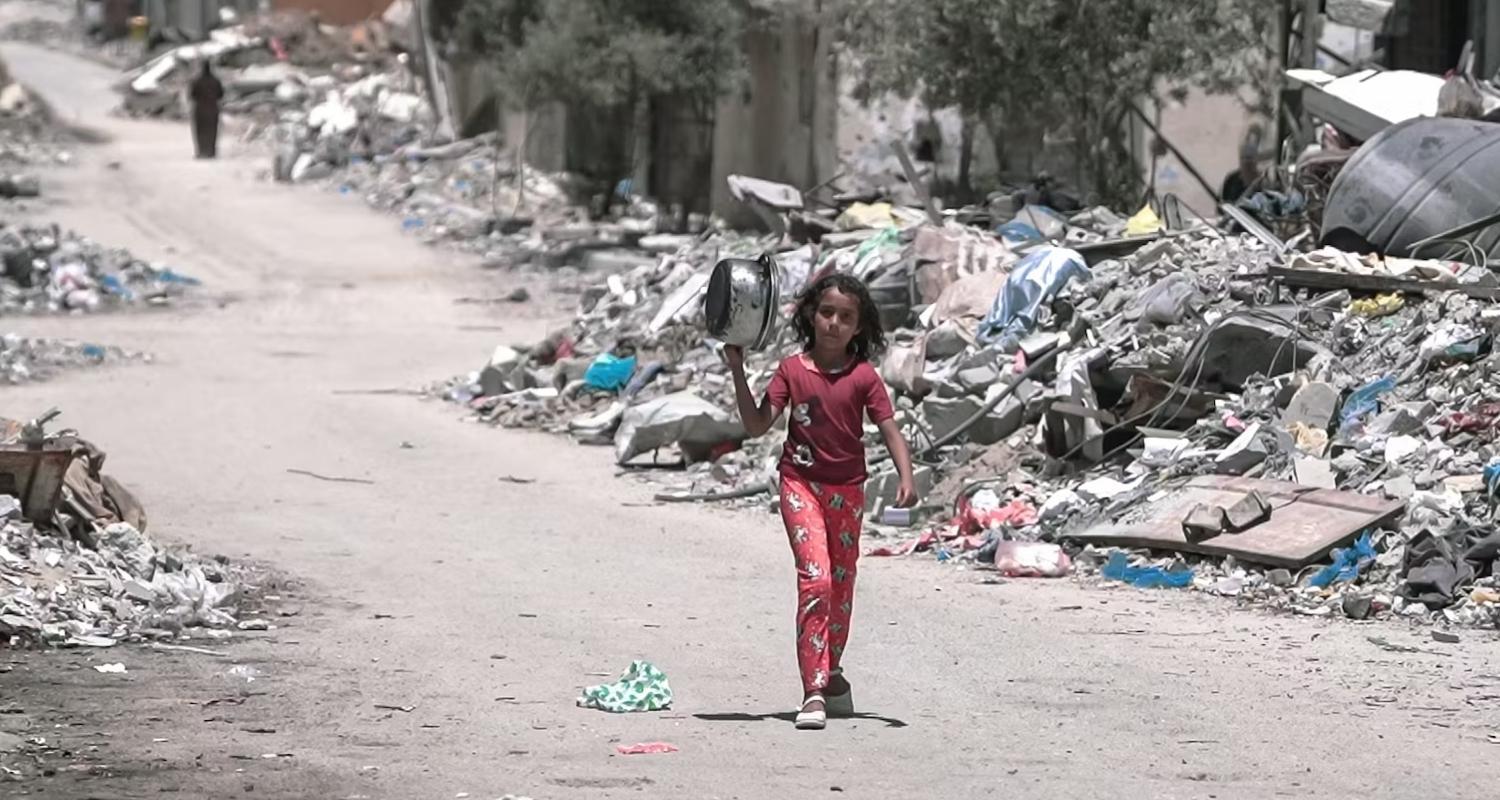
Following a visit to Gaza in January, UN undersecretary general, Jorge Moreira da Silva, called the level of destruction there “overwhelming”. He estimated that, on average, every person in the densely populated territory is now “surrounded by 30 tonnes of rubble”.
This staggering level of destruction raises urgent questions about how, and by whom, Gaza should be rebuilt. Since 2023, a variety of reconstruction plans and other initiatives have tried to imagine what Gaza could look like when the conflict ends for good. But which of these visions will shape Gaza’s future?
The Israeli government’s Gaza 2035 plan, which was unveiled in 2024, lays out a three-stage programme to integrate the Gaza Strip into a free-trade zone with Egypt’s El-Arish Port and the Israeli city of Sderot.
AI renderings show futuristic skyscrapers, solar farms and water desalination plants in the Sinai peninsula. The plan also shows offshore oil rigs and a new high-speed rail corridor along Salah al-Din Road, Gaza’s main highway that connects Gaza City and Rafah.
The US government has proposed a similar futuristic vision for Gaza. Its August 2025 Gaza Reconstitution, Economic Acceleration and Transformation Trust plan shows a phased series of modern, AI-powered smart cities developed over a ten-year time frame. The plan, which would place Gaza under a US-run trusteeship, suggested that poor urban design lies at the heart of “Gaza’s ongoing insurgency”.
The latest iteration of this vision was unveiled by Donald Trump’s son-in-law, Jared Kushner, at the recent World Economic Forum in Davos.
He presented slides showing Gaza reconstructed as a “Riviera” of the Middle East, with luxury beachfront resorts, gleaming tower blocks, residential zones and modern transport hubs. Kushner suggested it was “doable” to complete the construction of a “new” Rafah city in “two to three years”.
It has been reported that the US and Israeli visions are heavily influenced by US-based economics professor Joseph Pelzman’s economic plan for Gaza. This plan, Pelzman said on a podcast in 2024, would involve destroying Gaza and restarting from scratch.
In contrast to the US and Israeli visions, the February 2025 Gaza “Phoenix” plan includes input from the people of Gaza. It has a much stronger focus on maintaining and reconstructing the existing buildings, culture and social fabric of the enclave.
The plan was developed by a consortium of international experts together with professionals and academics from Gaza, the West Bank and the Palestinian diaspora, and suggests a reconstruction and development phase of at least five years.
Also read: Israeli strikes on Lebanon fuel legal debate on ecocide
Other plans from the Arab world take a more technocratic view of reconstruction, but still have a short timescale for reconstruction. These include a five-year plan by the United Arab Emirates-based Al Habtoor Group, which promises to grant 70 per cent of ownership in the holding company that will manage Gaza’s reconstruction to the Palestinians.
Feasibility of rebuilding Gaza
So, how feasible are these different visions and how inclusive are they for the people of Gaza? Rebuilding cities after war takes time and money, and also requires local resources. Even in China, a country with plentiful resources and abundant skilled labour, major new cities are rarely completed in less than 20 years.
And in Gaza rebuilding will be complicated by the fact that there are now 61 million tonnes of rubble there, as well as other hazardous debris such as unexploded munitions and human remains. This will need to be removed before any reconstruction can commence, with the UN estimating that clearing the rubble alone could take as long as 20 years.
For comparison, the Polish capital of Warsaw experienced a similar level of destruction during the second world war and it took four decades to rebuild and reconstruct the city’s historic centre. The time frames for reconstruction outlined in all of the plans for Gaza are far shorter than this and, even with modern construction methods, are unlikely to be feasible.
The US and Israeli visions also fail to include Palestinians in the planning of Gaza’s future, overlooking any need to consult with Gazan residents and community groups. This has led critics to argue that the plans amount to “urbicide”, the obliteration of existing cultures through war and reconstruction.
Reports that suggest Gazan residents will be offered cash payments of US$5,000 (£3,650) to leave Gaza “voluntarily” under the US plan, as well as subsidies covering four years of rent outside Gaza, will not have alleviated these concerns.
At the same time, the US plan does not propose a conventional land compensation programme for Gazan residents who lost their homes and businesses during the war. These people will instead be offered digital tokens in exchange for the rights to redevelop their land.
The tokens could eventually be redeemed for an apartment in one of Gaza’s new cities. But the plan also envisages the sale of tokens to investors being used to fund reconstruction. The Council on American-Islamic Relations, the largest Muslim civil rights and advocacy organisation in the US, says the “mass theft” of Palestinian land through the token scheme would amount to a war crime.
With their emphasis on community engagement and the repair and renewal of existing structures, the Phoenix plan and the other Arab-led visions are at least a step forward. But without a fully democratic consensus on how to rebuild Gaza, it is difficult to see how the voices of the Gazan people can be heard.
Whichever vision wins out, history shows that post-war reconstruction succeeds when it involves those whose lives have been destroyed. This is evidenced somewhat ironically by the US Marshall Plan, which funded the reconstruction of many European economies and cities after the second world war, and involved close engagement with civil society and local communities to achieve success.
Via The Conversation

 Follow us